
 by
Graham Price.
This text may be archived and redistributed both in electronic
form and in hard copy, provided that the author and journal are
properly cited and no fee is charged for access.
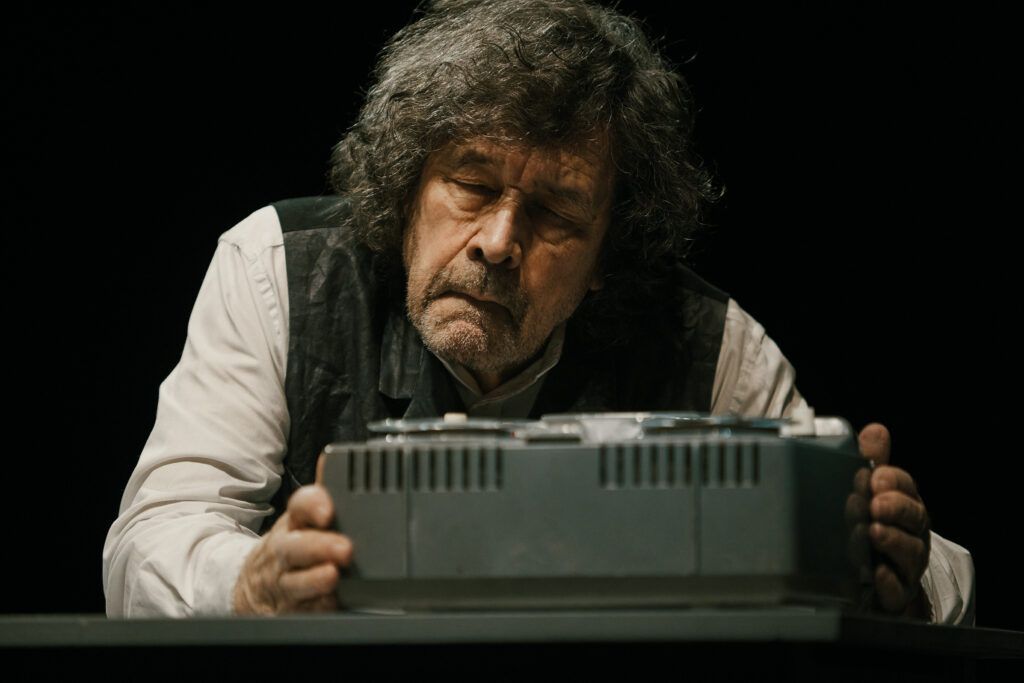
(Vicky Featherstone: Gaiety Theatre, October 21-26, 2024)
Following a very successful and critically acclaimed run at the Project Theatre earlier in the year, Vicky Featherstone’s version of Samuel Beckett’s minor-key masterpiece, Krapp’s Last Tape (1958), ran at the Gaiety Theatre for one week in October 2024. Stephen Rea reprised his lauded role as the titular character that he had played in the Project Theatre’s production previously.
The one-act play runs for thirty-five minutes and tells the story of Krapp: a man in his late-sixties who, every year on his birthday, records a tape of himself reminiscing about the year that has gone by. Krapp has just turned sixty-nine and is listening to recordings of himself made annually throughout his life. One tape in particular – titled “Farewell to Love” and recorded thirty years before – holds particular significance for him, the relevance of which is revealed as the drama progresses. The plot (such as it is) revolves around the older man’s listening to his younger voice as his present-day self remains attentively silent. Unlike the conventional theatrical soliloquy, the strategic monologue implicitly acknowledges the audience and active listenership. Innovatively, however, in Krapp’s Last Tape it is clear that Krapp is the only intended receiver of the aged voices and therefore he becomes a proxy for the regular theatrical audience. Via this audacious dramatic conceit, themes such as the relationship between the artist and his/her art, mortality, and the impact of modern technology on human consciousness and subjectivity are subtly explored in this meticulously constructed and quietly, subtly melancholic piece of theatre. As is the case with many of Beckett’s plays, powerful emotions are staged without recourse to sentimentality.
Stephen Rea and Vicky Featherstone had worked together before on David Ireland’s play, Cyprus Avenue, in the 2016 Abbey Theatre/Royal Court co-production. Since then, both artists have spoken about their enthusiasm of collaborating again. Stephen Rea, reliable as ever, turns in an effective portrait of a man who is looking back on his own life and thinking about what he might have achieved in the light of mistakes he has made and missed opportunities. The white socks and garish boots that this production’s Krapp wears gives a sense of a vaudevillian, clownish character serving as a reminder that Beckett’s drama owes a definite debt to the theatre of music hall.
Fortuitously, Rea had made and kept a recording of the early tapes from the production of Krapp’s Last Tape twelve years ago. At the time, he was not pleased with the result. He put them away in drawer where they remained until he was approached to reprise the role. Effectively, it allows audiences the rare delight of hearing the same actor’s younger voice as listened to by the older version of the same actor during the restaging. It was exactly how Beckett had envisioned an ideal incarnation of both subjectivities when he wrote Krapp’s Last Tape. The audience benefits from a very authentic contrast between the arrogance and optimism of the voice from the past and the worn decrepitude of its contemporary physical counterpart. That the former is rendered and the latter embodied by Stephen Rea is a serendipity of which directors of the play might have only dreamed. Like other noteworthy modern Irish plays, Krapp’s Last Tape features a male double act. Like in Brian Friel’s Philadelphia Here I Come! and Hugh Leonard’s Da, the duo in Krapp’s Last Tape is portrayed as different dispositions of the same person.
In an interview with Tanya Dean, Featherstone gave a perfect description of the character of Krapp and how he essentially represents a truly tragic figure in the classical sense of the word:
I think that he’s a fool for love and he falls very quickly; something that recurs all the way through the play is how he falls into people’s eyes and that shifts him in some way and he seeks that out. And of course, he has his big epiphany – which is the same as Beckett had – standing in the wild storm and thinking about the work that he should make; and he can’t, because love has stopped him from being able to. So love is the most important thing in his life, and the thing that he has to get out of his life in order to be able to continue to create. But then he can’t create, so he’s lost everything. So I think Krapp is deeply, deeply romantic. (Dean 2024)
Unlike his mentor, James Joyce, Samuel Beckett decided to create a portrait of the artist as an old man, and Rea plays to that persona perfectly. Krapp is a man who decided to privilege his work over life, and this resulted in a double loss. He has failed in love and is also unfortunately unable to claim having created perfect works of art. Yeats famously wrote that one must choose between perfection of the life or the work “and if choose the second must refuse a heavenly mansion raging in the dark”. Beckett explores the reality faced by his eponymous character: that Krapp has indeed made this tragic mistake. As he listens to recalled words on one recording – “I said again I thought it was hopeless and no good going on and she agreed, without opening her eyes” – he tragically hugs the tape recorder as if trying to recapture the life and the love to which he unwisely said goodbye three decades earlier.
At another significant moment in the play, the voice of the thirty-nine-year-old Krapp talks about being at a nursing home where is mother is dying. He recalls and reflects upon the instant he learned of her death: “All over and done with, at last. I sat on for a few moments with the ball in my hand and the dog yelping and at me. Moments. Her moments, my moments. The dog’s moments. In the end I held it [a ball] out to him and he took it in his mouth, greatly, gently”. Again, Rea’s younger voice is being heard by the much older man, and the distinction between the two is immediately audible: no performance is required with this degree of verisimilitude, and the dramatic impact is visceral. The moment is even more emotionally potent because it is a partially fictionalised account of Beckett’s experience of the death of his own mother, May, in 1950. Famously, it was around this time in his life that Beckett decided that his artistic aesthetic must centre on the decay and void of life.
At the conclusion of the play, when Krapp is listening to his younger self talking about how hopeful he was about his future – of the fire that burned within him – one can feel the sorrow and regret emanating from the face of the actor, as much as from the voice of the character. Featherstone described the experience: “I was watching Stephen as Krapp listening to the tape, listening to himself, and I was thinking that this is the older person genuinely listening to the younger person. The authenticity of that is heart-breaking. That is what Beckett wrote, and Stephen has created it”.
It might have been the case that Rea’s corporeal performance does not carry the frailty of Krapp that Beckett hoped might mirror his spiritual and psychological infirmities. This physical fragility is meant to emerge in the form of the character’s incontinence; conveyed by Krapp’s continual running to the bathroom at regular intervals during the play. The affliction is one shared with Valdimir in Waiting for Godot who suffers the same performance interrupting medical indignity. Like Krapp, Didi has to struggle with a reminder of the bodily disobedience and its interference with self-reflective ruminations. In the case of this production, Rea’s departures from the stage happen in a gentle canter giving the impression that the character is not entirely clear where he is going or what his ailment might be.
One of the disadvantages of staging Krapp’s Last Tape at the Gaiety Theatre, as opposed to the Project performance space, is that the former theatre is approximately five times larger. The risk of compromising Beckett’s intended intimacy of the play must be tackled by any putative producers, but this was largely successful in an effective and moving theatrical experience. Stephen Rea proved once again that he is utterly capable of carrying a play by himself, even when the performative load is as demanding as Beckett’s. In Rea, Irish theatre has found a version of the character that deserves to be mentioned in the same breath as those provided by the late John Hurt and the late Michael Gambon. This production also offers a timely reminder that Beckett was one of the great originators of the Irish monologue play: a convention that is, of course, still regularly used in contemporary Irish drama.[1] Krapp’s Last Tape is a foundational and noble example of this dramatic form.
Notes
[1] For a more detailed analysis of Beckett and the Irish monologue play, see Alan Graham (2024) “‘Repeat Play’: Repetition and Truth-telling in Play, Faith Healer, and Irish Monologue Theatre.” Irish University Review 54 (2): 248-68.
Works Cited
Butler Yeats, William. “The Choice.” (1933) https://www.brinkerhoffpoetry.org/poems/the-choice.
Dean, Tanya et al. (2024). “On Krapp’s Last Tape – how we made the acclaimed Beckett revival.” RTE (October 1). https://www.rte.ie/culture/2024/0930/1471658-on-krapps-last-tape-how-we-made-the-acclaimed-beckett-revival/.


