
 by
Brian Kelly.
This text may be archived and redistributed both in electronic
form and in hard copy, provided that the author and journal are
properly cited and no fee is charged for access.
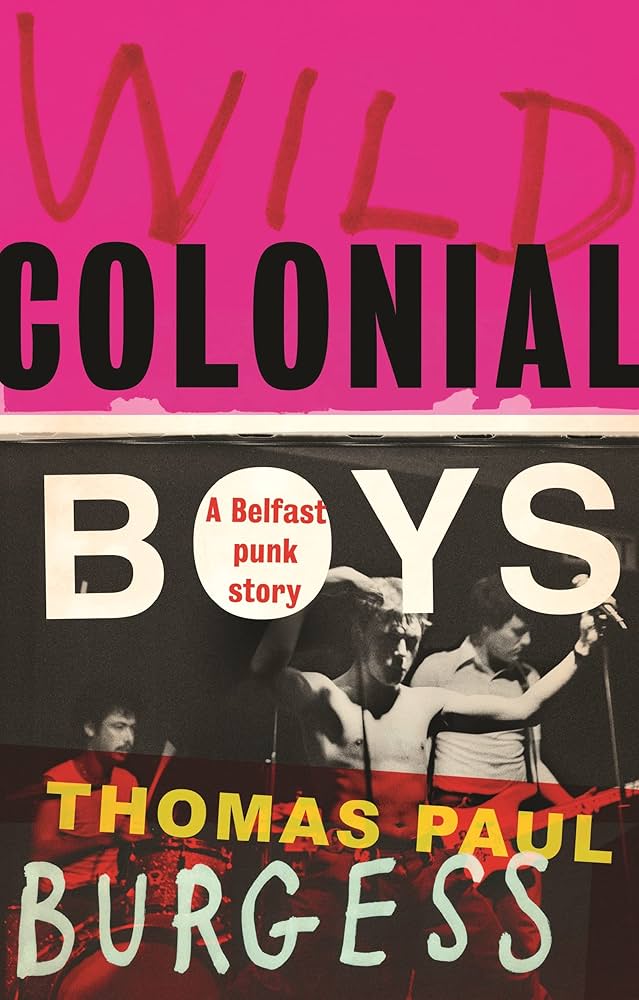
Paul Burgess
Manchester University Press, 2024. 312 pages.
ISBN: 9781526173379
Not many Punk memoirs begin in the Christ Church, Oxford. Thomas Paul Burges, drummer of influential Punk band Ruefrex, swaps out the standard pogoing, gobbing, and power chords for dinner in the Great Hall with Professor Martin Goodman (a Theology expert) and some other learned guests (xx). The working-class lad from the Shankill Road, Belfast, fears that the dinner talk will render him mute, so he uses his Sunday school knowledge of the Song of Solomon, to “hook” the academics into a conversation about the “preponderance of Jewish artists working in a variety of twentieth century media” and whether God’s chosen people have a special creative disposition (xxii). His guests talked and talked about the muse, the human condition, and its place in the arts, about the soul, about social protest and the creative act. “You couldn’t shut them up!” (xxii). Burgess sits back and lets this intellectual chatter wash over him before interrupting with “Did I mention I was in a band” (xxii). Burgess’s Oxford anecdote, a part of the book’s “sleeve notes” (rather than prologue) establishes a sense of both Punk Rock insurgency and, especially hybridity, a central theme of the book.
Initially, this hybridity has a rather unsettling effect. On the one hand, Burgess’s journey from plucky Punk outsider to fully paid-up member of academia (he now teaches at University College Cork) is a classic narrative hook which pulls us through the story proper. However, the early chapters describing Burgess’s childhood in Belfast and his meeting of TC (the future lead singer of Ruefrex) contains an odd tension, a sense that the adult narrator cannot give himself over entirely to sepia-toned childhood nostalgia. Burgess’s account of his street-gang shenanigans is shot through with Clockwork Orange aesthetics. The gang called “Debs”, short for debonair, “regarded the Tartan gangs of the period with disdain, for the lemming like way they attracted ‘mass affiliation and for their dubious sartorial choices” (4). On one level, this can be read as young men playing out their “Droog” fantasies against the backdrop of any 1970s British city. On another, however, the Shankill murals calling men to join the UDA, and the violence of the IRA, are very real. In 1972, there were over 12,000 shootings and bombings in Northern Ireland (7). Childhood games glamorizing the old ultraviolence become far more sinister when the adult world awaiting those children is so much more deadly than their imaginings.
Burgess and his gang escape this sectarian violence by inducting themselves into a version of what Hakim Bey calls the “Temporary Autonomous Zone” (TAZ), created inside bars and record shops linked to the Belfast Punk scene. But Punk in Britain largely sought to define itself through its opposition to the status quo: anti-Thatcher, anti-Capitalist, anti-colonial, anti-guitar solos, anti-prog rock. The problem with being a working-class Protestant lad who is proud of his parade culture and unafraid to call out Irish émigrés in America for funding IRA bombing campaigns in the auld sod is that you’re not performing the established form of Punk transgression. Calls of “Tiocfaidh ár lá” and “Troops Out” become more problematic when the presence of British soldiers is the only thing protecting your family from Provo murder squads. Therefore, Ruefrex, the “Wild Colonial Boys”, embody this intersectionality and Burgess explores the complicated position of being an outsider amongst the outsiders with subtlety and care.
As Burgess’s book moves into its account of writing songs, touring venues, and garnering attention from Punk Rock royalty, the unsettling feeling of the early chapters ebbs. Instead, Burgess gives us the expected sex, drugs, and rock ‘n’ roll details. There is an encounter with a young Bono on the streets of Dublin (90), a trashed hotel room while on tour with Stiff Little Fingers (105-110), and endless infighting about creative direction. Then, on the cusp of larger success, the band face the prospect of moving to London. Half of Ruefrex chose to make the move and play the record industry game, while the other half remain in Belfast keeping their steady jobs. The band is now a Belfast-London operation, hyphenated once more. Burgess’s time spent in various half-way houses from Cricklewood to Battersea becomes another TAZ populated by musicians, journalists and unmarried mothers escaping religious bigotry back home (223). This becomes a second education for Burgess, the place where the future PhD candidate emerges. Again, the book explores the importance of places outside of the normal confines of society where new ideas can flourish. Attention is drawn to the consequences of rising levels of student debt combined with precarious work that makes unconventional career choices so much riskier today, or the non-availability of cheap rental accommodation in the Republic. From where, one wonders, can organic counter-hegemonies emerge in an increasingly sanitised world?
However, Burgess does not romanticise TAZs as being beyond the pressures of society at large. The book ends by taking aim at cosy narratives of a completely non-sectarian Belfast Punk scene, as told by the 2013 documentary “Good Vibrations”. Teri Hooley, glorified in that film as an egalitarian, philanthropic and politicised inspiration, is for Burgess just a businessman trading on his own myth (250), a legend that, according to Burgess, required the airbrushing of Ruefrex from the Belfast Punk narrative:
Subcultures like the Belfast punk scene of the ’70s develop as often as not through deliberate shaping by “’scene makers”, those key players who just happen to be in the right place at the right time and can fashion things in their own image. What made the Belfast punk scene of that period different from others, however, was that the macro-narrative in which it took place was a much larger and disputed one. Therefore, in a society as contested as Northern Ireland, we would do well to ask ourselves, “why is the ‘Good Vibrations’ account of the Troubles era the only one that everyone seems to agree on?” Surely that raises some cause for suspicion? (250)
Therefore, the truth is to be found in dissonance, conflict and a heterogenous collision of voices rather than any hippy-dippy love in. Until the end Burgess is true to his Punk rock roots: the truth is only known by guttersnipes.
Works Cited
Bey, Hakim (2003). TAZ: The Temporary Autonomous Zone, Ontological Anarchy, Poetic Terrorism. Brooklyn, NY: Autonomedia.


