
 by
Emma Quinn.
This text may be archived and redistributed both in electronic
form and in hard copy, provided that the author and journal are
properly cited and no fee is charged for access.
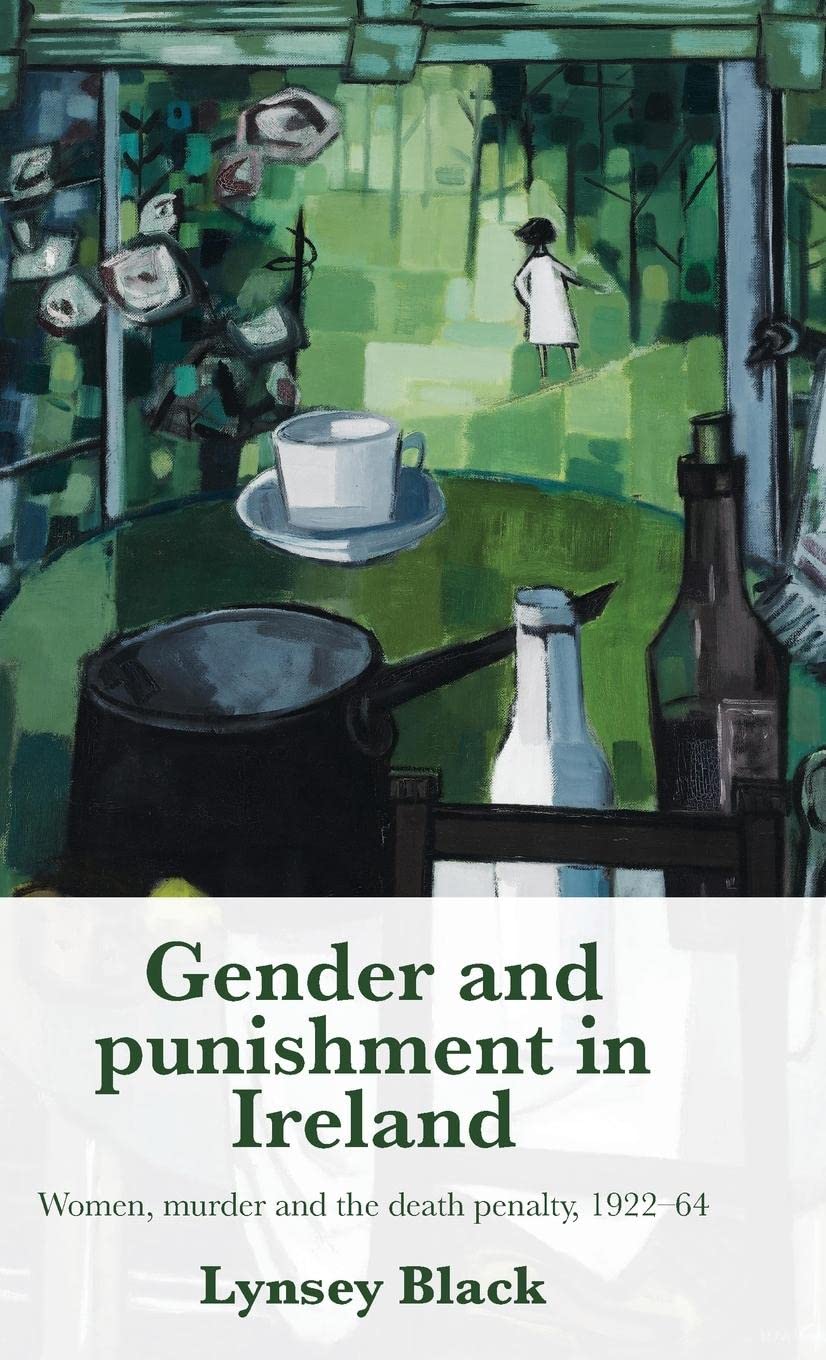
Lynsey Black
Manchester University Press, 2022. 312 pages.
ISBN: 9781526182340
The act of murder serves as a threat to not only the victim of the crime, but also the society in which the act occurs. Lynsey Black’s well-defined monograph on women who murder reveals a complex web of leniency, paternalistic assumptions, and gendered values behind the sentencing and punishment of women charged with murder in post-independence Ireland. Barring the lone execution of Annie Walsh in 1925, women charged with murder were reprieved from the death penalty and instead sentenced to a wide array of other fates, from release, to incarceration, to confinement in religious institutions. Black’s incisive research extends the relevance of this topic into a microcosm of Irish nation-building through complex negotiations of womanhood, violence, and culpability. This monograph draws on the historiography of death, gender, and sexuality in modern Ireland, and works well in tandem with the research of Ciara Breathnach, Elaine Farrell, and Lindsey Earner-Byrne, among others. It also follows in the footsteps of other national histories of women who kill, especially Lizzie Seal’s work on this topic in the British context. Black deftly combines quantitative research concerning all women prosecuted for murder with relevant case studies on each subtopic, illuminating the impact of these women’s sentences on both the macro- and micro-levels. What truly sets this research apart, however, is Black’s ability to contextualize this niche sample of women’s experiences into historiographical conversations on gender in the broader contexts of Irish national identity, religious confinement, infanticide, and the urban/rural divide. These connections shed new light on the study of women’s lethal violence.
Black emphasizes the impact of gender as a factor in sentencing for women and finds that while sentencing varied wildly, gender was always explicitly considered. Because violent crime was associated with masculinity, sentencing was a process of making sense of women who committed violent acts. Women prosecuted for murder that fell within the narrow definition of “female killings”, such as infanticide, were more easily understood than those who killed an employer or killed for political reasons, which were more masculine-coded motivations (33). Women who fell into the latter, more masculine archetypes of murder were more likely to be sentenced to the death penalty than others whose offenses aligned within accepted feminine motivations, while those who committed infanticide were always granted clemency. The only woman not reprieved from the death penalty, Annie Walsh, was seen as the dominant partner of her lover Michael Talbot in the murder of her husband. Because Talbot, who appeared to be following Walsh’s leadership, would certainly be executed, Walsh could not reasonably be granted reprieve. Furthermore, the petit treason of a wife killing her husband threatened hierarchies of gender and power in a way that infanticide did not (61-62).
These gendered conceptions of violence arose out of paternalistic views of women as inherently weak or incapable of taking responsibility for their actions. Black argues that this “chivalry” in reprieving women from the death penalty was exclusionary in its demarcation between women, who required leniency, and men, who as true Irish citizens were sentenced according to the letter of the law (67-68). These concepts of gender were harnessed, debated, and even entrenched into law. The Infanticide Act of 1949 established infanticide as a new crime akin to manslaughter, so that women would no longer be charged with murder and risk a capital sentence. Paternalism also served a central role in the development of religious confinement as a prevalent sentence for women.
Both women reprieved after a death penalty sentence and women convicted of lesser charges, such as manslaughter or concealment, were highly likely to spend time in religious institutions following their sentencing. Because most women charged with murder had killed their own or a family member’s infant, they fell into a larger population of women grappling with the strict standards of sexual purity and religious control in twentieth-century Ireland. Confinement in religious institutions was a common fate for women who stepped outside these bounds, including women who committed infanticide. Black points out that there was no legal groundwork authorizing or regulating the use of religious institutions in the justice system, and so women were often granted a choice between continuing their prison sentence or entering confinement, although the vulnerable position of convicted women meant they had little power to object (126).
The amount of time these women spent in religious institutions varied, with some women spending decades in Magdalene laundries until their deaths. Black again highlights the paternalistic attitude that impacted whether a woman would be released from a religious institution. Some women were denied release because their families lacked either the desire or the means to support them, while others were deemed “mentally defective” (157-59). Black describes these denials as a form of infantilization, in which women were not considered capable of providing for themselves on their own.
The women detailed in Black’s monograph are a specific sample of extreme cases of the deep intertwining of church and state in the decades post-independence, which James Smith has dubbed the “architecture of containment”. As Catholic standards of purity became a pillar of Irish national identity, those who strayed from the rigid standards of behaviour were ostracized from society and most often relegated to religious containment through an extensive decentralized array of institutions, including mother and baby homes, Magdalene Laundries, industrial schools, and even adoption agencies (Smith 2). Black further illuminates the long-occluded history of women in these institutions through the experiences of the minority whose deviations culminated in criminal charges.
An overwhelming 258 of the 292 women charged with murder in this period had murdered a child, typically their own child or a close relation such as a grandchild, niece, or nephew. Almost all cases of infanticide tied directly into the shame of illegitimacy, which was so overwhelming in rural Irish communities that many women saw no viable path forward other than “lethal violence” (171). A sizeable portion of infanticides occurred in religious institutions, while others hid their pregnancies and gave birth alone in secret. Those unable to hide their circumstances from their families and communities were in immensely vulnerable positions, often disowned, homeless, and destitute (176). Black argues that women who committed infanticide were impelled by the inflexible moral standards surrounding sexual purity, which made raising an illegitimate child untenable in their communities. While in practice those found guilty of murder of an infant were granted reprieve from the death penalty, this was not formalized in legislation until 1949, with the threat of the death penalty serving as a symbol of condemnation. Black keenly acknowledges that infanticide is one aspect of the larger history of sexual shame in this period, during which young unmarried women and infants bore the brunt of the societal cost of illegitimacy.
Most women charged with murder came from rural or small-town communities. This further marginalized them in court, where Dublin lawyers and judges considered them ignorant or backward, especially Irish speakers and Irish Travellers (234, 245-52). Black compares the romantic conception of rural Ireland in national identity with the lived reality of the mostly poor working people who lived there, acknowledging that the idealized image of the rural Catholic farmer often did not align with the religious and economic priorities of actual people. This was another point of intersection between the formation of an Irish national identity and the lived experiences of these women.
Black’s monograph highlights a kind of “aberrant womanhood” which defies rigid conceptions of gender in Irish national identity. She argues that gender was explicitly utilized and widely accepted as a paternalistic rationale to grant clemency and/or reprieve, rather than the implicit reluctance to sentence women to capital punishment in Britain. Women were “Othered” as part of a national identity formation that sought to relegate women to a passive and domestic sphere (263). Black notes that the Irish example does not adhere to the concept of “double deviance”, wherein women who stray from accepted moral behaviour are punished especially harshly (274). Instead, the records reveal that officials overwhelmingly favoured leniency in all but one instance, and women were “Othered” through religious confinement, denial of agency, and a paternalistic perspective of women as inferior and irrational.
The fledgling Irish state developed around a national identity of Catholic sexual purity, and the women described in this monograph presented immoral threats to that identity. The use of religious confinement as a solution to violent crime as well as illicit sexuality reveals that sin, rather than crime, presented the larger threat to Irish national identity. The sexuality of young unmarried Irish women was particularly feared, and so the visibility of these “Othered” women was minimized through religious confinement. Black’s work presents a novel perspective on the growing body of work on women’s sexual deviance in post-independence Ireland. By centring the experiences of prosecuted women, she skilfully sheds light on a myriad of adjacent topics, including confinement, national identity, poverty, and sexual shame. Her nuanced analysis offers points of similarity and difference in comparison with similar work in other national contexts, providing a worthy contribution to global conversations on women’s lethal violence.
Works Cited
Smith, James M. (2007). Ireland’s Magdalen Laundries and the Nation’s Architecture of Containment. Notre Dame, IN, University of Notre Dame Press.


