
 by
Bryan P. McGovern.
This text may be archived and redistributed both in electronic
form and in hard copy, provided that the author and journal are
properly cited and no fee is charged for access.
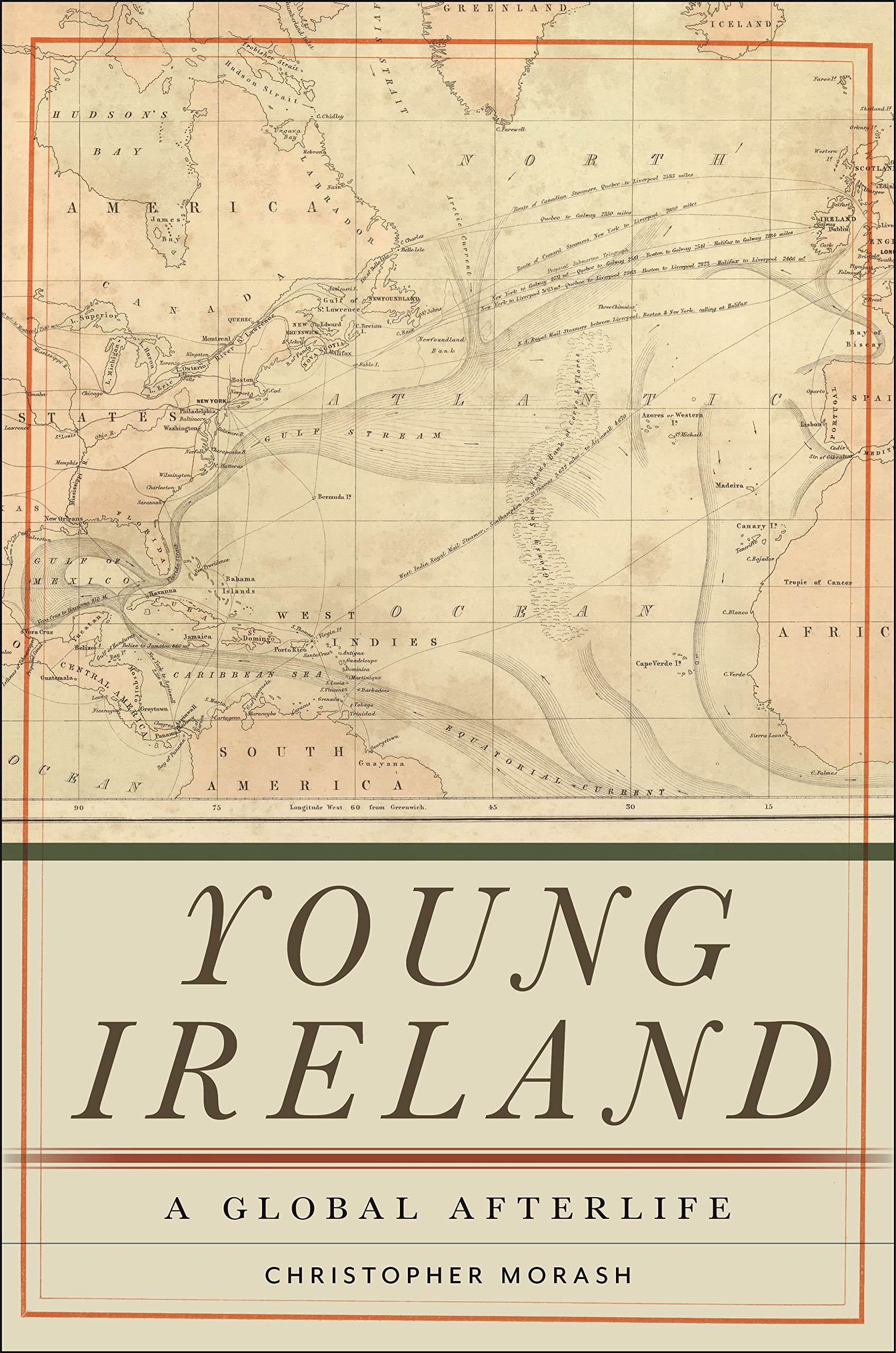
Christopher Morash
New York University Press, 2023. 288 pages.
ISBN: 9781479822218
Revolutionary sentiment spread throughout Europe in the late 1840s, leading to revolts in a number of different nations, including France, Germany, Austria, Poland, Denmark, Hungary, and Italy. Advocating for liberal, democratic nation states, the revolutionaries wanted to overthrow the monarchical states and create independent states that promoted the interests of the workers. Influenced by nationalists throughout Europe, Ireland also experienced its own revolution that summer, in which a group of young, educated, middle-class men, mostly urbanites, rose up against the British monarchy’s oppressive rule, which they blamed for governing malfeasance including the Great Hunger that ravaged most of the island. As people starved and succumbed to disease, the Young Irelanders, also incensed by the Crime and Outrage Bill which declared martial law, commenced a rebellion in the village of Ballingarry in County Tipperary. Although the rebellion was short lived and more political theater than threatening, the ideals and inspiration of the revolution remained an important influence on later nationalist groups.
Christopher Morash traces the early influences and political thoughts of the group, correctly identifying the importance of citizenship to its leaders, particularly the connection to political participation as a criterion. The failed revolution led to the migration, sometimes forced through transportation or threats of detention, of the leaders of Young Ireland. They went to the United States, Canada, and Australia, as well as other nations. It is here that Morash picks up the story of Young Ireland in exile and demonstrates how the foundation of Young Ireland led them to influence the Irish diaspora and the ideals of the settler nations in general.
Morash divides the book into specific time periods in different nations. For example, one chapter covers Young Irelanders in the United States from 1848-1861, while another Canada from 1857-1867. The book, which won the Lawrence J. McCaffrey Prize for Books on Irish-America from the American Conference for Irish Studies, covers a chapter on Van Diemen’s Land, where some of the Young Irelanders captured after the rebellion were transported to a penal colony. According to Morash, this served as the laboratory for their lives in North America and Australia. In Van Diemen’s Land, they created their notions of “honor, morality, the gendering of imperialism, and, ultimately, a concept of qualified liberty can be seen both as a continuation of how they understood politics in Ireland, and as an indication of how they would engage in politics in other parts of the world” (70). They also began to disseminate that the idea of the nation was “essential for both economic development and independence” (193), which was crucial to the underpinnings of nationalism in their new homes.
Morash argues that those Young Irelanders who went to the United States encountered a nation where the political discourse revolved around nativism, cultural nationalism, and manifest destiny. It was the latter that they embraced, asserting that their call for independence in Ireland mirrored the American desire to colonize the western and south-central regions of the continent. It allowed them to exert both their Irish identity and loyalty to the United States. However, it does conflict with the anti-imperialist rhetoric that was often present in the earlier writings of Thomas Davis, which Morash does not discuss. He demonstrates, however, how the concept of citizenship was so important to Young Irelanders, yet they often disagreed on who was eligible. Mitchel viewed race as paramount while Meagher believed it extended to all groups, including Native Americans.
The chapter on Canada explores Thomas D’Arcy McGee’s transformation from republican to liberal nationalist, as well as his role in uniting Upper and Lower Canada into one commonwealth. Morash adeptly articulates McGee’s peculiar changes in ideology, driven by his belief that “unlike in the United States, Catholics could achieve equality” in Canada (137). McGee had moved to the United States as a teenager and resettled there again after the 1848 rebellion. In America he embraced ultramontanism as a defense against American Protestantism, but in Canada he came to “valu[e] religious equality in a context of religious plurality, a value he would place at the center of his vision of Canadian state-building” (140). McGee also became critical of Irish nationalism and eventually was assassinated for his criticism of the Fenian Brotherhood, which had been created by more radical Young Irelanders.
Finally, the chapter on Australia explores the role of Charles Gavan Duffy, who was eventually knighted by British monarchy, who embraced the ideals “of settler colonization mingled with the politics of cultural nationalism as it took shape in Ireland in the 1840s” (168). Duffy emigrated voluntarily to Australia in 1856, while most of the other Young Irelanders who remained had been transported after the rebellion. Morash also demonstrates how Kevin Izod O’Doherty and his wife Kelly contributed to political formation in Australia by employing the “political and cultural strategies” Young Ireland developed in the 1840s (174). For example, for Duffy and the O’Doherties land ownership was instrumental in democratic participation, leading to the introduction of a Land Act in 1862 to make it easier to purchase land.
Morash’s book is an excellent study of the influence of Young Irelanders on their adopted nations and how they employed their foundational principles to meet the unique circumstances of each country, something that has been overlooked by many scholars. My only quibble with Morash is his assertion that Young Irelanders tended to be liberal on matters of race, but I would argue that it was more complex. He acknowledges Mitchel’s defense of slavery but states that it was unique. However, as Morash notes, Mitchel’s devotees, including Joseph Brenan and Richard D’alton Williams, as well as other Young Irelanders, supported slavery (as well as the Confederate States of America) and advocated for reopening the slave trade. Even Richard O’Gorman opposed black rights and used inciteful, hateful rhetoric to oppose Reconstruction laws that gave African Americans political and civic rights. The Young Irelanders admired Carlyle and were influenced by his views on race. When Frederick Douglass visited Ireland in 1845, The Nation, unlike other Irish newspapers, ignored his visit even though it generally opposed slavery. However, I fully recommend this book and think it provides a much-needed examination of Young Irelanders who settled in nations previously colonized by the British.


