
Cameron University in Lawton, Oklahoma | 17 March, 2026 | ISSUE 21 | Pages: 140-153
PDF | DOAJ | DOI 10.24162/EI2026-14166 | views
 2026 by Natalie McCabe |
This text may be archived and redistributed both in electronic
form and in hard copy, provided that the author and journal are
properly cited and no fee is charged for access.
In fall 2022, I directed the play Alias Grace at Cameron University in Lawton, Oklahoma, United States of America where I am an assistant professor of theatre. Playwright Jennifer Blackmer adapted the modern play from Margaret Atwood’s novel. The plot focuses on fictionalised versions of real-life Grace Marks, described as a nineteenth-century Irish immigrant from Ulster who found work as a maid in Ontario before she was accused of assisting another Irish immigrant in murdering her employer. The representations of these two characters were to be my original focus, with accent work a top learning goal for my students and directing goal for myself. Then, in the summer of 2022, just as I was driving across the border from Canada into upstate New York, news broke that the United States Supreme Court had overturned Roe v. Wade. Whereas the Republic of Ireland repealed its 8th Amendment in 2018, my now-home state of Oklahoma applied trigger laws, outlawing elective abortions in 2022. Although my 2022 production was not similarly halted, my plans for this production altered, in part after an uninvited interaction with a community member. This paper explores my directing focus, its shift to adjust to contemporary events and culture, and the preparation done to safely and successfully present a play that involves the Irish, intimacy, violence, and, glaringly, a supporting character’s abortion in a U.S. state in which, unlike in Ireland, pregnancy terminations are now firmly taboo. The ideas are my own and not those of my employer.
En el otoño de 2022 dirigí la obra Alias Grace en la Universidad de Cameron en Lawton, Oklahoma, Estados Unidos, donde ejerzo como profesora de teatro. La dramaturga Jennifer Blackmer había adaptado la obra a partir de la novela de Margaret Atwood. El argumento se centra en versiones ficcionalizadas sobre la vida de Grace Marks, inmigrante irlandesa del Ulster que encontró trabajo como doncella en Ontario antes de ser acusada de ayudar a otro inmigrante a asesinar a su empleador. La representación de estos dos personajes iba a ser mi objetivo inicial, poniendo especial interés en el aprendizaje del acento por parte del estudiantado, cuestión que también centraría mi trabajo como directora. Entonces, en el verano de 2022, cuando atravesaba la frontera entre Canadá hacia Nueva York, se produjo la noticia de que el Tribunal Supremo de los Estados Unidos anulaba el caso Roe v. Wade. Es decir, mientras la República de Irlanda había derogado la Octava Enmienda en 2018, mi actual hogar en Oklahoma activaba leyes restrictivas en torno al aborto en 2022. Y aunque la producción no se vio alterada, mis planes sí sufrieron cambios, en parte a raíz de un encuentro fortuito con un miembro de la comunidad. El presente trabajo explora los objetivos de mi dirección, los cambios efectuados para adaptar la producción a la cultura y los acontecimientos más inmediatos, y la preparación llevada a cabo de una obra que versa sobre los/as irlandeses/as, la intimidad, la violencia, y sobre la defensa del aborto de un personaje, en un estado de Estados Unidos en el que, contrariamente a Irlanda, poner fin a un embarazo es tema tabú en la actualidad. Las ideas aquí expresadas son mías y no de quien me contrató.
Alias Grace; teatro; representación; irlandés; Canadá; aborto; asesinato
Before I begin, I want to state what should be obvious, that the views expressed in this paper are not the views of my employer. The views are my own, a qualitative reflection of my experience of creative scholarship. The experience centred around directing a play where, initially, developing Irish accents with student-actors whose life experience was largely confined within the borders of southwest Oklahoma should have been the biggest challenge, but where, ultimately, present circumstances provided bigger, unanticipated issues and questions regarding the right to representation that linger today.[1]
In June of 2022, I was beginning the return leg of what has become my family’s annual summer road trip, a month-long pilgrimage of approximately 5000 miles, more than 8000 kilometres, a roundtrip, during which my spouse, children, and I journey from our present home in southwest Oklahoma, where my spouse and I are employed as theatre faculty, to see his family in Canada. My spouse is from Montreal, and his family still primarily live in the Canadian province of Quebec. My offer of a tenure-track position took us from our prior homes along the east coast of the United States, and we quickly realised that it would cost us less to drive the nearly 5000 miles / over 8000 kilometres roundtrip for a family visit than flying four of us to and from our present area. When planning for the trip, we thought that the most significant potential hurdles were, firstly, ensuring that our new home was maintained during the time in which we were away. Fortunately, par for the course for our current home, our neighbours are generous, kind people. One kept an eye on our home for security purposes, picking up any mail that made its way through our mail hold and occasionally parking their car in our car port to make the home appear occupied. The other is particularly lawn conscious. The weather worked in our favour, so dry that the neighbour decided that the lawn needed just a slight trim once during our absence. Secondly, we assumed that maintaining everyone’s health and following appropriate procedures on an app to prove our Covid vaccinations in order to cross the border would be the main challenge. At the time, this was still necessary to be able to get into Canada without quarantine. Our young children had not been eligible for vaccination until just before then, and, having spent nearly three years without seeing a single member of our biological family aside from ourselves, we were longing to see my spouse’s grandfather, then in his nineties, and attend his late grandmother’s memorial service. We thought that those would be our biggest issues along our journey and that, after we returned, preparing accent lessons for the play I would direct that fall would take up much of my time, especially as vocal work is not always my strongest suit.
We thought wrong.
On 24 June, we had just driven across the Canada-United States border into northern New York state when news broke that the United States Supreme Court had ruled in Dobbs v. Jackson Women’s Health Organization, effectively overturning 1972’s Roe v. Wade, which had guaranteed the constitutional right to abortion. Trigger laws regarding the procedure sprang up in several states of the USA. The Republic of Ireland repealed its Eighth Amendment in 2018, but, on the other side of the Atlantic Ocean, such trigger laws in my now-home state of Oklahoma clicked into place, outlawing elective abortions in 2022. Abruptly and uncomfortably, it felt as if we were driving our children, one of whom, like me, has a uterus, into the fictional Gilead of Margaret Atwood’s The Handmaid’s Tale. These recent events have profoundly impacted my present article, which in many ways is a personal reflection of directing challenges faced when state politics contradict characters’ actions in a play that includes individuals inspired by real people whom history has labelled as Irish-Canadian.
I have always been aware of the divide of opinions regarding abortion but had anticipated neither the United States Supreme Court’s decision nor how my theatre production would be impacted. Perhaps I had been naïve, assuming that abortion would remain legal federally, having been raised in the decades after the Supreme Court’s Roe v. Wade decision. Perhaps I was too comfortable in that security. Perhaps my upbringing should have been a warning of sorts. Three of my great-uncles, with whom I regularly interacted throughout my childhood and young adulthood, were priests in various denominations within the Roman Catholic Church. Two of them had baptised me in a convent when I was an infant. I attended Catholic schools between kindergarten and twelfth grade and knew the Catholic Church’s stance on abortion and hormonal birth control, which it had labelled as “intrinsically wrong” in its 1968 Humanae Vitae, or “Of Human Life”, encyclical, commissioned by Pope Paul VI but, in reality, penned by the man who would eventually become Pope John Paul II (Pope Paul VI 1968). In high school, between ages fourteen and eighteen, I was taught by the nuns and other teachers in my all-girls’ Catholic high school on the Philadelphia Main Line, an area full of old-money families, many of whom did not need the merit scholarships that I and a younger sister had earned to be able to afford to attend such an institution. The school is in what is considered the Greater Philadelphia Area in the USA state of Pennsylvania and, in general, provided an excellent education that encouraged us to be deep thinkers and wrestle with our beliefs in order to know what those beliefs truly were. As a result, during one religion class in the middle of my high school years, I thrust my hand into the air with a question for the teacher and demanded to know why our sexual behaviours should follow the mandates dictated by a “bunch of old men who don’t get none”. Fortunately for me, that teacher had a saintly level of patience and did their best to provide a legitimate answer rather than a punishment for any perceived teenage rebellion. As a newlywed in my early twenties, not yet ready for parenthood, I chose to be on a hormonal birth control pill and felt surprised to be criticised for this. A then seminarian, now presumed priest, of the Catholic Church essentially accused me of being a serial killer or mass murderer. Murder, in his mindset, included actions to prevent fertilisation or the implantation of a fertilised egg and, thus, he felt that I was unaliving my own children with every act of intercourse with my husband on every day that I took my pill. I wanted to ask him how he anticipated his future homilies being received by an audience of parents who, by and large, chose to have far fewer than the stereotypically huge Catholic families of prior generations. Instead, I tried to explain basic biology, human reproduction, and the facts of birth control to him, but he, comfortable in his belief as an incoming authoritative patriarch, laughed and dismissed me. Although I had been raised with people who believed similarly to this individual, I was still not perhaps as aware as I should have been about the controversy such a situation with a minor character in a play focused on other topics could create.
The play Alias Grace was written by Jennifer Blackmer and adapted from the 1996 novel of the same name by Margaret Atwood. It premiered with Rivendell Theatre Ensemble in Chicago, Illinois in 2017. A similarly titled Netflix series was developed around the same time as Blackmer’s play; the versions follow similar plotlines.
All versions dramatise the real-life individual, Grace Marks, who emigrated with her family from Ulster to Ontario in the mid-nineteenth century. Specifically, in the play, she claims to be from Belfast and that she has a thorough knowledge of her Bible and the verses within, though it is unclear which version of the Bible she utilises. In reality, Grace was one of eight or nine siblings under the guardianship of a father purported to be addicted to alcohol and who was believed to behave violently towards his offspring.[2] Grace’s mother, as far as is historically known and revealed in the world of the play, perished on the ship as they were travelling from Ireland to Ontario and was buried at sea. Eventually, as a teenager, in real life and in the fictionalised versions, Grace found work as a maid. Whilst working at the home of Thomas Kinnear, she met fellow servant and Irish immigrant James McDermott, who, in the play, says that he is from Donegal from a family that was poor but had a decent reputation. He claims to have left Donegal for Ontario because he “refused to lick the boots of the rich”, with his mother labelling him as satanic and his mother warning him that he was “goin’ straight to the Devil” (Blackmer 2017: 23). In the play, Grace recalls enjoying watching his step-dancing.[3] Not long after the two met, McDermott shot and killed Kinnear and took an axe to his housekeeper, Nancy Montgomery, before strangling her and likewise ending her life. She is referred to as Nancy in the play, not her last name, so we will continue with our trend of using first names for the women and last names for the men. Nancy had been pregnant by her employer at the time of her slaying; this was not her first out-of-wedlock pregnancy and may have impacted public perception during the later historical trial, especially when it came time for the otherwise innocent-appearing Grace’s sentencing. After the carnage, teenage Grace adopted the name “Mary Whitney” and absconded with twenty-year-old McDermott, with whom she may have been sexually involved, to upstate New York, where they were captured. Ultimately, both Grace and McDermott were found guilty of the double homicide and sentenced accordingly. McDermott was hanged, yet Grace was sentenced to life in prison and spent some time in a mental institution. Before his execution, McDermott claimed that Grace was the truly evil mastermind behind the carnage. Whether or not this was true, she was pardoned a few decades later and disappeared into upstate New York. The last years of her life are lost to history after her exit into northern New York state.
Grace Marks received notoriety due in large part to her age, just fifteen at the time of the murders, as well as the fact that sexual intrigue was involved. In 2018, Arminta Wallace penned an Irish Times article titled “The story of the Irish ‘murderess’ behind ‘Alias Grace’”, quoting Margaret Atwood’s afterword in the novel, in which she stated that:
The details were sensational: Grace Marks was uncommonly pretty and also extremely young; Kinnear’s housekeeper, Nancy Montgomery, had previously given birth to an illegitimate child and was Thomas Kinnear’s mistress; at her autopsy she was found to be pregnant. Grace and her fellow servant James McDermott had run away to the United States together and were assumed by the press to be lovers.
“The combination of sex, violence and the deplorable insubordination of the lower classes,” Atwood concludes wryly, “was most attractive to the journalists of the day.” (Wallace 2018)
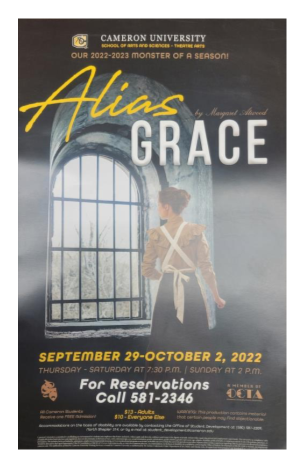
Figure 1. Poster Advertising the Production. Courtesy of Natalie McCabe.
In the fictionalised versions, an explanation is provided for the alias that the protagonist of Alias Grace adopts. During the time she was employed as a maid in her first household, before her fellow maid Mary Whitney’s death and before Nancy entices her away with a promise of higher pay under Kinnear’s employment, Grace befriends her fellow maid and roommate, supporting character Mary Whitney, likewise a teenage orphan. She is immediately portrayed as bolder and worldlier. In one scene, on the orders of their employer, Mary bathes Grace, who claims that she’s not had a bath before, certainly not one in which she was expected to remove all of her clothes. Mary explains that their employer wants them clean and scrubs her down. Mary Whitney, as an orphan and perhaps more desperate for love, becomes pregnant by their employer’s son and decides, in her desperation, to try to end the pregnancy. Ultimately, she haemorrhages, passing away in agony from the attempted abortion. In the play, fictional Grace later seems to have two personalities, herself and Mary Whitney, the same alias that the actual Grace used in her attempted escape after the murders. In the character Grace’s memories, she recalls the superstition taught to her by Mary, that one must open a window to allow the soul of the dead to pass through. Instead, Grace passes out after attempting to keep Mary comfortable before her inevitable death from blood loss. As a result, in Grace’s memories, she claims that Mary’s spirit was unable to leave the room soon enough after her death. It is implied that Mary’s spirit subsequently possesses Grace, at times altering her personality but leaving her with no recollection of her actions when Mary’s spirit takes over.
In Blackmer’s play, a character named Dr Simon Jordon is brought in by Mrs. Rachel Lavell, whose husband is in charge of the penitentiary. Rachel wants Dr Jordon, who is dealing with his own laudanum addiction, to interview Grace. He will eventually get lost in his own fantasies of sexual interactions with Grace which, in reality, are with Rachel. Initially sceptical due to her abuse in mental institutions, eventually Grace speaks with the doctor as he delves into her mental state, memories, and experiences. The play leaves the question of Grace’s guilt or innocence open. It shows her befriending a travelling peddler by the name of Jeremiah at the household where she and Mary Whitney work. Decades later, Jeremiah, who remembers Grace, has reinvented himself as Dr Dupont. He interviews Grace under hypnosis in front of Dr Jordan and a crowd of Rachel’s friends, during which Grace acts possessed by Mary Whitney’s spirit. Previously, Dr Jordan’s interventions do not and did not cause Grace to remember whether or not she participated in the dual murders. Ultimately, Dr Jordan’s mental health suffers as Grace’s sentence ends, and she leaves the penitentiary.
This play, full of sex, violence, and even dismemberment of the murder victims, is the one I was slated to direct in September and October 2022. My concerns initially lay in areas aside from Mary Whitney’s demise but in the other on-stage violence as well as particular character traits. Perhaps naively, in my vast preparations, I had not put much thought towards the abortion but, rather, into how to prepare my students for the staged violence and accent work that some of them would be called upon to perform.
My students primarily hail from within an hour’s drive of my university. For many of them, our location, with a population of 90,000 people, give or take, and a nearby military base, is a large city compared to the rural and isolated areas in which they were brought up. Due to many factors, it is not uncommon for my students to have little experience outside our own state save, perhaps, for Texas, barely an hour away. Few have left the country, and fewer still have been to Ireland or spoken with an Irish native. I wanted to ensure that the two actors cast as Grace Marks and James McDermott had ample time to prepare.
When preparing for the vocal work, my thoughts are as follows. I believe that if every character in a play is from the same area and the actors already naturally sound similar, then in theory no formal accent work is required. They are all speaking the same language from the same area, regardless. However, if there is time and reason to work on accents, particularly if only one or a few characters speak that way, I will try to work with my actors to develop their skills in this area. For my purposes, especially when directing university theatre, which is therefore educational, I strive to have my actors speak well enough for their characters’ place of origin to be identifiable by the audience. Our audience is primarily locals, many of whom have spent years in the area and/or are born-and-bred Okies. For Irish accents, I want them to be identifiably Irish in a general sense by our southwestern United States-based audience without sounding like a Lucky Charms leprechaun. Admittedly, this sometimes conflicts with what my students and audience members think an Irish character should sound like. I also want them to be able to maintain appropriate projection, diction, and enunciation. We generally do not use individual body mics for productions that are not musicals, so the actors still need to project appropriately for our rapidly aging local audience.
I will use different methods depending on the needs. My primary go-to is simply having the actors listen to as many appropriate videos, basically immersion. Of course, we cannot immerse ourselves within Ireland and have no one locally with whom to speak regarding such accents. We discuss letter sounds and begin to read lines in the accent but without intonation, emotion, or character goals, just to listen to the sound.
The above method worked for one actor, playing Grace, but the other actor, younger and only recently having completed his first voice and diction class, struggled. I only had one course in my undergraduate education that was dedicated to Lessac, a well-established vocal method, but tried to recall how that training went. Not finding myself educated enough in this method to pass it on to others, I subsequently sourced our department’s accent CDs. I also began to work with him specifically on mouth shape when he was speaking his lines, suggesting where to place the sounds in his mouth – for example, towards the front or the back – to try to reproduce the appropriate sounds. In the end, this actor did not do as well as the other, who replicated the accent well, though members of our audience, used to a southwest twang, did not always claim to understand her, either. Ultimately, there seemed to be two issues. One part of the issue with how these actors’ ways of speaking was received was due to factors we could not control, that is, our primarily local audience’s ears. The other had to do with my overall lack of time to devote to the actor playing James McDermott because we had other, more pressing, matters at hand.
Those matters were not something for which I had planned but they had arisen as a result of having to adapt to our altered political climate in a heavily conservative state. Earlier in the spring 2022 semester, when I proposed the play for production in the fall semester, I was enamoured more with the true-life murder mystery rather than focused on dramatised interpretations in a playscript and how much real-life conflict dramatic actions could cause. Grace was the protagonist. A supporting character, again, Mary Whitney, is the one who finds herself in a difficult situation with no adult assistance. Mary, who is not the leading character, is an orphaned teenage maid taken advantage of by her employer’s son and who, as a result, chooses to attempt to terminate her pregnancy – inadvertently ending her life – rather than risk ending up selling herself on the street with an infant to support. Although Mary’s situation heavily impacts the main character, it is far from the only one in the play necessitating trigger warnings about mature material for actors or audience. Those issues have already been mentioned within the play’s plot: emotional, physical, and sexual abuse as well as alcoholism, homicides, and abuse of corpses. Given these trigger warnings, maintaining a level of comfort, safety, and security for my performers as we worked our way through blocking these scenarios onstage was initially and primarily my priority over hemming and hawing about a non-leading character’s passing. The situation in which the character Mary finds herself and the decisions that she subsequently makes are not exalted – quite the opposite. What her character experiences highlights the lived reality that many female-bodied individuals suffered through before and after the nineteenth century, when pregnancy and giving birth were also far more dangerous and, at times, deadly. Thus, I felt empathy for her while also believing my focuses should be on accent work, as Grace and McDermott are listed in the script’s character descriptions as having a “slight Irish lilt” (Blackmer 2017: 1). Additionally, my focus as a theatre director in higher education is guiding young theatre scholars. When preparing for this play, I worked extensively with a student-dramaturg. Many may know what a dramaturg is, but, since even theatre practitioners sometimes have competing definitions of this position, I will define that role here.
On the website lmda.org, The Literary Managers and Dramaturgs of the Americas (LMDA) explains dramaturgy and “The Role of the Dramaturg” as follows:
[…] dramaturgs contextualize the world of a play; establish connections among the text, actors, and audience; offer opportunities for playwrights; generate projects and programs; and create conversations about plays in their communities. […] They work with their other artistic collaborators to hone their vision, focus their goals and find outlets for their creative work on new and classical plays and dance pieces. […] as experts on our dramatic past. (LMDA 2025)
For our purposes, the main role of my student-dramaturg was to contextualise the play for the actors. This included discussions about the playwright and the play’s prior productions as well as the author of the original novel. Additionally, this involved researching the play’s references and providing that information to the actors in a concise, digestible manner in the form of an actor packet.
To prepare for this, the first production of our academic year, the student-dramaturg and I met in the late spring semester and over the summer to outline what they would provide our production in terms of research and for the audience in terms of the lobby display. The lobby display plans came more quickly. The play is rather abstract, taking place in the title character’s memories, and does not provide a definitive answer about Grace’s guilt. Our dramaturg created a way for the audience to vote after the play on whether or not they feel that she was guilty of the murders. For research, I provided general topics that I wanted covered, such as terminology used in the play and basic facts regarding immigrants entering Toronto, Ontario at the time, the mid-nineteenth century. Fortunately, even though the course of study in my doctoral program was primarily theatre-focused, I had also studied under Dr Kerby Miller during that time and could guide the dramaturg to sources regarding the immigration aspect more readily. We laid out information related to immigrants of that time in conjunction with what we knew about the characters and what their lives would be as lower-class Irish immigrants to North America and, specifically, Ontario. With McDermott from Donegal and Grace from Belfast, we could make educated guesses regarding their religious affiliations but had no definitive answer in the text. The two meet up in the 1840s after Grace and her family, which included her father, who was a stonemason in reality, had migrated in 1842 from Ulster. We knew that Grace, at least early on, seems to find importance in her religion but does not state specifically what it is, beyond one that uses the Bible. We surmised that perhaps she, with the aforementioned factors and with a last name leaning more English in origin, was Protestant, perhaps Presbyterian. McDermott, on the other hand, whose exact year of immigration is unknown, we felt, may have been raised a Roman Catholic, the majority religion in Donegal. Unfortunately, in the latter’s case, this leant into the character stereotype of the violent, drunk, and even uncivilised native Roman Catholic Irishman. Whether or not these assumptions were correct, I found myself glad that Grace’s father does not make a literal appearance in the play and add to any stereotypes. In any case, Grace’s religious affiliation does not affect the play in a specific way. Rather, Grace claims to know her Bible well and mentions Bible verses, which means that she is literate but does not necessarily point to an identity beyond one under the umbrella of Christianity. Personally, to me, memorising verses feels more Protestant and less Catholic, even having grown up under the tutelage of my three Catholic priest-uncles. Whether she is honest about her claim to know her Bible verses well or uses it as a claim to manipulate the situation in her favour as a pious individual is not certain.
Regardless, despite this play taking place in the nineteenth century, the dramaturg and I discussed basic history of the Republic of Ireland and Northern Ireland, as Grace and McDermott were technically from two countries by today’s political and legal boundaries. Much of the play muddles through Grace’s hypnosis-induced memories and statements as well as the doctor’s drug-induced hallucinations. As a result, I relayed to the dramaturg, who was also my sound designer, that I consistently heard the Cranberries’ song “In Your Head” in my own head when I read this play. She used the themes, sounds, and lyrics within this song as a basis for the play’s pre- and post-show music, its intermission music, and sound effects.
The dramaturg also set out to find what certain props in the play would have looked like in reality. For example, there is a scene where Marks and Mary Whitney use an apple peeler. The duo peel apples, toss any unbroken peels over their shoulders, and see if the peel resembles a letter that correlates with the initial of a romantic interest. We discussed finding information regarding abortion practices and laws of the nineteenth century. I had a former graduate school classmate, Dr Sarah Lirley, who wrote about similar topics and practices in Missouri in the nineteenth century. Despite the fact that the exact information would not be the same between Saint Louis and Ontario, she provided some articles that guided us into a general framework that we thought would be sufficient in regards to how deaths likely from abortion attempts and other illicit activities that may befall women were described and prosecuted, or not. For some reason, the apple peeler became quite the topic of discussion, especially as we considered whether or not to have an unbroken peel prepared, if the knife used as the peeler should be sharp enough to peel an apple onstage, leading to potential risks or injuries, etc. That is, it was quite a topic of discussion before the United States abortion laws, and our local community’s perception of them, changed.
As I was preparing for the semester, before classes began or auditions were held, a community member showed up at my office on campus. I had not seen or met this person before as they were not a student or employee of my university. Still, evidently, they knew where to seek me out and had heard that the university had replaced the retired theatre history professor the prior year. Tentatively, they introduced themselves and asked for a brochure for our upcoming university theatre season. I did not have one yet and realised that the theatre website had not been updated, either. The community member laughed and said that I must not have my feet wet yet as a new, young employee. Gently, I explained that I was a faculty member. Producing a season brochure and updating the website are not in my job description, and faculty offices were not even yet officially open for the semester. Then, they brought up Alias Grace. Apparently, they had heard what the theatre season would include. This play and its upcoming performances were, apparently, what they were truly there to discuss.
The community member mentioned that members of their group at their church had drawn attention to the presence of an abortion in the play, which is what the community member was truly there to discuss. Elective abortions in the state of Oklahoma were now illegal except when necessary to save the mother’s life or if resulting from rape or incest. Even in the latter two instances, an elective procedure terminating a pregnancy can only be approved if the incident is formally declared to legal authorities within a certain timeframe.[4]
The individual mentioned that neither they nor their church group would be seeing my play even though, they emphasised, they normally saw the entire season. My exchange with them felt awkward, to say the least. A colleague who observed the encounter validated my feelings with a whispered, “So… that was weird, right?”
But was it? Weird, I mean? It dawned on me that I would have to prepare extra for the rehearsal process and ensure that my production concept moulded the performances into something that would both benefit goals for my students’ learning and be digestible by an audience one hundred miles away or more from professional theatre productions in the nearest big cities, Oklahoma City and Dallas, both located in states in which even spontaneous abortions, also known as miscarriages, could now be considered suspect.
I began to worry that my status as a state government employee could make me suspect in the eyes of my employer. I teach in a department that includes art, music, and theatre programs. The former chair, a theatre professor, had just retired; a music professor, who had not been involved in the planning for the theatre season, now sat in his place. I decided to fill her in on the topics included within the play. She was receptive and supportive, and the show, to which we had previously secured the rights, went on.
Following this, I tiptoed towards our rehearsal period of approximately six weeks with trepidation and caution. As I typed information sheets for those auditioning, I made the decision to write out trigger warnings that mentioned the “adult” material and events included in the script. For purposes of keeping dialogue open and providing confidentiality, I did not demand that potential cast members disclose their reasoning either way if they deemed certain role assignments unacceptable in relation to their personal beliefs or comfort. The way in which I prepared the audition forms, ensuring that problematic elements were in the open and not hidden, felt as if it was simultaneously insulating myself, any potential actors, and my public university from extraneous criticism since elective terminations of pregnancies were no longer allowed in my state. This weighed more heavily on my mind than dedicating further rehearsal time to our McDermott’s accent. Still, there were no issues brought forward on the actors’ audition sheets, so I cast based fully on strength of audition with a nod towards student learning outcomes. Warnings about the R-rated subject matter were hung at the entrance to the auditorium so that potential audience members could make educated decisions about attending the show. In fact, in the years since, I have told our student house managers and our box office manager to make certain to always post the signs we have, warning of mature topics, language, and, indeed, anything that could be offensive, by the entrances to our theatres before any of our productions out of abundant precaution for audience members’ sensitivities and, frankly, to protect myself and my students.
A student dramaturg aided with rehearsal preparation and a lobby display encouraging interaction from audience members. I provided guidance towards the dramaturg about which topics to research. Given what had happened politically and outside of my office door, information regarding the history, legal laws and rulings, and logistics regarding elective pregnancy terminations were the centre of this research focus.
For ease of research, we decided to search for information regarding this topic specific to the play’s location in Ontario as well as in the rest of nineteenth-century North America. No actors had noted a concern on audition forms or in discussions with me; still, the information and play presented intense topics. I moved forward with great empathy for my cast and the tasks laid out before them. For example, the cast was told that they need not remain in the rehearsal hall if they needed a breather from the information presented by the dramaturg or simply did not want to be there, without any required explanation on their part or penalties on my part. All remained. Details were provided about laws, court cases, and how abortions were attempted at the time to provide context about the character Mary’s death. The dramaturg and I proceeded slowly as we were evaluating the temperaments of the actors to ensure everyone continued to feel safe and supported in our rehearsal hall.
Because we were dealing with Irish characters, pregnancies, and an abortion attempt, I discussed basic scenarios that played out in Ireland before the Eighth Amendment was repealed. I tried to phrase the information in ways that were perhaps less specific to the U.S. and, especially, Oklahoma so that it might not feel quite so personal to the actors – or, I thought, less likely to offend or cause any complaints. The encounter with the community member remained fresh in my mind and kept me on alert for any potential issues. Situations from another country felt more distant but still could illustrate what can happen when crises happen during pregnancy without access to proper health care, such as Savita Halappanavar’s tragic 2012 death in Ireland.[5] I wanted the actors to absorb what may happen when pregnant individuals feel desperate to end their pregnancies or desperate to hide them but in a way that enabled them to, as mentioned, distance themselves enough to objectively observe as outsiders and, ideally, infuse their characters’ actions without judgement. In order to enable our actors to understand Mary Whitney’s frame of mind when she threatens to drown herself if she cannot end her pregnancy, I referenced the case of the fourteen-year-old Irish girl who was raped by her friend’s father in the early 1990s and subsequently became suicidal when she was initially prevented from travelling to terminate her pregnancy. In 2026, there are examples within the United States of women harmed by laws restricting pregnancy termination. However, with the title character’s origins and a need to allow my actors to understand the characters’ states of mind more objectively, I would likely still reference the examples from Ireland when discussing the topic of pregnancy termination.
One student who had felt fine with the topics discussed in our table work during rehearsal suddenly experienced light-headedness when we discussed the dramaturg’s research. We paused out table work, made sure they had what they needed (hydration, a safe place to sit outside of the rehearsal hall, basic calories such as crackers), and decided to end that part of the discussion for that evening. When they felt better, they explained that they had no problems with the topics at hand, but that mentions of blood sometimes made them feel woozy. They reiterated later that they felt respected with how their situation, and the information in general, were handled. Actor safety is always the goal, so their feedback was important to me as to how we would proceed. Still, they were not likely to be the only one there with reactions to the mentions of medical situations in the play’s dialogue, so we embraced the abstract and dream-like nature of the play and leaned in that direction for staging and design purposes.
Red and orange were colours that consistently came up in the script, with obvious nods to Mary Whitney’s haemorrhaged blood but also to the question of whether or not Grace was evil or “devilish”, like McDermott’s mother claimed him to be.
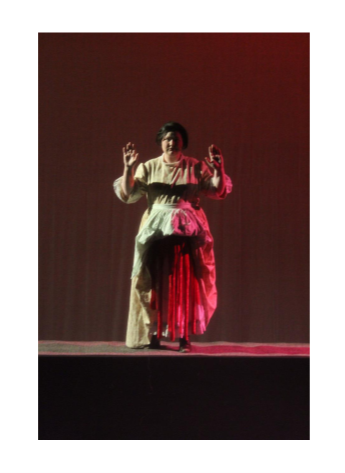
Figure 2. The spirit of character Mary Whitney, played by actor Jaiden Standridge, struggles to move on after her death following an attempted abortion. Photo courtesy of Ben Williams via Natalie McCabe.
References to gardens full of red or orange flowers, all poisonous in one way or another, abound in the play. I asked the designers the questions: “Is Grace the poisonous red flower? When she eats Dr Jordan’s apple, does she become like Eve in the Bible, damning all future women to painful reproductive consequences?” I felt that leaning on the colours of red and orange would allow us to get the elements of death across, including Mary Whitney’s from the abortion attempt, without having to stage everything along more realistic and, potentially, troubling lines for our audience, actors, and state.
My questions about Grace’s poisonous, red nature imparted the dream-like quality I intended and allowed my creative team to focus more heavily on an abstract interpretation. My student lighting designer subsequently used more red and orange hues in the dream, memory, and hallucination sequences, with the red growing more vibrant when elements of violence or sexuality were staged. For example, this concept was utilised in the scene in which Dr Jordan imagines strangling Rachel, his landlady. This was also employed in the scenes where he hallucinates Grace being surrounded by the men in her life- himself, McDermott, Jeremiah, and Kinnear, and disappearing inside their huddle, only to have Mary Whitney emerge and slap him.
When planning the character’s costumes, I took special care to guide the student costume designer when designing the costume worn during the character Mary’s death. Mary staggers onto the stage, clutching herself and bleeding profusely after the abortion attempt. The student designer leaned into the abstract as well as the practical when designing this costume as she anticipated audience responses, and chose textured, deep red material divided into narrow panels below the actor’s skirt. The fabric’s colour shone with a darker red when revealed under the red stage lights. Mary entered from stage right, bending over as she clutched her stomach and held up the skirt, revealing the underskirt of dark red, textured strips of fabric, and stumbled offstage left as she died. After this, and now dead, she reappeared upstage centre behind a scrim the set designer had planned for other-worldly moments in the script. Mary raised her arms as if unable to leave the area behind the scrim, the character’s soul unable to leave after her body had passed away.
This approach served our production well. I did not receive any true complaints about subject matter, especially as we avoided realistic depictions. The audience readily participated in the interactive lobby display that the dramaturgy had designed, in which the audience members could voluntarily cast votes for Grace’s guilt or innocence, rather than focus on the script’s controversial subject matter.
The colours chosen allowed us to visually contrast the end of the play, in which Grace appears hand-in-hand with the deceased Mary Whitney and Nancy Montgomery, all dressed in white nightgowns.
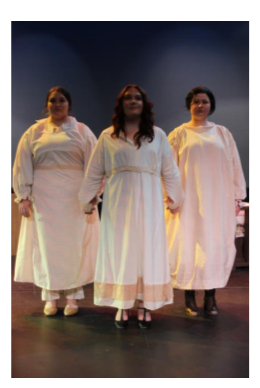
Figure 3. Characters Nancy Montgomery, Grace Marks, and Mary Whitney, played by actors Shayson Lenee’, Araia Heathcott, and Jaiden Standridge, respectively, together at last. Photo courtesy of Ben Williams via Natalie McCabe.
White is often associated with purity, innocence, and modern, though not Biblical, angel imagery, which stood in sharp contrast with the deep reds in which the rest of the design elements had been infused. I also wanted their last moments onstage to be cloaked in the bright white sleep attire for other reasons. I could not able to make a claim for the innocence of Grace in regards to the murders but could make a visual statement about the women’s innocence in a male-dominated time. Grace may or may not have been complicit in the murders. Still, she had only been working as a maid due to her father’s alcoholism. She later became influenced by McDermott, an older, more experienced male. Her second employer, Kinnear, an older, wealthier male, objectified her. Male employees in the mental institutions in which she was incarcerated after her conviction sexually abused her. Mary Whitney was orphaned and taken advantage of by an older male. Having no real social safety net at the time, she found herself with a very frowned-upon out-of-wedlock pregnancy and no way to prove paternity. Had she kept the pregnancy, as she exclaims to Grace, she would be unemployed, on the streets, with no way to support herself, let alone a baby, unless she turned tricks as a prostitute. She tells Grace that without the abortion she will drown herself, leading seemingly innocent Grace to lend her money to procure the procedure that ultimately kills her. Nancy Montgomery certainly enjoyed her power in a servant position higher than Grace’s and may have been Kinnear’s mistress, but she would have yet again been socially stigmatised by an another out-of-wedlock pregnancy had she survived. With the three women cloaked in pure white hand-in-hand as the final stage picture, I hoped that this would be a lasting image for the audience. Maybe, just maybe, seeing these women who could be seen as villainous devils costumed as innocent angels would, consciously or not, cause my audience to interrogate their own beliefs, much like Grace did in the play and much like I was taught to do in school decades ago, opening avenues for constructive dialogue between those of different beliefs as time progresses.
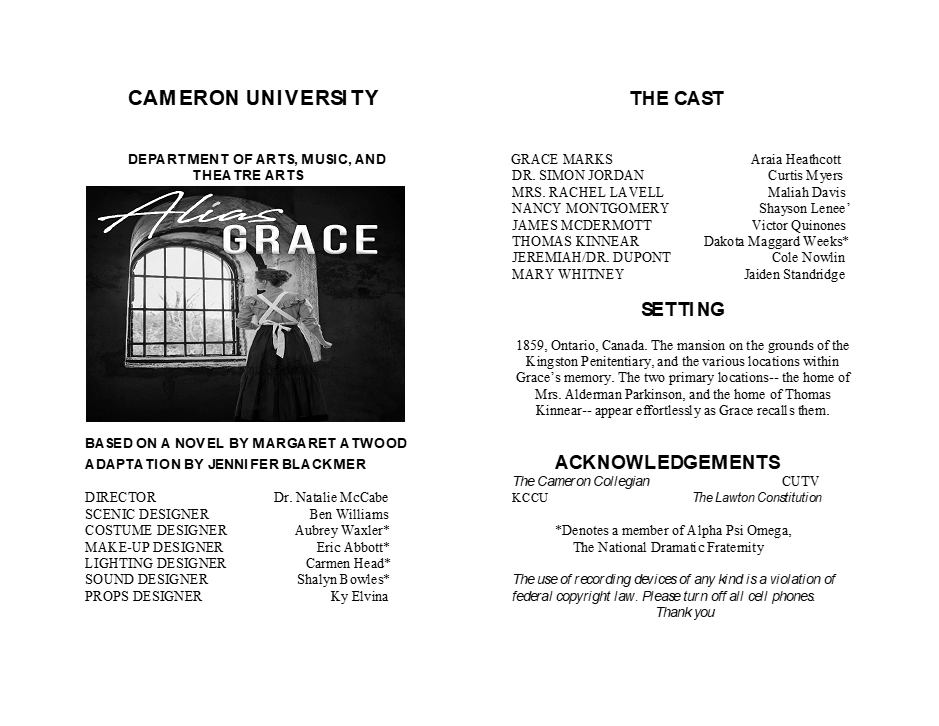
Figure 4. The playbill for the author’s production of Alias Grace. Courtesy of Natalie McCabe.
Notes
[1] A version of this paper was originally presented in the fall 2024 meeting of the American Conference for Irish Studies-Midwest (ACIS-MW) held in Columbus, Ohio, United States of America (USA). This article is separate; still, the situations experienced during the production’s direction were used to contextualise examples in another paper that focuses on discussing three different books surrounding issues of maternity and the politics thereof in the journal Ecumenica in 2023.
[2] I will subsequently refer to her as Grace rather than Marks as that is part of the play’s title.
[3] I will subsequently refer to the men by their last names, the servant as McDermott and the master as Kinnear, as that is how they are most often labelled in the play’s dialogue.
[4] Understanding that not every gestational parent identifies or is legally classified identically, as in the case of surrogates, the word “mother” will be used here in line with the wording of much of the material discussed.
[5] Savita Halappanavar, a dentist from India, passed away of sepsis and cardiac arrest in Galway in 2012 after being denied an abortion during a lengthy miscarriage due to Ireland’s restrictive abortion laws at the time.
Works Cited
Alias Grace. Directed by Dr Natalie McCabe. Written by Jennifer Blackmer. Cameron University Theatre: Lawton. 29 September – 2 October 2022.
Blackmer, Jennifer (2017). Alias Grace. 1252 International, LLC, 2017.
Pope Paul VI (1968). Humanae Vitae [Encyclical Letter on Human Life]. Vatican City: The Holy See.
Potts, Monica (2022). “What Ireland’s Past Can Tell Us About a Post-Roe America.” FiveThirtyEight (June 8).
Wallace, Arminta (2018). “The story of the Irish ‘murderess’ behind ‘Alias Grace.’” The Irish Times (January 15). https://www.irishtimes.com/life-and-style/abroad/the-story-of-the-irish-murderess-behind-alias-grace-1.3353581.


