
 by
Jinan Ashraf.
This text may be archived and redistributed both in electronic
form and in hard copy, provided that the author and journal are
properly cited and no fee is charged for access.
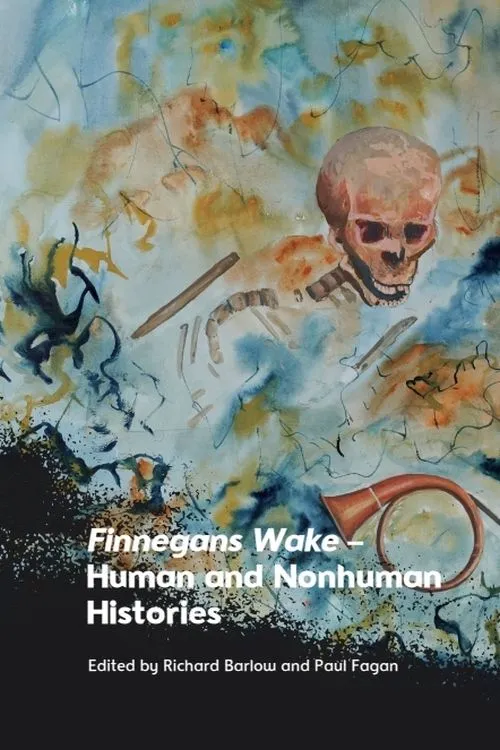
Richard Barlow and Paul Fagan, eds.
Edinburgh: Edinburgh University Press, 2024 (Paperback 2026). 256 pages.
ISBN: 9781399529440
The collection Finnegans Wake – Human and Non-Human Histories, edited by Richard Barlow and Paul Fagan (Edinburgh University Press, 2024), pushes the disciplinary boundaries of literary studies by calling to question the limits of individual theoretical paradigms in accounting for the planetary scope and scale of James Joyce’s Finnegans Wake (1939). The collection interrogates varying theories of the nonhuman in its overview of the field in a bid to provide its readers with new methodological and interpretive frameworks which trouble and expand the readers’ understanding of the Wake’s non-human imaginary. In the process, the collection brings into sharper focus the anthropocentric biases and failures of extant theoretical models in grasping the Wake. Richard Barlow and Paul Fagan situate new scholarship by veteran Joyce scholars broadly within the intersections of Joyce Studies (more narrowly, Wake studies), non-human studies, the New Modernist Studies, and Irish Studies, while retaining a critical interest in the wave of historicist readings of the Wake. Barlow and Fagan demonstrate that these critical overlaps are neither paradoxical nor dichotomous, and thus a productive field of inquiry. The “Introduction” provides a comprehensive and wide-ranging overview of the central debates opened up, not only by the Wake’s modernist and avant-garde form, but also by the excess of the non-human inflection of the Wakean storyworld. The ground-breaking interpretive models advanced in the collection are organised around the Wake’s dizzying planetary dimensions as well as key concerns in historiography, which are reflected in the apposite title of the collection. The collection contributes to novel conceptualisations of nonhuman subjectivities (thinghood, for instance, or geopolitical subjectivities) in the Wake.
Katherine Ebury opens the collection with an exhilarating reading of the Wake’s “energy unconscious” (29) informed by petrocultures methodology. Katherine O’Callaghan unpacks an “ecopoetics” of the storm (38) in glossing the Big Wind of 1839. Shinjini Chattopadhyay and Laura Gibbs bridge critical gaps in Wake studies and the blue humanities through an emphasis on female fluidity and agency in the Wake – through an application of Astrida Neimanis’s theory of watery bodies. Chattopadhyay examines the “transhistorical riverine identity” of ALP against colonial and masculinist exploitations of nature (55, 59) as Gibbs interrogates the Wake’s gendered phenomenology through which a new female authority emerges (68); both readings expose and subvert the patriarchal associations between women and fluidity. Though the chapters until this point have responded in equal measure to reinterpreting and reconceptualising the Wake’s nonhuman imaginary through historicised readings, Richard Barlow’s exploration of Joyce’s Wake responds more strongly to the collection’s interest in historiography, as much of the early sections of the chapter is devoted to Joyce’s positioning and exclusion in Revival contexts, reading Book IV of the Wake as Joyce’s corrective of the Revival’s “flawed historiography” (91). The early sections interpret the nonhuman obliquely in gesturing toward regeneration and the corpse as motifs in the Wake (87), and concrete attention to the non-human imaginary (watery bodies and aquatic locations, for instance) is deferred until the final section of the chapter.
Paul Fagan examines the palimpsestic layering of parchment, sartorial, and topographic skin in the Wake, broadly imagined as an “unstable, permeable” threshold which reveals the materiality of the nonhuman world (99, 106). Annalisa Volpone extends the collection’s interest in the role of the nonhuman in the modernist avant-garde through an examination of the role of wolves and werewolves in the Wake and the “animalesque” behaviour of Shem the Penman (116). The next three chapters interpret the nonhuman from philosophical perspectives. Christopher DeVault deconstructs the “humanist foundations” of mourning in an exploration of nonhuman grief and the ethics of mourning in the Wake (134). Sam Slote invites readers to observe how thinking “beyond the human” still “posits humanity at the centre” (148). Ruben Borg charts atomic activity in the Wake. Drawing from sound studies, ecofeminism, and new materialism, Michelle Witen reads Mamalujo I.6 and III.4 in developing a “musical nonhuman framework” for reading the Wake (181). The final chapter by Ronan Crowley concludes the collection with a focus on the “inhumanity” of Joyce’s expectations and demands in crowdsourcing the Wake.
The collection deftly teases out the tensions between classic (Campbell and Robinson 1944) and twenty-first century criticism (Brazeau and Gladwin 2014; Lacivita 2015; Grusin 2015; Chakrabarty 2021; and Mierlo 2023, to name a few), which in turn inform the work’s timely interventions in Joyce Studies. Contributors primarily draw on theoretical frameworks advanced by Astrida Neimanis, Jacques Derrida, Gilles Deleuze, and others. The radical novelty of the collection lies not only in the confluence and integration of new approaches and methodologies advanced in Wake studies, namely, petroculture studies, animal studies, sound studies, ecomedia studies, ecofeminism, and the blue and energy humanities – which stand out among the other foci of the collection – but also, and perhaps more significantly, its grounding in the twenty-first century, first, in terms of methods, discourses, and practices, and second, in its attention to contemporary readers of the Wake vis-à-vis Joyce’s original audience, which lends the collections its edge. Such a vantage point allows its contributors to retrospectively examine what earlier scholarship could not have achieved (25, 148) or how conversations in Ulysses and Finnegans Wake are likely to be read differently in the context of the present, particularly in light of the climate crisis (27, 37, 106). This approach allows contemporary readers to take better stock of what has changed since the composition of Joyce’s final avant-garde work, or how we might read moments from Irish history and Irish cultural memory retrospectively with and against ecological events.
While the collection expertly demonstrates the problems posed by the Wake and foregrounds the politics of inhabiting the planet, it gestures toward urgent planetary concerns but only fleetingly speculates on the responsibilities and roles of the historian in the context of ecological crises in the present time (12-13). These concerns and implications are gestured toward in the “Introduction” but not fully drawn out, and highlights the perceivable absence of any direct or concentrated reference to shared “vulnerabilities” (a word that came into better focus during the COVID-19 pandemic) in a capitalist world ecology in the Wakean storyworld as well as the world beyond the Wake. Considering the central nonhuman and ecological concerns underpinning the collection, the “Introduction” makes cursory references to, and reflections on, global change and uncertainty in the concluding section. The reality of the vulnerabilities shared by the human and the nonhuman and nonhuman resistance to human control and coercion are occasionally addressed by contributors (Ebury, O’Callaghan, Chattopadhyay, Gibbs, Fagan, and Slote for instance, each of whom interpret vulnerabilities in differing but significant ways). Given the twenty-first century focus on readers and the Wake, an attention to a reading of the Wake in light of the COVID-19 pandemic and the potential of the Wake to speak to the themes of infection, vulnerability, and the non-human imaginary is missing in the collection.
Each of the contributions respond to the organising themes of the collection. The contents of the collection, however, are not arranged into specific clusters, arguably due to the critical overlap between nonhuman and historicist readings more broadly and the intersections between critical approaches more particularly. The robust research advanced in the collection invites readers and scholars to reconsider the untapped potential of Wake studies. Finnegans Wake – Human and Non-Human Histories contributes to new and emerging methods, practices, and interpretive frameworks which expand any received ideas of the imaginaries at work in the Wake. In signalling toward energy futures or the mediation of technology in the Wake’s local and planetary ecoscape, the collection opens the field to a comparativism to come.


