
 by
Claire Mullaly.
This text may be archived and redistributed both in electronic
form and in hard copy, provided that the author and journal are
properly cited and no fee is charged for access.
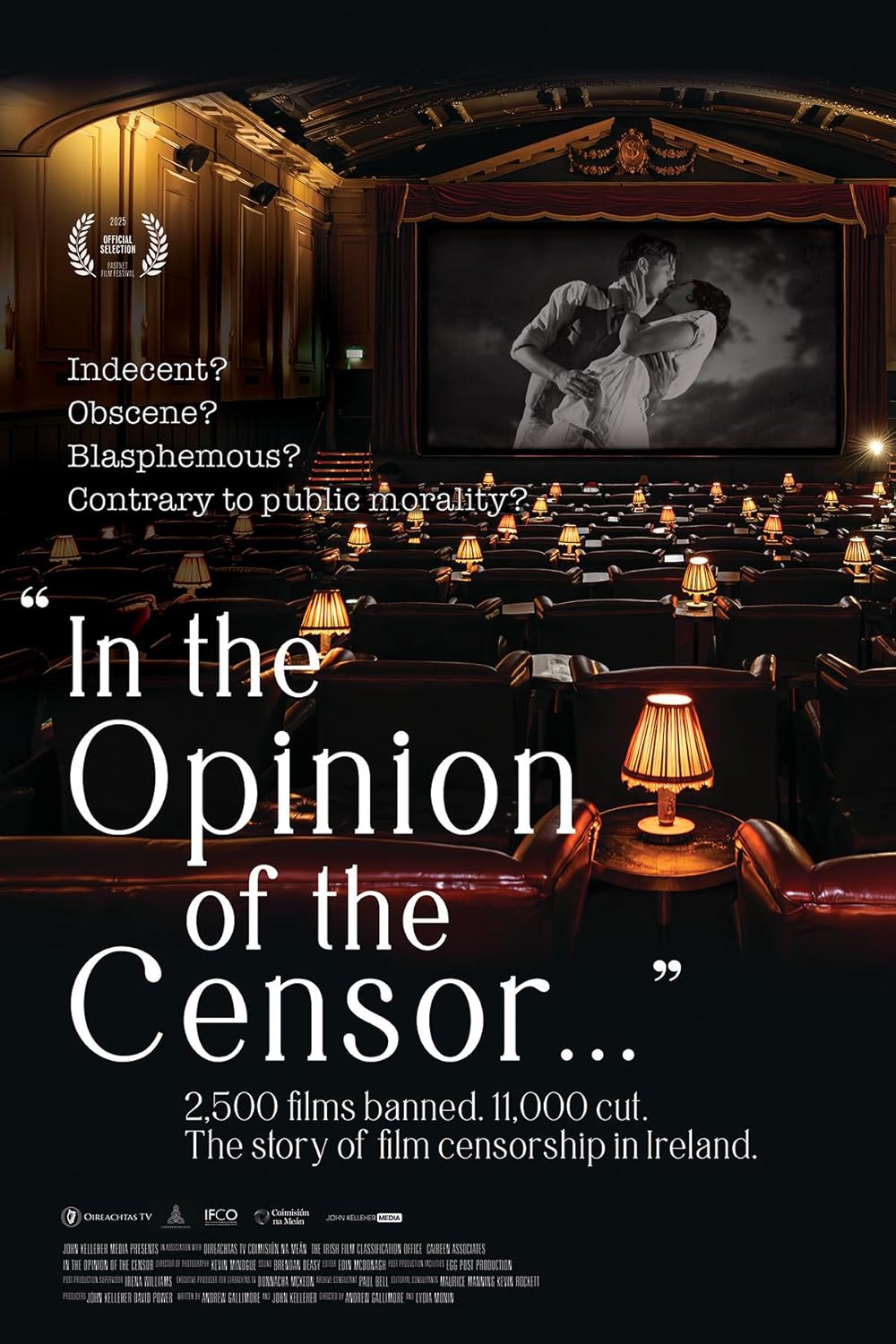
Andrew Gallimore and Lydia Monin (2025)
The feature-length documentary In the Opinion of the Censor (Andrew Gallimore and Lydia Monin) charts how over the course of a century in Ireland nine men censored over 65,000 films, banned around 2,500, and cut a further 11,000. One of the first pieces of legislation passed in the newly independent Irish Free State was the Censorship of Films Act (1923). The Act stipulated that publicly distributed films must be viewed by the Irish Film Censor whose remit was to cut or ban anything that “in the opinion of the Censor” was “indecent, obscene or blasphemous” or “contrary to public morality”. The Act was a bold divergence from the British Cinematograph Act (1909) and centralised the power to cut or ban films, placing the decision into the hands of one individual and (where relevant) an Appeal Board which was often made up of conservative political and Church representatives. So enduring was Kevin O’Higgins’ 1923 legislation that it remains in place to this day, albeit slightly amended. Co-director, Andrew Gallimore describes In the Opinion of the Censor as “very much a story of what we did with our freedom when we won it” (Hennessy 2025).
In the Opinion of the Censor was produced by John Kelleher Media and was supported by the Irish Film Classification Office (IFCO); the television service of the Irish Dáil and Seanad, Oireachtas TV; Ireland’s media regulator Coimisiún na Meán; and Caireann Associates. The film’s producer, co-writer and narrator, John Kelleher, the film’s producer, co-writer and narrator, was last holder of the position of Irish Film Censor and the first holder of the 2008 rebranded position of Director of Film Classification in Ireland. Expert contributions to In the Opinion of the Censor are drawn from a wide array of film academics, including Kevin Rockett and Ruth Barton, historians, veteran politicians, journalists, actors, archival experts, past film censors and the current Director of Film Classification. Their expertise is presented in the form of talking heads interviews, interwoven with rare archive footage, film clips, and images of documents and Film Censor archive records. The result is an entertaining documentary with intriguing use of some of the scenes that were removed, to illustrate the impact of the Censor’s decision-making on the films ultimately screened. The exclusion of marginalised identities and ideologies from film, often deemed alien and imported, impacted audiences, cultural life and Irish society as a whole. In the Opinion of the Censor sets out to demonstrate how film censorship mirrored Ireland’s shifting cultural and political values. However, perhaps a further question to explore is to what extent did film censorship shape rather than mirror the history of the country?
In the Opinion of the Censor draws on well selected film examples to illustrate an array of genres, eras and controversies. It sheds light on decision-making processes in a similar fashion to the hour-long Dear Censor… The Secret Archive of the British Board of Film Classification (Matt Pelly, 2011). Dear Censor… examines regulations and stipulations that the British Board of Film Classification (BBFC) imposed upon films distributed to British and Northern Irish cinemas by drawing on BBFC archive material including letters and other censorship records, film and archive footage. An early film example used by In the Opinion of the Censor to shed light on Irish Film Censor decision-making processes is From the Manger to the Cross (Sydney Olcott, 1912). The film presents an early example of Church and press influence on film censorship in Ireland. Film historian Kevin Rockett, author of Irish Film Censorship: A Cultural Journey from Silent Cinema to Internet Pornography (Rockett 2004), notes in the documentary that Protestant Churches objected to the depiction of Christ while the Catholic Church took issue with Gene Gauntier, the actress who played the Virgin Mary, because she was a divorcee. Even in the early days of cinema, under the pre-partition system of censorship using the British Censorship of Films Act (1909) and local corporations, controversies concerning religion and morality were widespread.
The chronological approach taken by In the Opinion of the Censor allows the film to chart social and political anxieties and sensitivities during the tenure of each censor from the 1920s. The family as the unit of the state and Catholic nationalism formed the basis of much censorship decision-making in the twentieth century in Ireland, and this led to the suppression of representations of – or the rendering oblique of more candid references to – sex, divorce, adultery, homosexuality, birth control and abortion, all of which were also removed from films’ advertising and promotional materials. In the Opinion of the Censor also dedicates time to examining the politics involved in the appointment of the Irish film censor. Many censors had connections with the governing parties, the most influential of which were Cumann na nGaedheal and Fianna Fáil, or had Irish War of Independence and Civil War “credentials”. The first film censors to have a background related to film were Cork Film Festival’s Dermot Breen, appointed in 1972, and broadcaster Frank Hall, appointed in 1978.
In the documentary, historian and producer and host of the Censored podcast series, Aoife Bhreatnach, explores the subject of idealised femininity as a means of understanding the often-gendered disposition of film censorship. Bhreatnach observes the identified “idealised femininity” through traits that were problematically demure, restrained, non-confrontational and accepting of patriarchal control. Insights like these are important in deconstructing the role of gender in early Irish film censorship. Another contributor, Gráinne Humphreys from Dublin International Film Festival expands on this concept by using the film example of the pre-code musical comedy Gold Diggers of 1933 (Mervyn LeRoy, 1933) to illustrate how a film with Busby Berkeley choreography, celebrated aesthetics, and a socially conscientious storyline about women surviving the contemporaneous Great Depression could be dismissed by the Irish Film Censor because of perceived on-screen risqué “transgressions” of women.
In the Opinion of the Censor explores the World War II years, or the “Emergency” as it was known in Ireland. Emergency censorship was operated under the remit of the Minister for the Co-ordination of Defensive Measures, Frank Aiken, in order to “keep the temperature down” (Ó Drisceoil 1996: 47. As the documentary considers film censorship during the Emergency it argues the significance of its role in ensuring that Ireland’s neutrality was not questioned. The film example of A Yank in the R.A.F. (Henry King, 1941) is used to illustrate the delicate balance that neutrality demanded.
Contributor Ciaran Carty has been an outspoken critic of censorship in Ireland (Carty 1995). His anti-censorship campaigning exposed the extent of the measures and practices on Irish audiences who often were oblivious to the cuts made. In the documentary, Carty suggests that filmmakers could also become the target of censors, often for living “immoral lives”. Mike Nichols, the director of Who’s Afraid of Virginia Woolf (Mike Nichols, 1966) and The Graduate (1967) is cited by Carty as one such targeted director. Both films are explored in the documentary: Who’s Afraid of Virginia Woolf for its over-21 classification and The Graduate as an example of a film that had scenes referencing sex and infidelity cut, exorcisms that left the plot almost unintelligible. As approaches to censorship developed with a more liberal outlook in Ireland, and some sensitivities subsided around themes of sex and morality, extreme violence remained subject to stringent observation until as late as the 1990s. Natural Born Killers (Oliver Stone, 1994) is used as an example of a film banned in that decade. The Censor at the time, contributor Sheamus Smith, explains his justification for banning the picture for its “gratuitous violence” and Gráinne Humphreys from Dublin International Film Festival observes that the film was only screened at the film festival before its ban. This last comment highlights the important role played by film festivals in exhibiting films that might otherwise never have been seen.
Former Irish President, Michael D. Higgins described censorship in the newly formed Irish Free State as “part of a wider exclusionary manifesto” that had “moral entrepreneurs, who, with an energy they suggested was drawn from divine sources, went from creating moral panics to legislative victories” (Higgins 2022). In the Opinion of the Censor charts a century of film censorship transformation from early “moral entrepreneurs” to liberalisation. The film ends with the on-screen text: “It’s been over 20 years since a film has been banned or cut in Ireland”. This marks the transition to classification from censorship and to openness from secrecy. Only in 1998 did the Irish Film Censor’s Office agree to transfer over one hundred volumes of film censorship material to the National Archives of Ireland. As recently as 1986, the former Fine Gael Minister of Justice, Alan Dukes justified the withholding of the files with the argument that Censors and Ministers for Justice “had always considered themselves precluded” on disclosure of film censorship information in Ireland (Gartland 2016). What In the Opinion of the Censor achieves is to draw together expertise, film and archive material to reveal a century of film regulation to people on the Oireachtas TV platform. It is entertaining, educational and an invaluable record of often overlooked histories. Contributor Anne Harris states that “film is one of the greatest starting points for a shift in societal attitudes”. Given the level of extensive censorship that film met in Ireland, new questions arise on the socio-political histories of film censorship and the impact of film censorship on the nation. Perhaps for follow-up in an In the Opinion of the Censor part II?
Works Cited
A Yank in the R.A.F. (Henry King, 1941). Twentieth Century Fox.
Carty, Ciaran (1995). Confessions of a Sewer Rat: Personal History of Censorship. Dublin: New Island Books.
Dear Censor… The Secret Archives of the BBFC (Matt Pelly, 2011). BBC.
From the Manger to the Cross (Sydney Olcott, 1912). Kalem Company.
Gartland, Fiona (2016). “War of Words in 1986 Over Access to Film Censor’s Files.” The Irish Times (December 30). https://www.irishtimes.com/news/politics/war-of-words-in-1986-over-access-to-film-censor-s-files-1.2905774.
Hennessy, David (2025). “And Cut!” The Irish World (November 11). https://www.theirishworld.com/and-cut/.
Higgins, Michael D. (2022). “‘1922 – The Most Significant Year?’ Machnamh 100 Seminar VI: Memory, History and Imagination.” President of Ireland – Media Library (November 17). https://president.ie/en/media-library/speeches/1922-the-most-significant-year.
In the Opinion of the Censor (Andrew Gallimore and Lydia Monin, 2025). John Kelleher Media.
Irish Statute Book, Censorship of Films Act, 1923 (2025). http://www.irishstatutebook.ie/eli/1923/act/23/enacted/en/html.
Natural Born Killers (Oliver Stone, 1994). Warner Bros.
Ó Drisceoil, Donal (1996) “‘Moral Neutrality’: Censorship in Emergency Ireland.” History Ireland 4 (2): 46-50.
Rockett, Kevin (2000). “Protecting the Family and the Nation: The Official Censorship of American Cinema in Ireland 1923–1954.” Historical Journal of Film, Radio & Television 20 (3): 283-300.
______ (2004). Irish Film Censorship: A Cultural Journey from Silent Cinema to Internet Pornography. Dublin: Four Courts Press.
The Graduate (Mike Nichols, 1967). Embassy Pictures.
United Kingdom Government, Cinematograph Act, 1909 (2025). https://www.legislation.gov.uk/ukpga/Edw7/9/30/enacted.
Who’s Afraid of Virginia Woolf? (Mike Nichols, 1966). Warner Bros.


