
 by
Stephanie McBride.
This text may be archived and redistributed both in electronic
form and in hard copy, provided that the author and journal are
properly cited and no fee is charged for access.
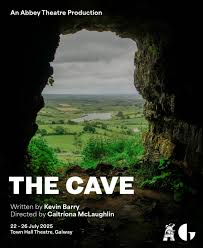
Caitríona McLaughlin (Writer, Kevin Barry) (2025)
The Cave is a recent play by Kevin Barry, who came to prominence with novels such as City of Bohane and the 2019 Booker longlisted Night Boat to Tangier, plays including Autumn Royal and There Are Little Kingdoms, and several screenplays and short stories. The Cave premiered at the Abbey Theatre in Dublin in June 2025, followed by a run at Galway International Arts Festival. Directed by Caitríona McLaughlin, the black comedy featured Tommy Tiernan and Aaron Monaghan as brothers Bopper and Archie McRae, with Judith Roddy as Garda/Helen (revealed as their sister).
Eschewing a conventional act structure, it presents “13 Desperate Scenes from the Lives of the McRaes” with surtitles. Living in a cave in the mountains of south Sligo, the brothers are local outcasts and petty thieves. Dependent on each other in their isolation, they attempt to repair their van, search for a reliable Wi-Fi connection to follow soap-opera celebrity Elvira Martinez on Streets of Tomorrow, and ventilate their resentment for Irish actor Con Costello, whom they see as their rival in Elvira’s affections.
The action and dialogue bristle with jokes and witty incongruities, tinged with an absurd logic and tragic inevitability. Beneath the surface banter, their story takes shape. Garda/Helen’s attempts to manage the brothers appear futile: they seem incapable of any kind of stable existence; racked by a troubled past, socially disconnected, ailing both physically and mentally, and are caught in a narrative of blurred boundaries between reality, celebrity culture and local gossip. Tommy Tiernan’s comedy and stand-up experience worked to great effect and revealed nuanced pathos, alongside Aaron Monaghan’s agility and fluid movement. The brothers’ struggling with a ladder, at one point for example, precariously balancing on the roof of the van to get a signal, as well as physical clowning and fisticuffs, all make for hilarious visual comedy, while capturing their fraught yet often tender relationship. Judith Roddy’s Helen was an effective foil, and her own troubled tale encapsulated both a garda’s official tone and that of a concerned and weary sister.
Joanne Parker’s clever design presented the cave as a set of grey sculptural mounds reminiscent of a lunar surface – greyness and blackness mark much of the play’s visual expression. The design also achieved a clever realisation of a broken-down rusty van, vehicle gubbins, ladders and trailing cables. The play’s first line sounds a rueful note as Archie crawls out of the cave to ask: “Am I right in myself yet?”, then swiftly answering his own question: “Indeed and I am not”. After dogged attempts to start the van, he gives up. Eventually, the engine and generator shudder into action, and Archie, now fully focused, bustles around, hooks a domestic socket board to the generator, and sets about charging his smartphone while Bopper looks on. But in this dead zone no phone signal is available; their struggles and obsession with coverage is a constant in their rickety, threadbare lives.
The McRae brothers’ streaming and scrolling media distractions sidestep the truth of their situation. Bopper is fixated by the soap opera diva while trapped by an idealised time in his past and, on the soundtrack “Forever in Blue Jeans”, underpins this yearning for a lost youth. The brothers’ attachment to media celebrity culture is so tenacious that the announcement of Elvira’s wedding leads Bopper to violent self-harm. Even Archie’s brotherly love is expressed in a birthday phone greeting “by” Elvira to Bopper in oleaginous tones; the shallow, glib script she reads to him is just one of a range of “personal” video greetings costing €300 a pop.
The lively idiomatic language drives the play, folding the pastoral and colloquial with digital neologisms into a rhythmic eloquence, and Barry’s talent for bathos in dialogue and stage directions is notable. “It is desolate and wintry in the Sligo mountains. It is the month of May” (Barry 2025: 12). “Confusion is general” (Barry 2025: 33). His wit and rooted knowledge of rural Ireland today is laced throughout the play, which is peppered with quips about Irish popular culture such as the brothers’ comic riffs on the “Sixty-Second Quiz”, the language of DIY manuals, or memories of a treacherous Superser heater. Places, townlands and counties feature frequently, with a comic begrudgery and rivalry as well as local interest – debs photographs, local football teams, Airbnbs, Lidl’s “middle aisle” with its associated jokes: “We were only in after a leg of lamb and we came out with a socket wrench set and a Spacehopper” (Barry 2025: 82). Amid the comic exchanges and constant swearing is a lyricism, as when Archie, remembering gentler times, sings the children’s song “Morningtown Ride” as a calming lullaby to Bopper, reassuring him that “we’ll be like two of god’s lovely little apples” (Barry 2025: 91), or when the prospect of a miserable death comes astride an image of children picking blackberries (Barry 2025: 23).
As noted by several commentators, Archie and Bopper echo Beckett’s duo in Waiting for Godot, and endure a similar mental, physical and emotional misery. The piece also offers an occasional nod to Martin McDonagh’s work, and has echoes of Patrick Kavanagh’s rural poverty in “The Great Hunger”. Misery, suicide and poor health are all part of the McRaes’ story. They even list instances of depression in the town, calibrating it in their exchanges: “depressed enough, like, but not black depressed” (Barry 2025: 32). Barry presents the McRaes’ suffering and ragged lives without sentimentality, yet with a comic exuberance that is shot through with a tragic insight and sad humanity that unfolds before the audience.
In a radio interview on RTÉ’s Arena, Barry said: “This is a play of rural Sligo in a very new way […] that tries to go into this total immersion that we’re in now in the digital world and what it’s doing to us” (Barry, RTÉ Radio 2025: 12/05). In the absence of any other links to the outside world – apart from Garda/sister Helen – the McRaes are bound to their phone screen. Rich Gilligan’s striking publicity image for the play, reminiscent of Caravaggio’s The Taking of Christ, shows the brothers’ rapture, gazing up at the smartphone, engrossed in and illuminated by its light while Helen looks outward, separated from her siblings both visually and metaphorically. According to Gilligan, his main objective was to create “more of a visual atmosphere or a state of mind […]. It was a kind of accidental Caravaggio meets wild Sligo energy and I just ran with it” (Gilligan 2025). Yet their rapture is also an entrapment: as the play implies, in the way that the search for a signal claims their attention. The trance-like state – gaze raised to screen – is not casual but a deliberate outcome of the attention economy. This harnessing process by tech companies and influencers – sometimes termed “human fracking” (Burnett 2025: 1) – is largely unregulated, with the full impact on individuals and societies not yet known. When the brothers venture down from the mountain to Helen’s house, “trying to work things out” themselves, they are fraught with fear and unease about a loss of control; as Archie explains: “It’s an awful torment when you don’t have control of your thoughts, Helen, you know?” (Barry 2025: 55). At another point, he suggests that there is a wistful release in the “no coverage situation” when he says: “We’re safe from it all … for a while … when we’re up here” (15). Cataclysmic loss of electricity and internet/phone access is given a dystopian inflection in Helen’s speech when her professional role is further jeopardised after an incident involving the son “of a gentleman who owns Airbnbs in Rooskey” (79). Her weariness and anxieties are channelled in her prospect of a solar radiation storm with apocalyptic impact:
solar radiation storm… it’s gonna wipe out the power grid entire… across the planet entire… from Tobercurry to Timbuck-fucken-too… [sic] it’ll take years before there’s power again… no phones… no internet… not the GPS even… nor the Tinder nor the Grindr… nothin’ but darkness… no lights on the hills… Nothin’ but… quiet… (80)
Stunned by Helen’s dark vision, all three McRae siblings lie down together to gaze in “perfect unison to the sky” – a still calm moment in their rattled world – and Archie scrolls on his phone to play Don McLean’s “Vincent”.
In Helen’s explanatory monologue after her brothers’ deaths, she makes a formal statement as a Garda to an inquiry and then, with a shift in register, reveals and reflects on their family’s troubles – lost youth, ruined plans, exclusion, failed care, alcoholism – that marred their lives. Her life was also thwarted, her aspirations for promotion to Dublin Castle derailed. Though lacking a clear story arc, there is some sense of resolution for Helen in her new posting to Kenmare. The play ends on a quiet, sombre note as we see Bopper and Archie make their own exits.
Declan Kiberd has cogently argued that art and literature have always acted as a critique in Ireland since Independence, and reminds us: “In our own once-thriving rural areas, libraries are cut back, police stations close, teachers let go. At the same time, incidences of mental illness rise. There is a connection between these events. Extreme market forces make lots of people ill” (Kiberd 2017). In The Cave, Archie’s conviction that “phones are the ruination of the country” (Barry 2025: 81) and Helen’s recollection of her “father’s old line about ‘Cause of death: The West of Ireland’” (Barry 2025: 104) pose wider reflections about the current state of rural communities and environments. The closures of small shops, local post offices, bank branches and pubs and the reduction of local services are accompanied by the pervasive rise of digital devices and the increasing App-ification of people’s lives. The McRaes are homeless and mentally unsettled, obsessed by digital streams yet without any effective help.
Barry’s portrait of the McRaes’ wretched existence is a powerful insight into their delusional fixation with digital media and their ailing decline. This is shadowed by the wider social and community decline in rural Ireland in the twenty-first century, caught in the grasp of large corporations, media technologies and streaming platforms and “the cloud” itself. Although “cloud” carries airy, even ethereal connotations – of being “up there somewhere” (i.e., nowhere), and somehow disconnected from the players involved – the data centres that it requires have a highly material presence in a definite somewhere – as large buildings with banks of servers, many of which are located in rural Ireland: storing, processing and transferring a vast amount of the cloud’s data. While social and public services decline, the cloud’s insatiable demands continue to be politically accommodated, despite growing concerns about their drain on energy and water resources, heat pollution, and reports of serious land/peat slides in the construction of access routes and additional energy infrastructures (Bresnihan, Brodie 2025: 3, 5).
In a discussion of John McGahern’s view of rural Ireland since 1922, Kiberd has suggested that McGahern saw Independence as “the British transferring responsibility of the management of the crisis of rural society to, if you like, an Irish comprador class, but the continuing decay of the rural areas continued under the new masters” (Maher and Kiberd 2002: 82-97). Today those new masters include big tech with its industrialisation of human attention and nature, in a “total immersion” which Barry explores in the McRaes’ servile dependency. His bleak comedy is a provocative invitation to reflect on their sad and damaged lives in these rapidly shifting social and physical contours of rural Ireland.
The Cave alludes to Plato’s allegory in which people trapped in their cave mistake the shadows cast on the wall as reality. Today, the same spectres haunt and harvest through glowing screens, collapsing boundaries and re-shaping realities. Just as the Anthropocene era has scarred the landscape and poisoned the waters, the attention economy has undermined and deranged not only the public sphere and social environment but also the inner world of the individual, the consequences of which have yet to be fully acknowledged, understood and addressed.
Works Cited
Barry, Kevin (2025). The Cave. London: Faber & Faber.
______ (2025). Arena. RTÉ Radio 1 (May 12). https://www.rte.ie/radio/radio1/arena/2025/0512/1512506-arena-monday-12-may-2025/.
Bresnihan, Patrick and Patrick Brodie (2025). From the Bog to the Cloud: Dependency and Eco-Modernity in Ireland. Bristol: Bristol University Press.
Burnett, D. Graham (2025). “Human Attention as a Philosophical Problem: The Question and the Nature of Questions.” Metaphilosophy 25 (November 25): 1-20. https://doi.org/10.1111/meta.70024.
Gilligan, Rich (2025). Interview with this author, 7 July 2025.
Kiberd, Declan (2017). “Irish writers were an early warning system about abuse.” The Irish Times (October 21). https://www.irishtimes.com/culture/books/declan-kiberd-irish-writers-were-an-early-warning-system-about-abuse-1.3260748.
Maher, Eamon and Declan Kiberd (2002). “John McGahern: Writer, Stylist, Seeker of a Lost World.” Doctrine and Life 52 (February): 82-97. https://arrow.tudublin.ie/cgi/viewcontent.cgi?article=1020&context=ittbus.


