
 by
Ellen Scally.
This text may be archived and redistributed both in electronic
form and in hard copy, provided that the author and journal are
properly cited and no fee is charged for access.
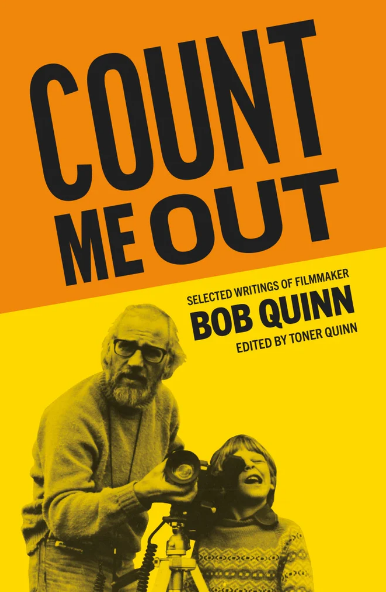
Bob Quinn, edited by Toner Quinn
Boluisce Press, 2025. 224 pages.
ISBN: 9781739577421 (Hardcover)
This collection of writings from Bob Quinn, edited and introduced by his son, Toner Quinn, attempts to encapsulate the life, work, and philosophical outlook of the singular filmmaker and producer behind Cinegael over the course of his life since his acrimonious departure from RTÉ in 1969.
The book’s structure is not strictly chronological, though it does open with Quinn’s exiting RTÉ in 1969 as a sort of “beginning” and end on a recent speech delivered while accepting an honorary doctorate at NUIG in 2022. Instead, it is divided into four sections – the first, “Conamara Revolution”, deals with Quinn’s thoughts on RTÉ, which he rather disdainfully dubs “The Factory”, and on public service broadcasting and the Irish media industry more broadly, as well as his developing thinking on sociological issues. This is perhaps the section that best outlines Quinn’s “manifesto”, if he could be said to have one. The decision to open the book on Quinn’s “Letter to RTÉ” – penned in protest following his exit in 1969 – sets the tone by emphasising his anti-establishment stance, but it also positions him as a prescient and incisive cultural commentator, particularly in light of the national broadcaster’s recent scandals. In this way, the book asks the reader to engage in a re-appraisal of Quinn, once supposedly criticised by his contemporaries as “naïve” (8), characterising him instead as an underdog whose thinking was ahead of his time. The book’s second part, “View from the Periphery”, deals primarily with his contributions to Film West in the years that followed the RTÉ affair, and is peppered with anecdotal accounts of one-off events such as Quinn’s unusual meeting with Colonel Gaddafi in Libya in 1988. The third part, “Maverick”, features an extract from Quinn’s 2001 book of the same name, published following his second untimely exit from RTÉ, this time following a stint on the RTÉ Authority, his appointment to which he credits to “the sense of humour of the minister responsible […] Michael D. Higgins” (155). It also includes a piece on the writer Desmond Fennell and a reflective piece on a Leonard Cohen gig that Quinn attended in Lissadell, County Sligo, in 2010. The last part of the book, “Final Thoughts”, contains two short, recent pieces, including Quinn’s musings on death, and the aforementioned NUIG speech which closes the book.
One possible criticism that could be levelled against the book is that it is not entirely clear why the collection is presented in this way; for example, included amongst Quinn’s non-fiction Film West contributions on the state of the Irish film industry is a two-chapter excerpt from his fictionalised memoir Smokey Hollow. Although it makes for consistently interesting reading, and Quinn is a witty and engaging narrator, it is possible that the sheer array of material here might dilute what is essential across his writing over the years. Existing reviews have arguably disproportionately praised the anecdotal aspects of this collection. In the Irish Times, Kevin Rafter skims over the idea that “[Quinn’s] views still deserve serious consideration”, opting to focus instead on his assertion that “the real nuggets are in the personal stories” (2025). There is no doubt that Quinn is an entertaining storyteller, but to reduce this collection of his thoughts and ideas to its capacity to entertain seems somewhat like a failure to grasp the point.
In his introductory chapter, Toner Quinn alludes to the significance of his father’s outlook on life and work, referring to their shared Gramscian philosophy that “while ultimately doing anything about anything may be futile, you have to be doing something” (10). One could be forgiven for reading this as tongue-in-cheek considering the sheer extent of Quinn’s activities in the seven decades covered in the collection, although it is perhaps more reflective of his ability to, in his own words, “hold six contradictions in [his] head at the one time” (213). It is this contradictory nature, this oppositional weighing of pessimism of the intellect versus optimism of spirit, that seems to be at the heart of the collection. Quinn claims, for example, to be “an apolitical animal” (18), and although he acknowledges that he accepted a financial contribution from Sinn Féin to make Caoineadh Airt Uí Laoire (1975), he insists that he was surprised by the response to the film (it has still never been shown on RTÉ). But Quinn’s refusal, his belligerent request to be “counted out”, is an inherently political act.
A great number of the pieces chosen for inclusion in this collection are concerned with public service media. Quinn’s move to Connemara in 1970 served to further the ideological, as well as the physical, distance from RTÉ. Seeing that popular media outlets, including Radió na Gaeltachta, were failing to serve those native Irish speakers living in the real Gaeltacht, he dedicated himself to raising the profile of the region. Through his contributions to Film West, he petitioned for better Irish language media, including a channel aimed at children (“Teilifís 1994”) and some of his strongest language emerges when criticising the national broadcaster’s perceived failure to fulfil its obligation to educate the population. Recalling that he once spent a week in hospital with only Radió and Teilifís Éireann to occupy the time, Quinn notes that he did not feel frustrated but, worse still, “massaged by the mindless mediocrity of it all” (32). Echoing certain contemporary arguments made by politicians in the UK parliament relating to the commercialisation of broadcasting, Quinn expresses the fear that “if it is entertaining, the worst canned rubbish or the most insidious commercial will educate and form the mind of the viewer” (29), with those in marginalised and lower income groups the most vulnerable. Quinn’s concerns relating to the treatment of the population as mere passive consumers remain pertinent as we navigate the newer and more complex territory of internet and AI regulation and policy. It is possible that he was being facetious when he described himself as “apolitical”, but there is a real risk that what is raw and confronting within this collection may be flattened by focusing solely on its most amusing anecdotes. If, as Quinn argues, “everything that entertains, educates” (29), then perhaps there is scope for both.
Works Cited
Rafter, Kevin (2025). “Count Me Out by Bob Quinn: The Real Nuggets Are in the Personal Stories of this Important Filmmaker.” Irish Times (March 15).


