
 by
Noelia Carmona Rivero.
This text may be archived and redistributed both in electronic
form and in hard copy, provided that the author and journal are
properly cited and no fee is charged for access.
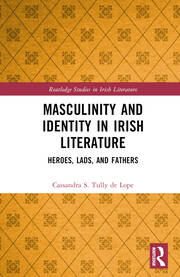
Cassandra Tully de Lope
New York: Routledge, 2024. 171 pages.
ISBN: 978-1-032-39319-3
The volume Masculinity and Identity in Irish Literature is the result of Cassandra Tully de Lope’s research, using corpus tools, on the representation of Irish masculinities in fiction written by male Irish authors. Providing insightful explanations of both the theoretical framework and the digital tools used to approach the analysed texts, the study serves as a splendid guide to anyone pursuing studies on masculinities in the Irish context or interested in the use and application of digital humanities on literary texts. The book is composed of nine chapters in which the scholar tackles different questions regarding Irish masculinities, identity, and language; all of which are analysed through the use of digital software.
In the introductory chapter, Tully de Lope begins her work by introducing the Celt warrior and hero as one of the main foci of the book’s analysis. Although this traditional archetype will be largely swept away by the impact of the so-called Celtic Tiger, there remains a prevalence of Irish mythology in the construction of contemporary Irish masculinity. This has led Irish men towards a sense of unfulfillment regarding the heroic unachievable ideals of their own gender identity. The scholar explains that she will use corpus studies to bring forth questions of masculinity embedded in the characters’ language, which will place identity as a key element for analysis. The aim is not to explain male behaviour but to emphasise how these identities are ingrained in literary characters. This first chapter finishes with a helpful list of terminology to aid the reader in the navigation of the volume.
Chapter 2 contains the framework necessary to approach questions of Irish identity and masculinity within literature, beginning with key concepts such as language. To open the language section, Tully de Lope uses Lakoff’s pioneering work on the relationship between language and gender, which established a differentiation between “women’s register” and “neutral language”, which is closer to male language, making an act as basic as communication a heavily gendered one. Language also creates and establishes a certain hierarchy amongst peers, since acts such as interruption show power plays and displays. The scholar then moves on to analyse the use of language in fiction, it being one of the most important strategies, especially in the novelistic genre, to construct identity. Regarding Irish literature, it is necessary to pay attention, if present, to the use of Irish English in the text and the way it is used for representation.
The fourth section is the longest in this chapter, dealing with aspects specific to Irish masculinity and placing the roots of the Irish male ideal in colonial Ireland and early 20th century narratives. The author explains how Irish literature helped further mark the gendered dichotomy between the colony and the coloniser, and then between the rural and the urban landscapes of the country, making it so that historical identities in Ireland are highly polarised. She then goes on to explain some of the most common male archetypes in Irish literature, namely the hero or soldier, the “lads”, the father, and the son. The conclusion of the chapter makes it clear that what unites all these performances is language, and as such, language will be the key concept in this volume.
The next chapter serves as an introduction to the framework used for the investigation in this volume; summarising the different methodologies existing in digital humanities and how they can be applied together in a textual analysis. It is worth noting how the researcher defends that, even though digital tools can greatly add to literary research, it is ultimately humans who analyse the selected texts. Through the use of such tools, Tully de Lope focuses specifically on terms of address, speech acts, and body language. This leads us directly to chapter 4, in which the scholar explains her corpus of study, the Corpus of Male Irish Writers (from now on, CMIW), which she compiled for this work. It is composed of 18 novels by male Irish authors, written between 1950 and 2018. This chapter ultimately provides an insight into each of the novels and the different male archetypes found in them in order to provide a solid background for the consequent analysis.
Chapter 5 offers the reader an introduction to her preferred software for corpus analysis, the one that is used throughout the volume, which is Sketch Engine. Main tools in the software such as wordlists or keyword searches are explained, as well as N-grams or clusters, which are of use in the analysis of body language. One of the most interesting tools for Tully de Lope is that of word sketches, which she uses for preliminary queries. Having briefly explained its usage, the scholar displays the initial results that appear in word sketches of terms such as “man” or “hero”, and the collocates that go with them. Regarding the use of collocations, the researcher is mainly interested in “frequent combinations of words that are related to how male characters address, describe, and see each other and themselves” (83). The information gleaned from the searches is reflected in the following chapters, each dealing with specific queries that provide a greater insight into the characters’ use of language.
Following McCarthy and O’Keeffe 2003’s division of vocatives into six types (relational, topic, badinage, mitigator, turn, and summons), chapter 6 is concerned with the analysis of male vocatives and how they represent male hierarchy. The results of the search for male vocatives in the CMIW showed there were 1149 instances of relational ones, out of which the “establishment of a conversation, greetings, and compliments [were] the most common” (91). Interestingly enough, the results showed that interruptions and addressee identifications were more prevalent in fictional dialogue than in real conversation. Tully de Lope analyses proper names, nicknames, male nouns, insults, and endearments individually, coming to general conclusions about their different uses. Most of them are shown to work as mitigators, with terms belonging to the male noun category – such as “boy”, “man”, or “lad” – unsurprisingly coming up in high numbers while terms of endearment, usually associated with women, remained the least frequently used.
The following chapter is focused on the use of adverbs and verbs of speech; therefore, the section is concerned with the classification of verbs of speech that were found in the CMIW. Using Lakoff’s theory on dominance in conversation and other gender views of language, the scholar develops a model merging previously existing theories to review the power struggles that take place in conversation (102). The chapter is divided into different subsections dealing with one pronoun usage each, namely “he”, “you”, “I”, and proper names, accompanied by one verb of speech and an adverb. The analysis shows how verbs of speech and adverbs “add to a process of characterisation that is not solely based on narrative description but on how male characters express themselves in direct conversation” (141). The findings ultimately show that neutral verbs such as “say” are the most frequently used, while several adverbs with aggressive connotations can be found in the male characters’ direct utterances.
The last chapter deals with the examination of body language and how it directly connects with different performances of masculinity. Such analysis is especially relevant since most performances of masculinity are marked by an emphasis on the body and physical culture in general (145). Therefore, the main focus of this chapter is to review the representation of male characters’ body language through the use of certain verbs of movement. Specifically, the author chooses to focus on those relating to eyes, mouth, hands, face, head, and body. Some interesting results showed that acts such as blushing were often diminished or hidden, since showing emotions is considered an act of weakness for men (150), or how male characters had to justify having tears in their eyes (152). All in all, the analysed clusters show that, contrary to what could be expected, “male characters do not resort to violent outbreaks naturally […] despite the aggressiveness that could appear in certain tense moments or through their language” (158), but that most of the verbs regarding the use of body parts were linked to showing homosocial camaraderie through the act of touching.
In the concluding chapter, Tully de Lope justifies the relevance and contribution of the volume to the fields of literary and linguistic research, summarising the important findings that were analysed throughout the different chapters and defending the use of interdisciplinarity in research of this kind. Moreover, she offers interesting possible paths for future investigations, such as expanding the corpus to include a wider variety of male identities or creating a corpus of female writers dealing with male characters.
In sum, Masculinity and Identity in Irish Literature: Heroes, Lads, and Fathers is a wonderful exploration of the use of language in fiction and the multiple ways in which it can define gender performativity. Through the analysis of different speech acts and terms, Tully de Lope develops a solid analysis of the representation of male characters in Irish fiction, which undoubtedly enriches our understanding of masculinities within Irish Studies and testifies to the increasing relevance of studies of this kind that the field is experiencing in recent years. All in all, the volume is a highly recommendable read for anyone interested in both the topics and the approaches it contains, whether previously familiar with them or not.
Works Cited
Lakoff, R.T. (2004). Language and the Woman’s Place: Text and Commentaries. Oxford University Press.
McCarthy, M. J., & O’Keeffe, A. (2003) “‘What’s in a Name?’: Vocatives in Casual Conversations and Radio Phone-in Calls.” Language and Computers 46: 153-166.


