
 by
José M. Yebra.
This text may be archived and redistributed both in electronic
form and in hard copy, provided that the author and journal are
properly cited and no fee is charged for access.
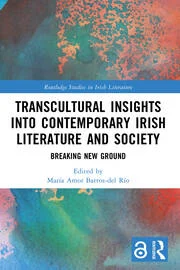
Edited by María Amor Barros-Del Río
New York: Routledge: 2024, 196 pages.
ISBN: 97-81-032549-72-9
Transculturality is a major concern in current literary and cultural studies. The complexity of Irish history ‒ from an isolated island under British rule to a melting pot of nationalities and traditions ‒ explains why Ireland is especially appropriate for transcultural analysis in the early twenty-first century; hence, María Amor Barros-Del Río’s edited volume is particularly timely in its insightful and engaging exploration of the representation and effects of transculturality in the country. The book is challenging and comprehensive, exploring key aspects of Irish transculturality, namely globalisation, change, diaspora, and, very especially, the tensions between uniformity and diversity. The result is, as Barros-Del Río points out, “the first collective work entirely devoted to approaching Irish literature through a transcultural lens” (xix).
The collection includes a total of ten articles, an introduction by the editor, and a coda. Barros-Del Río opens with an illuminating and thorough overview of the main characteristics of transculturality and how it applies to the fluctuating history of Ireland. This mostly theoretical introduction contrasts with Gerry Smyth’s more experiential discourse in the coda. Barros-Del Río’s framework is necessary to understand and structure the selected articles. Smyth recalls his experiences to explain the present and foresee the future of Ireland and analyse the complexity of what Irishness entails. This contrast between the introduction and the coda works perfectly well, giving the collection a balanced feel. The ten articles explore the multifarious forms in which literature has responded to the anxieties Ireland has undergone in the last century to come to terms with rapid changes in the postcolonial era and, more specifically, at the turn of the millennium. They approach the evolution of Irish society and culture from different angles, which make an all-inclusive close reading of the country. Nonetheless, the main idea, which permeates the different contributions, is the role of literature as an agent of change.
The first section of the collection, “Texts that Blur Frontiers. The Island of Ireland and Beyond”, addresses the liminality of frontiers when it comes to literature. In fact, borders become contact zones when texts dialogue with each other. These transcultural conversations break national as well as temporal boundaries, as the three articles of the section prove. In the first one, Mariana Bolfarine explores transculturality in and through James Joyce and Roger Casement, two Irish classics of the first half of the twentieth century. Their dissimilar lives and careers serve Bolfarine to analyse the different paths of Irish transculturality. Yet, the article particularly focuses on the haunting presence of Casement in Joyce’s “Cyclops” episode. In this way, the critic attempts to prove the transness of time and space, the national and the international in these two literary icons. The second and third articles focus on the transcultural links between poetry in Ireland and Eastern European countries, namely Romania and Russia. Shannon Kuta Kelly highlights the role of censorship in two poets, Irish Ciaran Carson and Romanian Marin Sorescu. Kuta Kelly connects both artists and their poetic traditions arguing the two countries are peripheral and have experienced synchronic crises: the Troubles in Ireland and Nicolae Ceaușescu’s dictatorship in Romania. Although the connections may seem far-fetched, her close reading of both poets is compelling and proves how poetry becomes a contact-zone to challenge two regimes that rely on censorship and silence. Stephanie Schwerter delves into translation of (Russian Soviet) poetry to revise transculturality and hybridisation. As happens with Ciaran Carson and Marin Sorescu, Seán Dunne’s translations help him to deal with the Irish Troubles and break the cultural barriers between Ireland and Soviet Russia and those between “own” and “foreign” in Wolfgang Welsch’s theories (1999, 2001).
The second section of the volume examines entanglement as a key feature of transcultural writers. It may seem problematic to label authors as transcultural when Abu- Er- Rub et al. argue that “entanglement, exchange, porosity and hybridisation have always been an instrumental part of the ongoing definition and development of cultures” (2019: xxvi). However, the three articles of this part of the collection prove the special incidence of transculturality in current Irish literature. In “Social Borders and Contact Zones in Leland Bardwell’s Different Kinds of Love”, Burcu Gülüm Tekin focuses on some of Bardwell’s short stories. As Tekin demonstrates, these texts bear witness to the complexity of Ireland nowadays. The article especially points to the tensions that emerge at the margins of Irish culture and society. In other words, the chapter sheds light on the socio-cultural implications of otherness and transgression and how they model new conceptions of identity which break with prior paradigms of Irishness in Bardwell’s short stories. Melania Terrazas and María Amor Barros-del Río examine Evelyn Conlon’s fiction, paying attention to transcultural issues like mobility and the tensions between the global and the local. In this way, both critics explore how Conlon probes the limits between centre and periphery. Thus, change, constant displacements and the agency granted to women in the diaspora are elements that constitute the basis of Conlon’s transcultural writing. David M. Clark also approaches Irish complex transculturality, in this case through Ken Bruen’s crime fiction. Both Bruen and his fiction partake of aspects like cosmopolitanism, mobility and hybridity, all of them part of “the transcultural playground – or battleground – which is modern-day Ireland” (102). Clark’s analysis is insightful. However, why crime fiction constitutes a suitable breeding ground for transcultural Ireland could be further explained.
The third section, just before the coda, explores the connection between current Irish literature and the social complexity of the country. In the last decades, Ireland has contested its traditional representation(s), beliefs and assumptions. Referendums dealing with issues like abortion, gender identity and sexual orientation have turned the country upside down. Ireland can no longer be considered a monolithic territory with a restricted conception of itself in terms of culture, traditions, race and, especially, religion. However, at the turn of the millennium, with the coming of new generation, transculturality has recast former ideas and realities. The four chapters of this part respond to these topics and new socio-cultural sensibilities.
Iria Seijas-Pérez aptly examines the representation of teenage pregnancy and abortion in transcultural young adult literature in Ireland. In a networked world where Ireland is culturally and economically indebted to the USA, it is no wonder that American anti-abortion lobbies and discourses have made an impact on the abortion debates in the island. Seijas-Pérez’s main argument is that, despite American influence, current Irish young adult novels like Claire Hennessy’s Like Other Girls and Moïra Fowley-Doyle’s All the Bad Apples constitute a step forward in the genre. Both texts represent the transcultural move that challenges stereotypes and traditions in today’s Ireland. Margarita Estévez-Saá also deals with the legal reforms that have transformed the social landscape of the country. In the context of Brexit and a growing intolerance, Estévez-Saá argues that Irish writers like Donal Ryan and Oona Frawley (and Irish literature as a whole) are “intent on vindicating the need for a transcultural coexistence that involves negotiating both belonging and otherness” (136). In other words, literature has an ethical responsibility to encourage conviviality in difficult times.
Asier Altuna-García de Salazar’s reading of Susan Ryan’s The King of Lavender Square is as perceptive as necessary in approaching second-generation immigration in Ireland. The article is ambitious as it addresses a thorough theoretical framework, including Wolfgang Welsch’s distinctions between multiculturality and transculturality, Mary Louise Pratt’s “contact zones” and Monica Juneja’s “issues of processuality”. According to Altuna-García de Salazar, Ryan’s novel portrays at a micro-level the changes happening at a macro-level, namely the demise of a monolithic and stable understanding of cultures, nationalities and identities. The analysis proves that second-generation immigrants, places like Lavender Square, and even sport are valuable in the reformulation process of Irishness.
The last article before the coda, “Resistance and Activism in Queer and HIV/ AIDS Irish Theatre”, by J. Javier Torres-Fernández, is also necessary to understand often overlooked territories in Irish society, culture and literature. Theatre is often ignored, let alone the one produced by minorities and dealing with sexually-transmitted diseases. As Torres-Fernández points out, AIDS has been silenced and its victims have been neglected for decades worldwide. That is why literature has been crucial to voice them and their experiences. As Ireland only decriminalised homosexuality in 1993, theatre addressed queerness and HIV/AIDS later than in other countries. At the beginning, the disease was represented in pessimistic terms, but a new wave of playwrights is claiming for recognition through “a more political, testimonial, disrupting and transcultural” (172) discourse.
For all the above, Barros-Del Río’s edited collection is a reference book for those interested in new trends in Irish literature and culture. The introduction, the coda and the articles cover a wide range of texts, sensibilities, interests, topics and anxieties concerning tranculturality in Ireland. For years, the country was considered a peripheral territory under the shadow of the United Kingdom. However, as this volume has proved, it is much more than that. Ireland is no longer isolated as it partakes of the current transcultural paradigm and thus shares a sense of crisis, mobility, change, relationality and, also, of hope. This volume has proved how literature has been and is an agent of change and is, therefore, necessary to fully understand the transcultural turn of Ireland.
Acknowledgements
Research for this chapter was funded by the Spanish Ministry of Science and Innovation (MICINN) (code PID2021-124841NB-I00) and by the Government of Aragón and the European Social Fund (ESF) (code H03_23R).
Works Cited
Abu-Er-Rub, Laila, Christiane Brosius, Sebastian Meurer, Diamantis Panagiotopoulos and Susan Richter, eds. (2019). Engaging Transculturality. Concepts, Key Terms, Case Studies. Routledge.
Welsch, Wolfgang (2001). “Transculturality: The Changing Form of Cultures Today.” Filozofski vestnik 22 (2): 59–86.
______ (1999). “Transculturality: The Puzzling Form of Cultures Today.” Spaces of Culture: City, Nation, World 13 (7): 194–213.


