
 by
Burcu Gülüm Tekin.
This text may be archived and redistributed both in electronic
form and in hard copy, provided that the author and journal are
properly cited and no fee is charged for access.
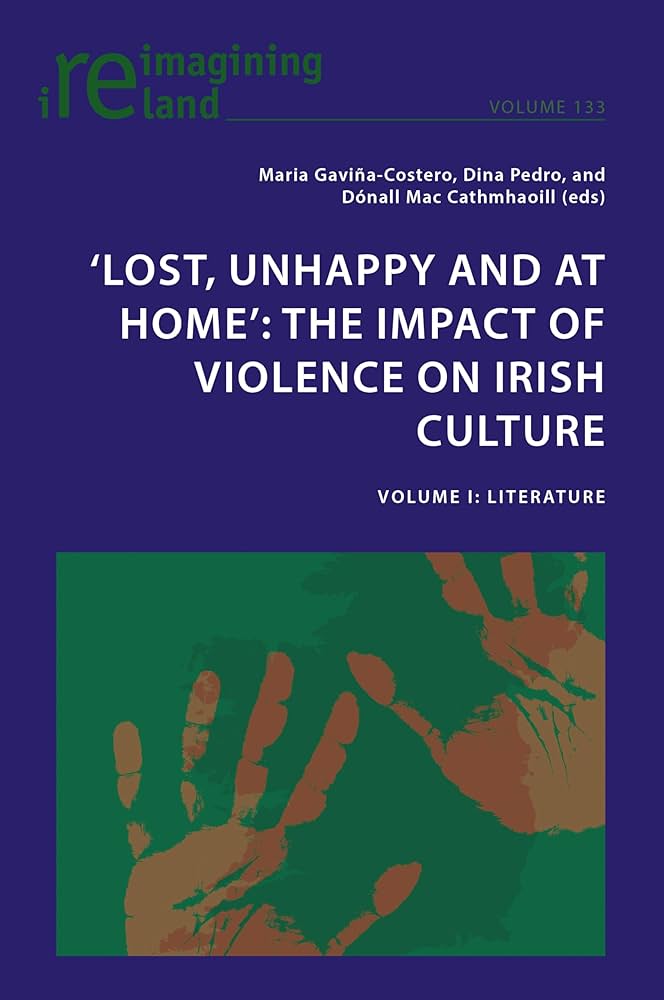
Edited by María Gaviña-Costero, Dina Pedro and Dónall Mac Cathmhaoill
Oxford: Peter Lang, 2024, X, 286 pages.
ISBN: 9781803743219
‘Lost, Unhappy and at Home’: The Impact of Violence on Irish Culture, edited by María Gaviña-Costero, Dina Pedro, and Dónall Mac Cathmhaoill, offers an expansive and multi-dimensional examination of how violence, in its various forms, has permeated Irish society, history, and culture. This volume, focused on an in-depth exploration of violence’s varied expressions and repercussions through the lens of narrative fiction, serves as a crucial contribution to the ongoing discourse on Irish literature and cultural studies, engaging with contemporary global issues, such as migration, gender-based violence, historical memory, and the socio-political impacts of Brexit, while also reflecting on Ireland’s historical struggles. The book is divided into three parts. The first focuses on violence on women, while the second expands the scope to trauma, and the third travels through borders focusing on the North. This organizational structure not only reflects the diversity of forms in which violence is represented but also mirrors the range of ways in which Irish writers have historically used these forms to address complex and often silenced social issues. Throughout the fifteen contributions, there is a consistent thematic focus on the repercussions of violence, both personal and collective, and how these forms are used as mediums of resistance and recovery.
Gaviña-Costero introduces the volume arguing that “the arts, and literature in particular, with its role as a mirror of the profound truth of a community, in its past, present and even desirable future, can aspire to mediate between society and its trauma” (2024, 5). From this standpoint, the chapters that follow call for a revision of the ethics in research. More precisely, literary and cultural research, and the ways in which advocacy against violence can be fostered through such works. Opening the first part of the volume, dedicated to gender violence, Charlie Jorge’s analysis of Fatal Revenge (1807) by Charles Maturin opens the discussion with a focus on the archetype of the terrible mother as exemplified by Countess Montorio. Jorge suggests that Maturin’s portrayal of this character can be read as a reflection of Ireland’s own troubled historical moment, marked by the Act of Union and two violent rebellions. This reading connects the character’s destructive influence with the broader social upheavals in Ireland, suggesting that the female figure of violence, embodied by the Countess, is not only a personal but a national symbol of trauma. Jorge’s chapter serves as an important historical contextualization of the violence against women, laying the groundwork for subsequent chapters that further explore the intersection of colonialism and patriarchy in Irish society.
Virginie Roche-Tiengo’s examination of Brian Friel’s portrayal of women in plays such as Dancing at Lughnasa (1990) and The Freedom of the City (1974), among others, adds another layer to this discussion. Roche-Tiengo explores the ways in which Friel’s characters navigate a complex network of colonial and patriarchal oppression. Friel’s work is positioned within a broader literary tradition of Irish women being subjected to confinement, both domestic and institutional. Roche-Tiengo argues that these confinements are not merely expressions of physical restraint but also metaphors for the repressive cultural conditions in which Irish women were forced to live. The suffocating environments depicted in Friel’s plays are framed as fertile grounds for creative energy and, in some cases, rebellion, marking a key moment in the history of Irish women’s literary representation.
The chapter by Madalina Armie on Donal Ryan’s All We Shall Know (2016) offers a contemporary examination of violence, trauma, and marginalization. Through the figure of Melody Shee, an Irish female antihero, Ryan’s novel critiques the divisions between settled communities and the Irish Travellers, highlighting the violence of inequality and social exclusion. Armie’s reading situates Ryan’s poetic language within a postcolonial framework, emphasizing how issues of diversity and otherness are crucial to understanding the traces of violence embedded in Irish social dynamics. This chapter bridges the gap between the colonial past and the persistent forms of violence that continue to shape contemporary Irish identity.
David Clark’s contribution focuses on Irish crime fiction, specifically Louise O’Neill’s After the Silence (2020), a novel that deals with coercive violence in domestic spaces. Clark applies the concept of domestic noir to this genre, exploring how coercive control precedes physical violence and how it operates in the domestic sphere. His analysis is instrumental in unpacking the ways in which Irish crime novels have turned to gender-based violence, particularly within intimate relationships, as a thematic core. Clark’s work reveals how literature can serve as both a reflection of social issues and a vehicle for social critique, offering a nuanced perspective on how violence operates within the private sphere.
Concluding the part of the volume focused on gender-based violence, the examination of the Magdalene Laundries in the chapter by Marta Martín Amor brings the reader face-to-face with institutional violence in Ireland. Through a focused analysis of Claire Keegan’s novella Small Things Like These (2021), Martín Amor situates the Magdalene Laundries within a broader narrative of trauma and social neglect. The chapter emphasizes the passive role of Irish society in perpetuating these institutions and critiques the complicity of the Catholic Church in maintaining these spaces of oppression. Martín Amor’s reading illustrates how violence in these institutions was not only physical but also psychological, reflecting the broader cultural and social mechanisms that enabled such practices to persist for decades.
The second section of the volume, specifically devoted to trauma, opens with Elisa Lima Abrantes’s chapter on Sebastian Barry’s Days Without End (2016) tackling the difficult subject of Irish participation in the Indian Wars and its implications for Irish memory. By positioning the Irish protagonists as both victims and perpetrators, Abrantes demonstrates how these figures occupy a morally ambiguous space, embodying Primo Levi’s concept of the grey zone. This exploration of complicity and trauma is critical in understanding how the Irish narrative surrounding victimhood is complicated by the history of colonial violence. The trauma of Irish soldiers is depicted not only as a personal crisis but as a national reckoning with Ireland’s own colonial history.
Elena Cotta Ramusino’s exploration of Hugo Hamilton’s The Pages (2021) similarly engages with the cyclical nature of trauma. Hamilton’s work reveals the inability of historical progress to break the chain of violence, as characters struggle with the weight of unresolved pasts and the recurrence of violence across generations. Ramusino’s chapter presents the novel as a reflection of the failure of collective memory to prevent the repetition of violent histories, which resonates with larger discussions of how societies fail to learn from past atrocities.
Giovanna Tallone’s analysis of Mary O’Donnell’s Empire (2018) brings the theme of violence into the historical context of WWI and the Easter Rising. O’Donnell’s short story cycle is framed as an exploration of both external and internal violence exemplified by physical conflict and the psychological toll of oppression. Tallone argues that O’Donnell’s use of violence serves as a metaphor for the long-term scars left on Ireland by its colonial history, drawing a direct line between past struggles and contemporary issues of identity and resistance.
Angela Vaupel-Schwittay’s study of John Banville’s April in Spain (2021) extends the conversation beyond the Irish context to include international trauma. By exploring Banville’s crime fiction set against the backdrop of the Spanish Civil War and WWII, Vaupel-Schwittay argues that Banville links Irish trauma to broader European histories of violence and conflict. The chapter positions Banville’s exploration of personal and collective trauma within the larger framework of European historical memory, demonstrating how the legacies of war and violence continue to shape contemporary narratives of suffering and resilience.
Maria Butler’s analysis of Marian Keyes’s Last Chance Saloon (1999) closes part two by providing an insightful reading of popular fiction’s role in addressing the AIDS epidemic and its impact on Irish perceptions of homosexuality. Butler’s application of Sara Ahmed’s concept of stickiness reveals the ways in which associations of disease with homosexuality contributed to the marginalization of LGBTIQA+ communities during the 1980s and 1990s. Butler argues that Keyes’s work, often classified as commercial fiction, emerges as a powerful vehicle for addressing the social stigma surrounding AIDS and homosexuality, challenging the negative stereotypes of the era and contributing to the disruption of such associations.
The final section of the book focuses on the Northern Irish conflict, often referred to as the Troubles. Esther de la Peña’s chapter on Bernard MacLaverty and Wendy Erskine examines how short stories set in Belfast reconstruct the traumatic experiences of violence and social transformation during this period. The stories selected by de la Peña are emblematic of the ways in which literature has been used to represent the emotional and psychological aftermath of conflict. De la Peña’s analysis suggests that these narratives offer important insights into the resilience of communities facing profound social shifts.
Maria Gaviña-Costero’s comparative study of the Ardoyne Commemoration Project and Anna Burns’s novels explores the historiographical challenges of representing violence in Northern Ireland. Gaviña-Costero highlights the role of literature in filling the gaps left by official histories, particularly in terms of gendered violence during the Troubles. Her work stresses the importance of memorializing the experiences of women, who were often silenced or overlooked in the official narratives of the conflict. Also considering the works of Anna Burns in her analysis, Galyna Hartischyn’s chapter examines the trauma and post-conflict uncertainty in Seamus Deane’s Reading in the Dark (1996) and Milkman (2018), by Burns. Hartischyn offers a powerful critique of the peace process in Northern Ireland. Through a detailed analysis of the two novels, Hartischyn explores how these authors capture the unresolved traumas of the past and the ongoing uncertainty about the future. She argues that these works highlight the failure of peace processes to fully address the emotional and psychological legacies of violence.
Marisol Morales-Ladrón’s chapter pays special attention to Jan Carson’s novels Malcolm Orange Disappears (2014) and The Fire Starters (2019) examining them in the context of magical realism as a means of dealing with unresolved violence in Northern Ireland. Morales-Ladrón’s work on Carson demonstrates how magical realism serves as a vehicle for representing the psychological dimensions of post-conflict trauma.
The concluding chapter, by Hedwig Schwall, is focused on three short stories from Rosemary Jenkinson’s collection Love in the Time of Chaos (2023), all set in Belfast. Central to Schwall’s analysis is Judith Butler’s concept of vulnerability, which permeates through all the stories. Schwall stresses the ways in which memoirs can help in reshaping identity, integrating Paul Schilder’s theory of body image and Merleau-Ponty’s notion of the flesh to reveal the interconnection of mental, emotional, and physical experiences. Focusing on the male protagonists of Jenkinson’s stories, affected by Northern Ireland’s paramilitary violence, Schwall explores how they confront trauma, silence, and fractured memory concluding that while memoirs offer a clear pathway to address trauma, bodily representations also provide a helpful way to express traumatic experiences.
‘Lost, Unhappy and at Home’: The Impact of Violence on Irish Culture, and more precisely Volume I: Literature, offers a crucial exploration of violence in contemporary Irish literature and culture, with a particular emphasis on its intersection with historical memory, trauma, and resistance. Through a careful analysis of the thematic concerns across different contexts within fiction, the volume demonstrates that violence, whether political, gendered, or historical, is not a detached event but an ongoing process that shapes individual and collective identity. The works analyzed in this collection by its contributors offer not just reflections on trauma but also responses to it, emphasizing the role of literature as a means of both healing and resistance. This collection is invaluable for anyone seeking to understand the long-lasting effects of violence on Irish society and how Irish writers have used their craft to confront, critique, and resist the forces of oppression.
Works Cited
Gaviña-Costero, María, Dina Pedro and Dónall Mac Cathmhaoill. eds. (2024). ‘Lost, Unhappy and at Home’: The Impact of Violence on Irish Culture. Volume I: Literature. Oxford: Peter Lang.


