
 by
Lydia Freire Gargamala.
This text may be archived and redistributed both in electronic
form and in hard copy, provided that the author and journal are
properly cited and no fee is charged for access.
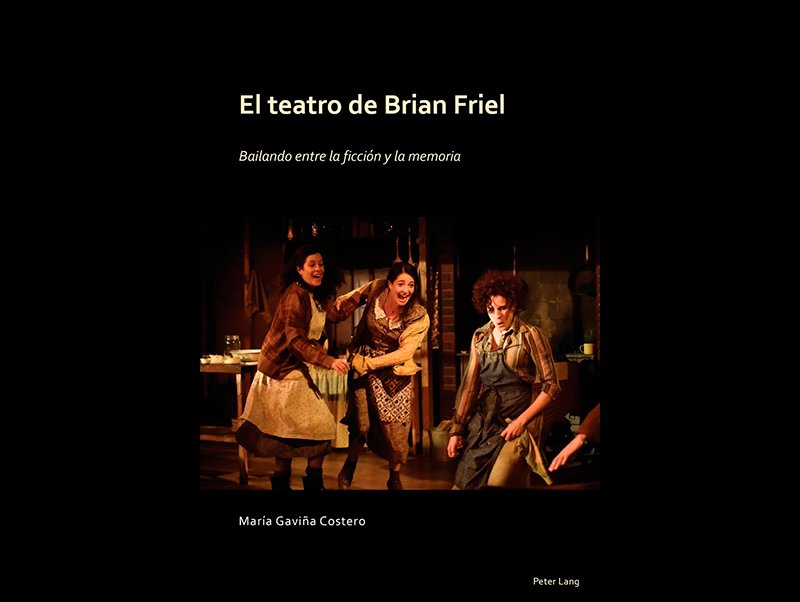
María Gaviña Costero
Oxford: Peter Lang, 2025, 236 pp.
ISBN: 9781803744650
María Gaviña Costero’s El teatro de Brian Friel: bailando entre la ficción y la memoria is an ambitious study that offers Spanish-language readers a wide-ranging, systematically organised account of Brian Friel’s dramatic production, presented through a chronological framework that doubles as an interpretive proposal. Published by Peter Lang in 2025, this volume is anchored in a sustained interest in how Friel’s theatre stages the fluctuating interplay between lived experience, memory, and articulated “truth”, and it consistently revisits the notion that remembering is not the retrieval of a fixed archive but an act of (re)compostion with aesthetic, ethical, and political ramifications.
Following an insightful introduction, the volume advances through five chronological segments – 1964-1970, 1971-1979, 1980-1989, 1990-1999, and 2000-2015 – culminating in a concluding synthesis and a bibliography. The table of contents thus signals a progression that is not only chronological but also decisively interpretive: the early plays (1964-1970) give way to the entry of conflict into the dramatic field (1971-1979), the Field Day decade (1980-1989), the 1990s framed explicitly through the rubric that “the personal is political” (1990-1999), and the later work of the new millennium (2000-2015). This periodisation functions, then, as more than a practical organising device, constituting an argument about the interplay between dramaturgical invention, cultural history, and political contingency, particularly in relation to Northern Ireland. Each phase is subdivided into concentrated discussions of significant plays, enabling the study to combine comprehensive career mapping with detailed, play-specific analysis.
Within this periodised structure, one of the book’s most compelling contributions lies in its reading of Ballybeg as a dramaturgical microcosm that condenses Ireland’s historical, linguistic, and affective tensions within a single, recurring imaginative space. From Friel’s earliest plays onward, Gaviña Costero shows how this fictional territory operates as a narrative laboratory in which the pressures of exile, communicative fracture, and the shaping and instrumentalization of collective memory can be tested and dramatized. Her study demonstrates how these processes are rearranged across successive creative phases, and how Friel repeatedly juxtaposes divergent versions of the past in order to expose the fragility of dominant identity narratives. Situated within a postcolonial frame attentive to the Northern Irish conflict, this dialectic underscores both the political complexity of Friel’s theatre and its persistent capacity to question the stories through which communities explain, and contest, themselves.
In its treatment of Friel’s early theatre (1964-1970), the book analyses Friel’s formative dramatic period as a phase of sustained experimentation in which the playwright begins to develop the thematic and formal concerns that will shape his subsequent work. Instead of viewing the early plays as tentative or merely preparatory, Gaviña Costero interprets them as a cohesive body of work organized around themes of emigration, fractured family relationships, and the difficulty of articulating affect within restrictive social frameworks. The chapter opens with a comprehensive analysis of Philadelphia, Here I Come! (1964) and then extends its scope to The Loves of Cass McGuire (1966), Lovers: Winners and Losers (1967), Crystal and Fox (1968) and The Maundy Scheme (1969), illustrating how these plays repeatedly stage fractured forms of love, exile, and belonging. As the author observes, Friel’s early theatre is already marked by an interest in “the processes through which facts are transformed into fictions by memory”, (9, my translation) with particular attention to the social and political circumstances that condition those transformations. The chapter further emphasises Friel’s increasing departure from strict naturalism through devices such as character doubling, direct address, ritualised speech and musical or symbolic motifs, strategies that allow the theatre to externalise interior conflict and communicative failure. By contextualising these formal innovations within the social realities of 1960s Ireland – emigration, cultural stagnation, generational rupture, and emotional repression – the study convincingly illustrates that the dialectic between memory and fiction is already fully active in Friel’s early dramas, thereby justifying the chapter’s foundational role in the book’s overall interpretive trajectory.
Chapter 3 serves as one of the book’s key argumentative pivots, as Gaviña Costero illustrates how Friel’s 1970s dramaturgy solidifies a politics of representation focused on narrative authority, competing truths, and the social uses of memory. The chapter comprises six subsections – The Gentle Island (1971), The Freedom of the City (1973), Volunteers (1975), Living Quarters (1977) Aristocrats (1979), and Faith Healer (1979) – which are organised not as isolated readings but as a cumulative argument about the ways violence and conflict reconfigure what theatre can claim to know and how it can claim it. Across these plays, Gaviña Costero foregrounds how institutional discourse (mostly explicitly in The Freedom of the City), ideological structures (as framed through Volunteers), and family mythologies (crucial to Living Quarters and Aristocrats) operate as narrative systems that legitimise specific interpretations of the past while disqualifying others. The chapter’s final transition to Faith Healer is especially effective: by placing the artist’s voice and ethical stance at the centre of the analysis, the chapter suggests that Friel’s theatre exposes the violence embedded in public narratives while remaining attentive to the ethical responsibilities of artistic representation, a tension that carries forward into the Field Day decade and its intensified engagement with language, culture, and institutional intervention.
Chapter 4 examines Friel’s involvement in Field Day as a decisive institutional and artistic context that reshapes the scope and orientation of his dramaturgy during the 1980s. For Gaviña Costero, Field Day provides the framework through which Friel’s theatre engages more directly with questions of language, history, and cultural authority. The sections focused on Translations (1980), The Communication Cord (1982), and Making History (1988) present a thorough examination of the construction of national identity through naming, translation, commemoration, and historical narration. Across these plays, the study shows that linguistic mediation and historical rewriting function as sites of power, with direct consequences for how cultural preservation, tourism, and historiography are imagined and institutionalized. Situating these works within Field Day’s commitment to public cultural debate and its geographical location in Derry, the chapter foregrounds theatre as a form of civic intervention capable of engaging the symbolic dimensions of the Northern Irish conflict. Read together, the plays of this period demonstrate a shift in scale from familial and communal narratives towards explicitly national concerns, preparing the ground for the more introspective yet politically inflected works of the following decade.
Chapter 5 traces how Friel’s 1990s drama relocates political pressure into domestic, affective and embodied registers. The chapter opens by clarifying Friel’s changing relationship with Field Day and his growing unease with institutional frameworks that might constrain artistic freedom, an unease captured in his own remark that “institutions are inclined to enforce characteristics, impose an attitude or a voice or a response” (Coult 2003: 105, cited in Gaviña Costero 2025). From that point, the argument unfolds through four subchapters focused on Friel’s plays Dancing at Lughnasa (1990), Wonderful Tennessee (1993), Molly Sweeney (1994), and Give Me Your Answer, Do! (1997). Gaviña Costero interprets Dancing at Lughnasa through the lens of memory play, emphasizing the dominance of atmosphere and emotion over chronological sequence. She regards music and dance as integral devices that elucidate aspects of experience that conventional language cannot adequately encapsulate. With Wonderful Tennessee, the chapter transitions from remembrance to ritual: drawing upon Victor Turner’s anthropological theories, it interprets the pier as a liminal theatrical space and emphasizes storytelling, repetition, and musical motifs as means of consolation and the construction of meaning in a secular, late-century Irish context. In Molly Sweeney, the personal is overtly rendered political through the connection the chapter draws between patriarchal oppression and colonial ideology, interpreting the medical “restoration” narrative as a manifestation of coercive domination. Finally, Give Me Your Answer, Do! explores uncertainty as both an aesthetic and ethical issue: Gaviña Costero highlights how Friel dramatizes the assessment of artistic value amid academic and market pressures, and how the play’s linguistic patterns – particularly the repeated interrogative tags – represent a broader crisis of value, integrity, and self-awareness.
The next chapter addresses the final phase of Friel’s dramatic production by situating it within a context marked by institutional recognition, adaptation work, and the lingering pressures of an unresolved political past. Gaviña Costero regards this period as one of consolidation and introspection, in which previous concerns surrounding memory, homeland, and narrative authority are revisited through more restrained dramaturgical manifestations. This section primarily examines Performances (2003) and The Home Place (2005), analysing both plays as reflections on inheritance – cultural, familial, and historical – and on ethical responsibilities associated with acts of remembrance and artistic expression. In The Home Place, issues of land ownership, social hierarchy, and colonial legacy are explored through the enduring presence of social structures that transcend the political era in which they originated, while Performances is analysed through its interaction with music, biography, and memory as interconnected modes of interpretation. Across these readings, Gaviña Costero emphasises that the apparent simplicity of the late plays conceals a deep reflection on how the past persistently shapes present experiences, even within the context of post-agreement Northern Ireland. The chapter also documents the ongoing existence of violence and instability beyond the peace process, incorporating this understanding into its examination of how Friel’s late theatre addresses both continuity and change. By concluding the volume with this period, the study underscores its central thesis that Friel’s dramaturgy consistently focuses on the question of how narratives are constructed, inherited, and ethically sustained, even as historical immediacy yields to more subdued forms of reflection.
Overall, El teatro de Brian Friel: bailando entre la ficción y la memoria provides a thorough and clearly structured analysis of Brian Friel’s dramatic output from the early 1960s to the second decade of the twenty-first century. Organised chronologically and structured around a consistent critical framework, the volume integrates detailed analysis with historical and cultural contextualisation to examine the development of Friel’s dramaturgy across distinct creative periods. Throughout the study, Gaviña Costero foregrounds the dynamic relationship between fiction and memory as the central framework of Friel’s theatre, using this lens to connect formal experimentation, narrative techniques, and evolving political and social contexts. The book’s emphasis on dramaturgical structure, institutional frameworks, and the ethics of representation positions it as both a detailed reference work and a rigorous interpretive contribution within Irish Studies, particularly for a Spanish-speaking academic readership.
Works Cited
Coult, Tony. (2003). About Friel: The Playwright and the Work. London: Faber and Faber
Gaviña Costero, María. (2025). El teatro de Brian Friel: bailando entre la ficción y la memoria. Oxford: Peter Lang.


