
 by
Úna Kealy.
This text may be archived and redistributed both in electronic
form and in hard copy, provided that the author and journal are
properly cited and no fee is charged for access.
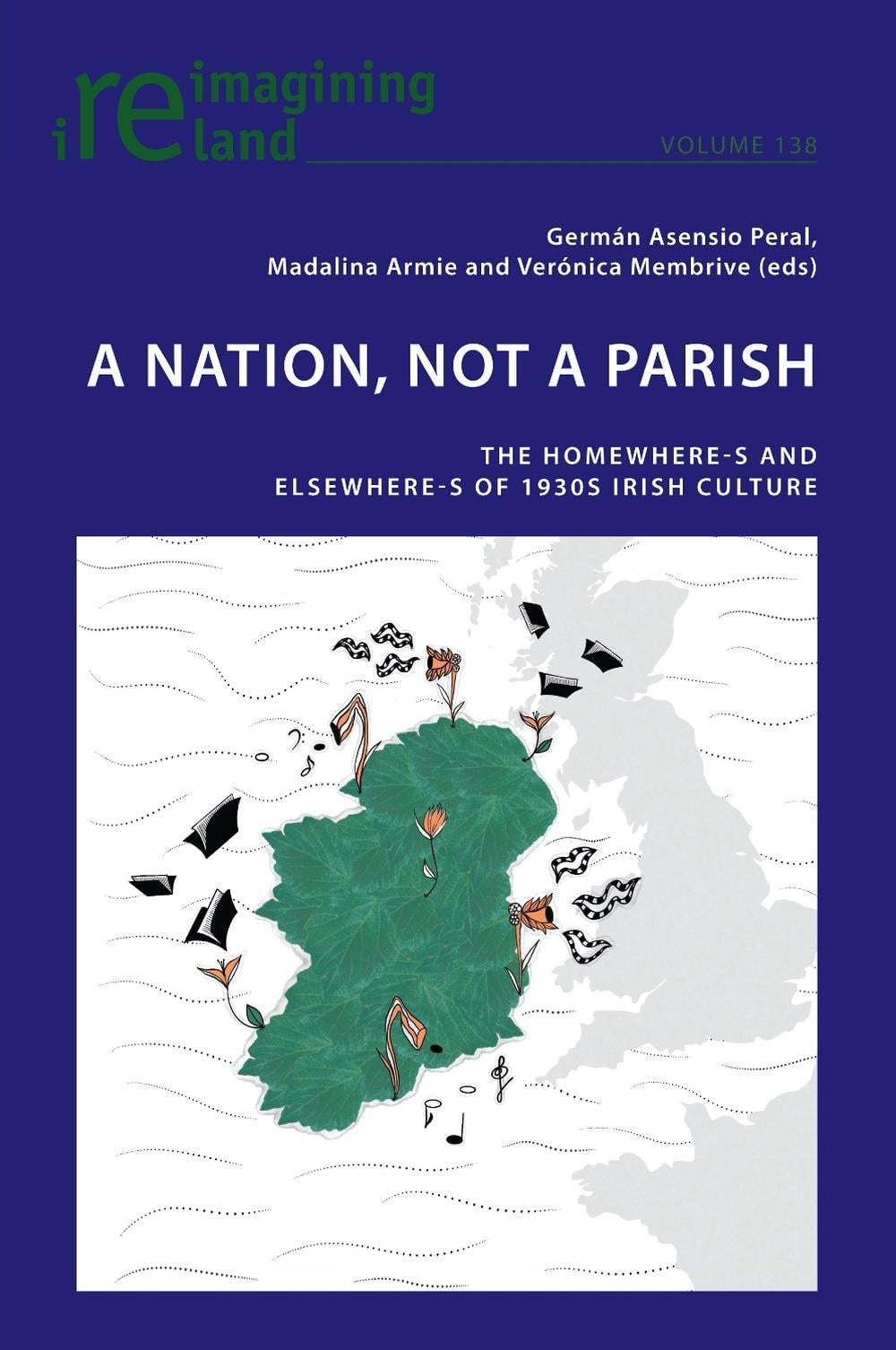
Edited by Madalina Armie, Verónica Membrive and Germán Peral.
Oxford: Peter Lang, 2025, XVI, 280 pp.
ISBN: 9781803748498.
A Nation Not a Parish: The Homewhere-s and Elsewhere-s of 1930s Irish Culture characterises the 1930s as a decade in which a dissident counterculture of Irish and Irish-based artists, intellectuals and activists responded to intersecting aspects of the Revival, Irish nationalism, republicanism, modernism, global depression, the rise of fascism and the outbreak of the Spanish Civil War. The milieu of 1930s Ireland is recreated through the careful curation of essays analysing literature, music, cinema, literary networks, novels in Irish translation, poetry, journalistic and political writing and travelogues created during that decade. Constituting a useful and original contribution to existing research into the trans and international dimensions of Irish politics, art and culture of the 1930s, editors Peral, Armie and Membrive have curated a volume that details the national and international cultural dynamics of 1930s Ireland. Arguing that Irish writing is unhelpfully divided into a traditional dichotomy of those who left and those who remained, the collection focuses on Irish life and culture within Ireland but also beyond its geographical borders functioning as a syncretism of analysis of economic, political, cultural and social events and discourse.
Each essay sits comfortably within the stated purpose of the collection which is eminently suited to researchers working within the field of Irish Studies, literature, music, cinema and Irish political history. Ruth Barton’s “‘A group of persons who regard themselves as ‘intellectuals’’: Cinema-going and Film Culture in Dublin of the 1930s” offers a succinct overview of the emerging Irish cinema scene in the 1930s. Providing a compact contextualising of film making and exhibition in Ireland during the 1930s, within a religious and political hierarchy that was inherently afraid of what it considered to be the morally corrupting influence of the artform, Barton profiles Mary Manning and Liam O’Leary’s involvement in the Dublin Film Society and the Dublin Film Club (DFC), usefully explaining the relationship between the DFC and the Dublin Little Theatre Guild. Barton briefly charts the reaction to the Little Theatre Guild’s screening of Sergi Eisenstein’s Battleship Potemkin in 1936 to exemplify a prevailing fear and opposition to Soviet cultural and political influence within mainstream Irish society during the decade. Her careful research, drawing on extensive archival references, adds colour and detail to an analysis that serves as an important reminder of how the contemporary Irish film industry owes so much to the dynamism and commitment those small film clubs and societies of the 1930s.
In “‘Wild Field to a Later Generation’: The Irish Women Writer’s Club and the Global Literary Marketplace”, Deirdre Brady adds valuable material to her existing research into the networks of women’s literary clubs in Ireland. Brady confidently argues that the radical, innovative and liberal attitudes of Irish women writers and social, cultural and political activists during the 1930s influenced the popularity of progressive ideas and thinking both within and outside of Ireland during the decade. Establishing and exploring the links between Irish and international feminist groups, Brady illustrates how interconnected and mutually supportive international and trans-national feminists created an “intellectual symbiosis” which allowed ideas, political movements and literature to merge and progress during that decade. Through critical case studies, illustrated through extensive archival research, Brady highlights the extent of the profile and activism of Hanna Sheehy Skeffington, Rosamond Jacob, Patricia Lynch and Ena Dargen.
Fiona Feron’s excellent essay, “Anti-facism and the Gothic in the Work of Dorothy Macardle (1935-53)”, reads Macardle’s The Seed Was Kind (1944) in relation to her journalistic work and her social and political activism. Constituting a valuable and original contribution to existing scholarly research, Feron’s essay contextualises Macardle’s early literary, journalistic and political work ahead of providing a detailed reading of The Seed Was Kind. The resulting analysis interweaves a fascinating commentary on the fragility of small nations during international conflict, the deprivations and trauma experienced by refugees – particularly women and children – and the collapse of moral certainties.
In “Blanaid Salkeld’s poetry of the 1930s: ‘peculiarity in and out of her time’” Grainne Condon identifies the multi-talented Salkeld as a poet who questioned gender roles and female agency. Considering Salkeld’s three poetry collections of the 1930s, Hello Eternity (1933), The Fox’s Covert (1935) and …the engine is left running (1937), Condon analyses Salkeld’s formal and thematic experimentation that critiques the impact of cultural nationalism and religious, social and political conservatism on Irish life and particularly upon Irish women’s lives. Condon cogently argues that Salkeld’s …the engine is left running offers a sophisticated critique of gender roles, inequality and the impact of modern technology on the nascent Free State and her analysis considering why Salkeld’s poetry remains outside Irish canonical boundaries is astute and instructive.
Gearóid Ó hAllmhuráin’s “The Sensual Moan of the Saxophone: The Soundscape of Irish Cosmopolitanism in the 1930s” provides a thorough, lively and engaging critique of the emergence and subsequent attempt to restrict and/or censor jazz music in Ireland. Ó hAllmhuráin creates a nuanced and detailed account of the impact of the draconian and often misapplied Public Dance Halls Act of 1935, which, he argues, became an instrument of moral control during the 1930s. As the 1930s progressed, Ó hAllmhuráin contends that the holiday homecomings of emigrants changed the soundscape and rhythms of popular Irish music and dance, creating a destabilising sonic cosmopolitanism and the eventual naturalisation of jazz within Ireland’s soundscape.
Katrina Goldstone contributes “Circles of Solidarity: Irish writers in transnational radical networks in the 1930s”, charting a fascinating analysis of the complex and multifarious networks and personal and political relationships forged within the socio-political climate and conditions of interwar London. Contributing original analysis of Irish Jewish writer, broadcaster and educator Leslie Daiken (1912-1964), poet Ewart Milne and activist and novelist Peadar O’Donnell, Gladstone illustrates, by excellent use of archival material, the connectedness of the literary and political milieus of Dublin and London. She catalogues in meticulous detail how resistance to tyranny was coordinated and sustained through literary magazines, transnational networks and aid committees creating intersecting mutually supportive communities. One such community included Daiken, Milne and O’Donnell and, inter alia: the Spanish Medical Aid Committee; The Irish Friends of the Spanish Republic Women’s Aid Committee; the International Coordination Committee for Aid to Republican Spain; the Irish Food Ship for Spain Committee and the Spanish Medical Aid Committee. Goldstone’s analysis of the writers and organisations involved evidences a dynamic transnational and international intellectual and political orientation that rejected the narrow cultural nationalism with which Irish writers of this decade are sometimes associated.
“The Rediscovery of Máirín Mitchell” by Martin Tyrell constitutes an excellent contribution to Irish studies providing, as it does, new biographical detail and analysis on Mitchell which contextualises her within contemporaneous literary and political networks. Because so little biographical information on Mitchell exists, any new biographical detail and analysis of her work is a significant contribution to extant research. Tyrell’s account of Mitchell’s early life, her identity reinvention and her assimilation into “a countercultural world of anarchist, feminists and maverick Irish nationalists” (Tyrell 2025: 178) allows for a detailed and nuanced analysis of her work exemplifying the approach taken by Mitchell in her analysis of Spanish culture and politics in Storm Over Spain (1937).
Alberto Lázaro creates a compelling case for reading Peadar O’Donnell’s Salud! An Irishman in Spain! to better appreciate 1930s Ireland. Lázaro analyses how Salud!, part memoir, part war reportage, reflects on the evolution of early twentieth century Irish life and culture through O’Donnell’s reportage on the Spanish Civil War and reveals how socialist politics provided O’Donnell with a lens to position the emergence of right-wing values, propaganda and political policy in Ireland within international politics and culture. Lázaro positions O’Donnell within a cohort of Irish writers and political activists that warned against Church-sponsored intimidation, anti-democratic political forces and the spread of misinformation and sensationalist media reportage in a chapter that often reads like analysis of current global politics and journalism.
Máirtín Coilfér’s essay, “Irish-Language Translation as Internationalism? Gilbert Parker’s The Right of Way and Séamus Ó Grianna as An Bealach Actuighthe in 1937”, argues cogently for the importance of translation as a process and as a genre within Irish language literature, contextualises the increase in Irish language translations during the 1930s, and charts the hyper-localisation of Irish-language texts such as Fiche Bliain ag Fás (1933) and Peig (1936) within Irish language literature. Constructing a valuable and well-articulated contextualisation of the international dimension of literature translated into the Irish language during the 1930s, Coilfér brings original analysis to bear on the imperialist ideology within Gilbert Parker’s The Right of Way (first published in 1901 and translated by Séamus Ó Grianna as An Bealach Achtuighthe in 1937) to reveal how acts of translation and/or cultural assimilation can act as insidiously destabilising influences within the cultures and literary corpuses into which they are transposed and assimilated.
Monica Paulis illuminates in “‘Tell me some secrets about Irishmen’: James Joyce and Italo Svevo, An International Friendship” how the friendship between Jewish Italian-Hungarian modernist writer Ettore Schmitz (Italo Svevo) and James Joyce influenced Joyce’s writing. Inclusion of extracts from letters from both Joyce and Schmitz and analysis of Triestino idiom provide a nuanced insight into how Joyce adopted and adapted language and dialectical content into his own work with such fluency and flair. Analysis of the literary preoccupations and practice of Schmitz support an informed reading of both writers’ work.
In summary, Irish cultural life, activism and politics emerge within the collection as animated and informed by Irish and Irish-based activists, artists and intellectuals whose writing, social criticism, politics and attitudes were influenced by the politics, writings, culture and rhythms they encountered globally. The collection provides essential reading for those interested in 1930s Ireland and its relationship with international events and political and ideological trends.


