
 by
Stephanie McBride.
This text may be archived and redistributed both in electronic
form and in hard copy, provided that the author and journal are
properly cited and no fee is charged for access.
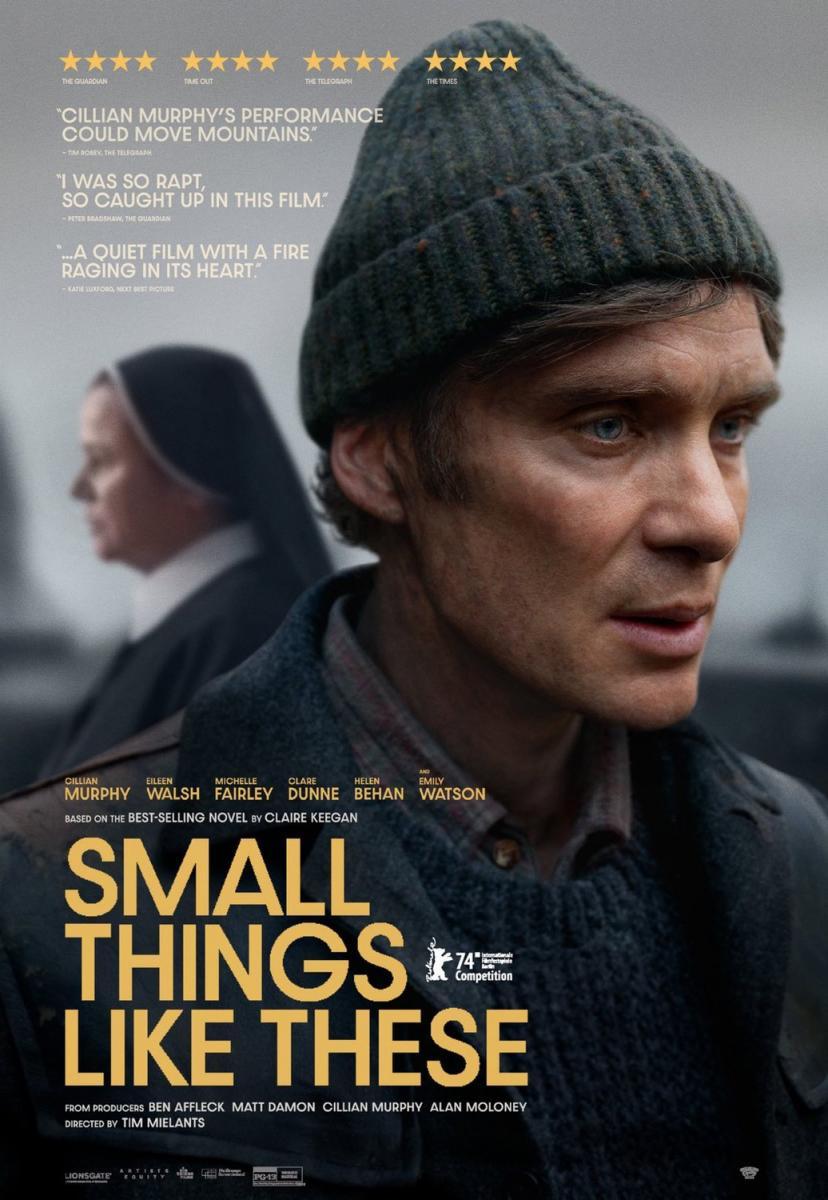
(Tim Mielants, 2024)
Small Things Like These (2024) is adapted by Enda Walsh from Claire Keegan’s acclaimed 2021 novella of the same name. Directed by Tim Mielants, the film was produced by actor Cillian Murphy and his Big Things Films partner Alan Moloney, supported by Screen Ireland/Fís Éireann. Following Murphy’s discussions about it with Matt Damon while on the set of Oppenheimer (2023), it was also financed by Artists Equity, a relatively new artist-led studio run by Damon and Ben Affleck. An earlier adaptation of Keegan’s story Foster, An Cailín Ciúin (The Quiet Girl, 2022) was among the first Irish-language films to gain international acclaim after its Oscar nomination.
Small Things Like These is set in December 1985. Bill Furlong (Cillian Murphy), a fuel merchant in the town of New Ross in Co. Wexford, is busy in his yard managing orders. Hardship is widespread: a boy is seen stealing milk from a cat’s dish, while another gathers sticks for firewood. Bill and his wife Eileen (Eileen Walsh) are rearing five daughters. Although Bill was born to an unmarried domestic servant in highly conservative, small-town Ireland, he was fortunate to have benefitted from the protection of Mrs. Wilson (Michelle Fairley), his mother’s Protestant employer, who allowed his mother Sarah (Agnes O’Casey) to continue working in her house. He endured bullying at school and remains deeply troubled by not knowing his father’s identity. In the run-up to Christmas, Bill makes a delivery to the convent – “a powerful-looking place on the hill” – and finds a young mother locked in the coal shed, another Sarah (Zara Devlin). An inmate in the laundry run by the nuns, she has had her newborn baby taken from her. Deeply disturbed by this, Bill returns to the convent in a Christmas Eve snowstorm to rescue her and bring her into his home.
Unlike other films whose focus is on the inmates of such institutions, Small Things Like These explores the crisis experienced by Bill, which the author describes as “a breakdown, a self-destructive action” at the end (Tóibín 2022). Having witnessed the cruelty at the convent, Bill is driven to make a moral choice, despite the risk to his family and business.
A sense of the hegemony of Church/State and the complicity of silence is palpable in the everyday lives of the people in the story. Eileen Furlong and neighbour Mrs. Kehoe warn Bill about the nuns’ power and how “they have a finger in every pie”. Eileen Walsh’s understated performance conveys her dilemma, torn between her concern for Bill’s restless anxieties and her fear of the nuns and public disapproval. More pragmatic than Bill, she chides him about his easy generosity: “Just mind what we have here and stay on the right side of people and soldier on”. “Don’t you ever question it?” he asks Eileen at one point. In the novel, his increasing withdrawal from the pieties and conventions becomes evident. His growing realisation at the insidious power of church rituals is clear as he “watched how easily they genuflected and slid into the pew, as they had been taught” (Keegan 2021: 76). Later, he refuses to take Communion and “stayed contrarily where he was, with his back against the wall” (Keegan 2021: 78). Murphy’s facial acting is eloquent and haunting in conveying this opposition and doubt.
Following Bill’s discovery of Sarah imprisoned in the coal shed, they are escorted through prison-like passages where he glimpses girls toiling in the steamy underworld laundry before entering the Mother Superior’s office. Sister Mary (Emily Watson) conveys a chilling menace: manipulation, lies and guile are all in service as she forces the girl into obedience. Her outwardly civil exchanges with Bill about his business and family contain a veiled threat about his daughters’ future at the convent school. When she expresses pity at his not having a boy to continue the name, Bill’s retort that he has his mother’s name (and “no harm ever came of that”) shows his growing confidence and resilience – “a type of contrariness to stay on, and to hold his ground” (Keegan 2021: 69). As though doing a deal, the nun stuffs banknotes into an envelope with a card and signs “Eileen” in a flourish; a cunning means to ensure that he will accept the hush money. “That’s us done, I’d say”. Earlier in the scene we see the cowering servitude of an old nun ordered to bring tea by her superior. A younger nun emulates the menacing manner of her superior. In both novel and film, the Church’s male hierarchy which make the rules is largely absent; women are shown as the handmaids carrying out Church policy and managing the laundry workforce.
In discussions of film adaptation, “fidelity criticism” remains a key touchstone for readers and viewers, despite its dismissal by film scholars. An adaptation, among its defining characteristics, will usually retain many distinguishing features, from its source text to central elements of the plot, characters and settings. It may downplay or drop some elements in the transition from page to screen, amplify other elements from the book, or introduce new elements. However, as noted by James Harold (2018), the criterion of fidelity may not be useful within such analysis:
Fidelity is thought to be harmful because it crowds out other, more fruitful lines of inquiry. Further, fidelity is often associated with another troublesome assumption that has plagued the academic study of film since its beginning: the privileging of the written word (particularly “high” literature) over pictorial storytelling (of which films have often seemed like the lowest form). (91)
In adapting Small Things Like These for the cinema, Murphy and Keegan both articulate a more nuanced dynamic. Murphy says he and Enda Walsh were determined to be faithful to the source material, while saying he was also drawn to the novel as he had “an inkling it could be very cinematic” (Gleeson 2024). Keegan in turn has talked of her reluctance to hover around the filmmakers, who she describes as having their own vision for the work, explicitly seeing the film as a new artwork. She, too, has noted how the visual aspect is very important to her in telling a story. “I cannot be taken along by a story that isn’t visual” (Tóibín 2022).
The film’s impressionistic style – often dimly but beautifully lit, with only the light from a window in some night scenes – creates a mood and visual tone to draw viewers into its world. Black crows and sombre churchbells charge the film’s visual and aural scape. Recurrent shots through doorways frame scenes, suggesting an aloofness or sense of isolation. Director of Photography Frank van den Eeden films the narrow streets of New Ross and the Furlongs’ modest home in subdued tones, with a distinct shift in visual register for the flashbacks to Bill’s childhood. Keegan’s prose, though sparse, is rich in creating a sense of place and past. As a period piece, the film relies on the visual impact of the old telephone, office ledgers, Bill’s handwritten orders, the handpainted lettering on his battered lorry. Weather also locates the story and small-town context: shots from his lorry lurching across the bridge in rain, the glow from a street lamp on wet tarmac, spattered raindrops along the edges of a window. The cosy yet claustrophobic atmosphere within the family home is rendered through location shooting, and the dungeon-like cavernous convent hints at the hidden and half-hidden as Bill glimpses shadowy figures on their knees scrubbing and polishing floors. Snatches of news bulletins and songs by Dexys Midnight Runners and Human League play diegetically in the background – locating the story in the mid-1980s – but visually it is sufficiently blurred that it might be mistaken for 1950s Ireland or earlier still. In the 1980s the Catholic Church could still influence the outcomes of key referendums on abortion and divorce, although in retrospect its power was starting to wane. While several commentators have rejected the film’s depiction of 1980s’ Ireland (Linehan 2024), its visual style has a retro quality that may evoke earlier decades, a reminder of how residual cultural influences persist into later generations. William Trevor, when asked about setting The Ballroom of Romance in the 1970s, remarked on how slowly change came, especially to rural communities outside the metropolitan centres.
In considering any film adaptation, besides the relationship between the original text and the cinematic one, other intertextualities will come into play – such as previous film and TV dramas exploring the repressed histories of the “Magdalene laundries” in Ireland – and their tragedies and traumas continue to reverberate as a living memory. Commercially run, and funded by the Catholic Church and the State from 1922 to 1996, these workhouses incarcerated thousands of young, single mothers into long hours of servitude; their babies were sold for adoption and some met even worse fates. Besides fictional and autobiographical dramas, this cruel and powerful coalition of Church and State has also been explored in artworks such as Alison Lowry’s powerful sculptural (A)Dressing our Hidden Truths in the National Museum, and TV and radio documentaries. The rescue of a young mother and baby is at the core of Pray For Our Sinners (2023). Sinead O’Shea’s documentary focuses on doctors Paddy and Mary Randles in Navan in the 1970s who, despite intimidation, directly opposed Church and State by providing contraception, protecting single mothers and their babies, and exposing corporal punishment in a local school. Gentle but determined, their resistance finds echoes in Small Things Like These.
Producer Alan Maloney has described Small Things Like These as a Christmas film. Seasonal rituals feature – letters to Santa, baking the Christmas cake, carol-singing, the traditional crib (with its archetypal single mother and her baby) – yet Bill undermines and questions their value, as “he found himself asking was there any point in being alive without helping one another?” Compassionate, humble and hardworking, his upbringing has set him apart and sharpened his perception. It influences how he responds to his discovery at the convent, aware that his mother could have ended up in a similar institution were it not for Mrs. Wilson, a member of a marginalized religious minority in the Catholic State. Novel and film conclude with the rescued Sarah preparing to enter Bill’s family circle, yet both narratives withhold the outcome of his action and – inverting the generic Christmas film – deny any trite sentimental closure of a “happy family” tableau. Readers and viewers are left to reflect on moral choice and potential fallout when an unassuming man performs an act of resistance and is brave enough “to go against what is there”.
Winter snow scenes are prominent in the novel’s cover images. Faber & Faber’s initial hardback edition from October 2021 uses Pieter Bruegel the Elder’s painting The Hunters in the Snow (1565). In a muted palette of greys, blues and white, and bare trees in a bleak landscape, watchful crows perch (and also punctuate the film’s canvas), a magpie glides across the picture. Writing in Nature about how Christmas cards use Old Masters, art historian Martin Kemp states that “probably no ‘secular’ subject is more popular” than Hunters in the Snow (Kemp 2008). Yet for all its modern festive connotations and “secularity”, the painting has an ominous atmosphere. Some scholars see it reflecting a decline or abandonment of Christian values, and point to how in Bruegel’s work magpies and crows are birds of ill omen, associated with the devil. The painting’s bird’s-eye view is reflected in the novel’s opening. Keegan, with signature restraint, locates us immediately in the rural landscape: October’s seasonal colours, November winds. From this aerial perspective she brings us “down in the yard” to focus on Bill Furlong, through whose perspective readers will experience the story.
Small Things Like These arrived in cinemas when, as Variety put it, “Ireland appears to be everywhere on screen at the minute” (Ritman 2024), and Deadline announced that “Ireland’s screen industry is having a moment” (Lodderhose 2024). Both articles singled out the film; the Variety article noted how these recent achievements were “the culmination of a movement that’s been ascending for some time”, and quoted the film’s co-producer Alan Moloney: “It’s a bit like the overnight success that takes 30 years to come”. The film itself is an example of that steady accumulation of talent and experience over decades. Moloney’s early credits include Amongst Women (1998) – the TV adaptation of John McGahern’s novel – as well as Intermission (2003) and Breakfast On Pluto (2005), both with Murphy in lead roles. Small Things Like These also reunites Enda Walsh with performers Murphy and Eileen Walsh, both of whom came to prominence in Walsh’s stage play Disco Pigs in 1996. Eileen Walsh’s lead film roles go back – most notably, in this context – to The Magdalene Sisters (2002).
Works Cited
Gleeson, Sinéad (2024). “Cillian Murphy on Small Things like These”. Sight and Sound Interviews. BFI, (November 5). https://www.bfi.org.uk/sight-and-sound/interviews/scale-any-project-secondary-its-always-about-quality-writing-cillian-murphy-small-things-like-these
Harold, James (2018). “The Value of Fidelity in Adaptation”. The British Journal of Aesthetics 58 (1): 89-100. https://doi.org/10.1093/aesthj/ayx041
Keegan, Claire (2021). Small Things Like These. London: Faber & Faber.
Kemp, Martin (2008). “Looking at the face of the Earth.” Nature. 456 (18): 876.
Linehan, Hugh (2024). “Cillian Murphy’s Small Things Like These has become a cause celebre of the Make Ireland Great Again brigade”. The Irish Times (November 9).
Lodderhose, Diana (2024). “Hot Spots: How Ireland’s Booming Screen Sector Shows No Signs of Slowing Down and Why It’s ‘An Overnight Success, Thirty Years In The Making.’” Deadline (May 17). https://deadline.com/2024/05/hot-spots-how-irelands-booming-screen-sector-shows-no-signs-of-slowing-down-why-its-an-overnight-success-thirty-years-in-the-making-1235917076/.
Ritman, Alex (2024). “How Ireland’s Film Sector Went From a ‘Cottage Industry’ to a Global Force (and Awards Season Darling).” Variety (March 4). https://variety.com/2024/film/global/irish-film-industry-growth-awards-tax-relief-talent-1235927711/.
Tóibín, Colm (2022). “The Art of Reading Book Club” with Colm Tóibín / Claire Keegan. The Arts Council / An Chomhairle Ealaíon. https://youtu.be/H9nzyTicyDg.


