
 by
Sacha Wood.
This text may be archived and redistributed both in electronic
form and in hard copy, provided that the author and journal are
properly cited and no fee is charged for access.
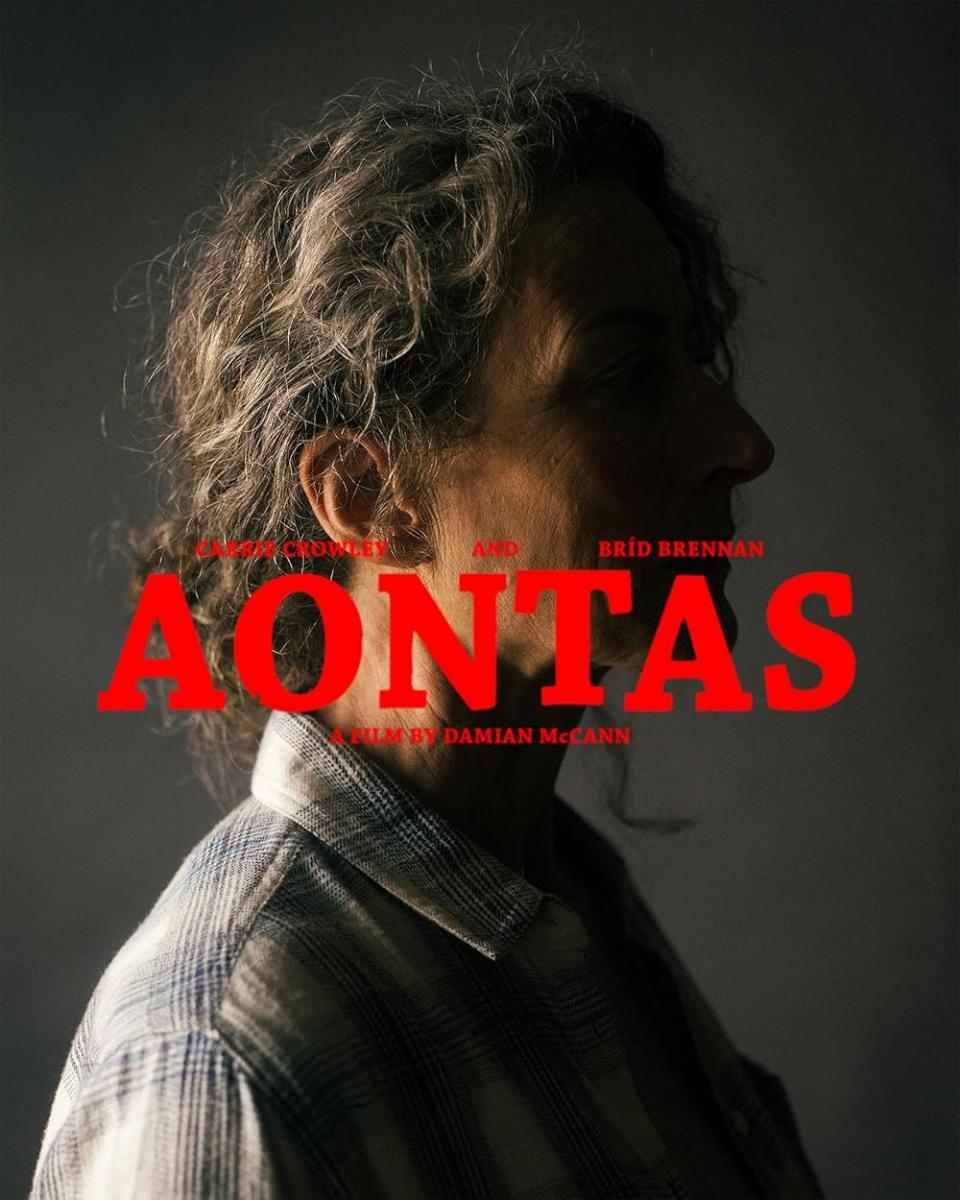
Damian McCann (2025)
Signalling another confident stride forward in Irish-language filmmaking, Armagh director Damian McCann’s second feature film Aontas is a bold and poignant offering with much to add to the steadily growing indigenous-language canon. As much an empathetic portrait of a struggling community as a heist story told in reverse, the festival-favourite’s exploration of three women driven to rob their local credit union moves Irish-language cinema yet further in the direction of assured genre storytelling and poignant social commentary. Rather than simply an attempt to “resemble global product” (Barton 2019, cited in Woods 2025), however, it can be argued that it is precisely this intertwining of the Irish language with a new, non-linear mode of storytelling which elevates the affective and sociopolitical impact of the film.
Responding to the contemporary proliferation of “puzzle films”, Warren Buckland summarises this phenomenon in relation to the postmodern experience: “[I]n today’s culture dominated by new media, experiences are becoming increasingly ambiguous and fragmented; correspondingly, the stories that attempt to represent those experiences have become opaque and complex” (2009: 1). It is a point Thomas Elsaesser then develops into a deep exploration of the “epistemological problems” and “ontological doubts” (2009: 15) at the heart of these puzzle, or “mind-game” (13) films. These characteristics place the viewer into alternative and “abnormal” ways of “‘being in the world’” (14) in response to an increasingly complex and precarious social reality. Taking a Foucault-inspired reading of these films, Elsaesser points to their political power in portraying “‘aberrant’ mental states [which] signify the effects of […] new disciplinary machines” (2009: 32), most acutely that of “the social matrix of ‘affective labour’” (Hardt and Negri 2001, cited in Elsaesser 2009: 32).
While Aontas is perhaps not a “true” mind-game film by Elsaesser’s definition (2009: 27-28), given that it limits its narrational complexity to a relatively consistent reverse-chronology which is ultimately resolved for a concluding sequence, the effect of its non-linear storytelling can nonetheless be illuminated by answering Elsaesser’s own thought: “[W]hy [did] the writer or director [go] to such trouble in the first place[?]” (2009: 22). By situating us within the aftermath of a fatal credit union robbery, the film’s opening scenes place immediate emphasis on the crucial narrative element of cause-and-effect – specifically, on the absence of cause in the face of extreme effect. More poignantly, by preceding this first narrative scene with a short, slow-motion montage introducing the protagonist, Máiréad, in a highly distressed emotional state, the film directs as much, if not more, attention to the extreme affect at the heart of this unexplained action. With the question of cause thus formed, by the time the first close-up of a backwards-ticking clock cues a jump back in time, we are primed to scour the visual landscape for clues and hints, indicators and inscriptions – “index and trace”, in Elsaesser’s words (2009: 31) – of “how we ended up here”. It is this very “forensic” attention (to paraphrase Mittell) and “passionate involvement” (to paraphrase Elsaesser 2009: 13) which forms our close relationship to the on-screen world and its characters, guiding us towards a deeper understanding of the diegetic social reality and, crucially, a heightened level of empathy.
While it is not paranoia, schizophrenia, or amnesia which forms the “‘aberrant’ mental state[s]” (Elsaesser 2009: 32) of Aontas’ characters and perspective, the “madness” (32) which guides the film’s non-linear “perception of reality” (14) manifests as what could be termed “explosions of affect”. Like the very first shot of a mug smashed on the floor, these moments of social misbehaviour inscribe the audiovisual landscape with the signs of a community struggling under the weight of the “affective injustice” of neoliberalism (Srinivasan 2018); a quality represented in the narrative by the arrogant, exploitative Dara. Cáit, first introduced as a victim and subsequently revealed to be both Máiréad’s estranged sister and her accomplice in the robbery, acts as the main “inscriber” of this struggle, with her confrontation of Dara at the wake, destruction of shop property, and throwing of a rock at the quarry protest marking out a pattern of deliberately disruptive behaviour which simultaneously explains her social exclusion and voices her desperation. The characters who remain comparatively quiet, however, are those who find their own bodies inscribed with these signs of socioeconomic struggle and decline, from Sheila’s black eye (inflicted by her husband, Colly) to Nóirín and Caoimhín’s deaths, respective, from stress and suicide.
If, as Elsaesser’s Foucaultian reading maintains, such madness signifies the socialisation of “subjectivity […] under the conditions of liberal market economics” (2009: 32), then we can see how Aontas’ sociopolitical narrative is intertwined with the empathetic impetus of its non-linear narration: presented backwards, each one of these “explosions of affect” might be understood as both cause and effect, both pathology and symptom, each becoming a clue in the viewer’s process of understanding Máiréad’s extreme transformation between by-the-book police officer and gun-wielding heist leader. Discouraging the viewer’s socialised response of judgement by imposing this task of understanding, the heightened level of empathy thus encouraged allows these events to transcend dramatic plot-points and come to signify a wider, more systemic story of a community’s unwitting reactions to and embodied protests against their experience of socioeconomic vulnerability. Indeed, if Peadar Kirby and Karl Polyani’s understanding of vulnerability in the contemporary context is one where “the relationship of the market to society [is understood] as the central causal mechanism at work” (cited in Woods 2025: 26; my emphasis), then this can be seen to be equally true of Aontas itself, with each jump back in time motivated by a pivotal moment of realisation of this socioeconomic “relationship” and the community’s vulnerability within it. A crucial example of this is one which also demonstrates a (cor)responding shift in Máiréad’s understanding of morality: when Sheila begs her to confiscate Colly’s gun, Máiréad initially refuses simply because he has the legally required licence. As Sheila’s emotional regulation (“affective labour”) breaks down, however, Máiréad comes to understand the reality of the young woman’s vulnerability as one that cannot be truly protected by the legal system. She ultimately takes the gun, signalling a movement towards a postconventional morality – to use Kohlberg’s terms (1981: 411) – to which Sheila appeals through allusion to Máiréad’s own vulnerable past.
The theme of vulnerability within Irish-language cinema is illuminated by Jeannine Woods in her analysis of An Cailín Ciúin (2022) and Foscadh (2021), in which she finds the qualities of a “minor cinema” (James 2005, cited in Woods 2025: 24) defined not only by the socioeconomic marginalisation experienced by Irish-speaking communities, but also by the “symbolic universe” (Ó Crualaoich 1988, cited in Woods 2025: 27) held within Irish-language culture which can offer alternative ways of being and knowing in the face of the hegemonic discourse of neoliberalism. Central to the symbolic universe of these Irish-language films is the concept of “dúchas” (Woods 2025: 25), a notion loosely translatable as “indigeneity” or “place” in which the foregrounding of “relationality” (25) offers a mode which could, Woods argues, “mitigat[e] some of the major challenges and divisions issuing from vulnerability” (34). Relationality is undoubtedly at the heart of Aontas’ empathetic mode as heretofore explored, with the scene above proving its pivotal role in the characters’ understanding of their own experiences and their roles within the community, ultimately leading to their joining of forces towards a postconventional, community-focused solution: the staging of a robbery to frame the Ó Baoills and claim back the money they stole. Moreover, as in An Cailín Ciúin and Foscadh, we can see how Aontas’ expression of this relationality is not only intertwined with its form in terms of narration, but also in terms of language and place, through the central metaphor of the standing stone.
The standing stone represents a key element of dúchas, with such monolithic structures serving across the island as legacies of ancestral communities and thus linked to pre-modern (and pre-colonial) “landscapes” (Woods 2025: 27). Taking on a role of increasing centrality in Aontas, from unassuming subplot to the ultimate repository of the film’s resolution, the stone serves as a key index of relationality within the narrative as the characters’ various ways of understanding and relating to it reflect their own self-positionings within the community. Valuing the standing stone as a symbol of individual power, for example, Dara Ó Baoill purchases it and has it moved to his own property, decontextualising it from its cultural and historical place (dúchas) and reappropriating it into his own discourse of socioeconomic hierarchy. Unlike An Cailín Ciúin (or, indeed, McCann’s first feature film Doineann), power and vulnerability in Aontas are thus not directly “indexed in linguistic terms” (Woods 2025: 28) but rather in cultural and epistemological ones, where Dara’s simultaneous use of the Irish language and disrespect for its cultural and discursive heritage points to the decontextualising and assimilating forces of globalisation. Reflected similarly in his misnaming of Nóirín at her own wake, the film thus demonstrates how Dara’s cultural and linguistic heritage, and therefore his identity within the community itself, have been appropriated into the individualist and exploitative discourses of neoliberalism at the expense of their own rooted and relational “symbolic universe”.
In contrast, Éamonn’s (Máiréad’s young colleague) respect for the standing stone and its place within the community is demonstrated in his attempt to arrest Dara for theft, an apparent naïveté redressed by Máiréad as she explains the lack of an existing legal framework for such a situation. Positioned as the catalyst of the film’s longest sequence, which moves from Dara’s arrest to Sheila’s plea to Caoimhín’s suicide in climactic succession, narrative parallelism here thus embodies a relational mode of understanding for both viewers and protagonist, as the standing stone and the community are shown to be subject to the very same forces of exploitation and therefore the same vulnerability. In this light, Éamonn’s expression of a postconventional understanding based on respect and relationality (rather than ownership and hierarchy) illuminates the alternative ontologies and epistemologies afforded by the symbolic universe of indigenous Irish culture, and offers, in retrospect, a solutional mode through which Máiréad can process the grief, guilt and moral struggle informing her own vulnerable position.
That the film’s ultimate reunification of narrative and narrational chronology takes as its “causal mechanism” the restoration of the standing stone to its rightful place, suggests a poignant message of cultural reclamation as affective reintegration, in which personal and communal freedom, healing and justice are rendered alongside relational, postconventional and ultimately de-colonial lines. With a resonance for struggling Gaeltacht communities across the island, as well as echoes for a nation still reckoning with the legacies of economic collapse and state-sanctioned abuse, Aontas’ intertwining of non-linear narration with the discursive world of the Irish language thus extends an empathetic mode of cinematic storytelling which combines the expressive power of the puzzle film with the “mitigating” (Woods 2025: 34) potential of minor cinema. Building on the affective impact of those that came before it, Aontas thus reasserts the potential of Irish-language cinema as one which not only illuminates, but offers solutions to, the complex contemporary experience of affective injustice and vulnerability.
Works Cited
Buckland, Warren, ed. (2009). Puzzle Films: Complex Storytelling in Contemporary Cinema. Hoboken: John Wiley & Sons, Incorporated. ProQuest Ebook Central.
Elsaesser, Thomas (2009). “The Mind-Game Film.” Puzzle Films: Complex Storytelling in Contemporary Cinema, edited by Warren Buckland. Hoboken: John Wiley & Sons, Incorporated. 13-41. ProQuest Ebook Central.
Kohlberg, Lawrence (1981). Essays on Moral Development, Vol. I: The Philosophy of Moral Development. San Francisco: Harper & Row.
Mittell, Jason. n.d. “Forensic Fandom and the Drillable Text.” Spreadable Media (Web Exclusive Essays). https://spreadablemedia.org/essays/mittell/index.html.
Srinivasan, Amia (2018). “The Aptness of Anger.” Journal of Political Philosophy 26 (2): 123-44.
Woods, Jeannine (2025). “Language, Silence and the Place of Irish Language Film in Contemporary Cinema: Colm Bairéad’s An Cailín Ciúin (2022) and Seán Breathnach’s Foscadh (2021).” Estudios Irlandeses 20 (March): 22-35. https://doi.org/10.24162/EI2025-13182.


