
 by
Ciara Barrett.
This text may be archived and redistributed both in electronic
form and in hard copy, provided that the author and journal are
properly cited and no fee is charged for access.
Ruán Magan (2025)
In their book on Irish myth-busting director Neil Jordan, Emer and Kevin Rockett first highlighted the iconoclastic significance of his exploding the image of Lough Tay in the 1997 film adaptation of The Butcher Boy (2003: 192). Sandra Costello recalled the importance of this moment in her review of the Hollywood rom-com Irish Wish in this journal last year, showing how the latter film’s more traditionally scopophilic depiction of the lake – a rejection, if an unwitting one, of Jordan’s revision – represents the lingering, ideologically opposed tendency of Hollywood films to (re-)impose a tourist gaze on Ireland’s landscape, seeing only “one-dimensional versions of the country as perpetually undisturbed and unchanged by time” (2025: 260).
In Jordan’s film, the image of the lake rising into a nuclear mushroom cloud behind the head of an Irish schoolboy functioned in visual terms to explode both the coloniser’s primitivist gaze upon Ireland and Ireland’s own internalised colonial mentality. In a plume of grey-brown vapor the hopes and dreams of protagonist Francie Brady – a native youth of the heavily patriarchal, postcolonial mid-twentieth century Ireland – dissolve; aspirations which might have been realised had he not fallen victim to the multiple side-effects of patriarchy and colonialism: socio-economic disenfranchisement, sexual abuse, and a litany of others of which indigenous narratives constantly remind us. In the burned-out, post-apocalyptic wasteland that remains after the explosion both within and beyond Francie’s mind, Jordan shows the “perpetually undisturbed” and timeless Ireland of the coloniser’s vision (Costello 2025: 260) to be, in fact, profoundly disturbed, like so much lake water.
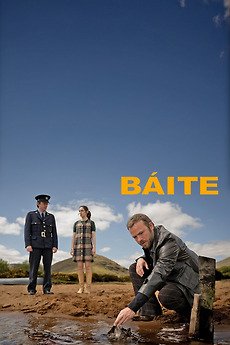
While Ruán Magan’s début fiction feature film, the Irish-language Báite (“Drowned” in English), is set upon a different lake (shot in Connemara but obliquely set in Kerry, judging from the film’s taking place during the 1975 All-Ireland football final between Dublin and Kerry), the lake’s visual representation and narrative omnipresence within the film renders it inescapably derivative of the iconic Lough Tay. The film must therefore be read in this semiotic context, even if it were not for the fact that the narrative subtext of the film critiques – with limited success, I will argue – the globalisation of Ireland vis-à-vis American influence.
The story of the film, adapted by screenwriter Sheena Lambert into Irish from her own English-language novel The Lake, centres on Peggy Casey, proprietor of Casey’s Pub and guest house, located on the shores of a manmade lake in the fictional town of Glanaphuca. The fact that the exact location of Glanaphuca in Ireland is never directly named (minus the green and gold flags at its end) renders the town, similar to the island in The Banshees of Inisherin, at once spatially specific – rural and quintessentially Irish – and also place-less. As such, it is to be understood as an archetypal Irish town and a microcosm for Irish society.[1] From the outset, Báite buys into at least half the hackneyed “binary of Irish cinematic representations, between the urban and the rural, in which the latter is alternately depicted as a pastoral repository of cultural authenticity” – which the film’s political project supports – “or a repressive site of outdated conservative values” (Holohan 2019: 408), which the film tries awkwardly to reject through characterisation and dialogue.
The opening of the film is a conventional drone shot, diving through clouds over Glanaphuca’s lake (these clouds’ mysteriousness is enhanced by ethereal background music), and soaring swiftly beneath them as we follow Peggy’s dip into its waters. Splitting the lake’s surface, we quickly discover there is a whole, ruined world beneath. The lake covers the remains of an original village, drowned to allow for the creation of a power plant, which – we learn through some pointed dialogue – provides electricity to far-away Dubliners. Thus, a familiar diametric opposition is imposed between traditional/rural Ireland as a pastoral “source” culture versus the urban as foreign, capitalist, and exploitative. Under Magan’s direction, the film doubles down on its myth-making of rural Ireland as “real” – at least as it is associated with Irish-speaking rural Ireland. Yet through its sumptuous cinematography, Báite serves up the landscape to be consumed, as unironically as ever, by a fetishising touristic gaze.
Returning to the plot, more than two decades before the start of the film, American soldiers stationed in Belfast post-World War II have been called in to lay explosives to facilitate the lake’s flooding. Thus, American outsiders – associated with an international conflict Ireland famously refused to join – strongarm the town into joining the global capitalist machine. Around the same time, a local woman named Bernadette Murphy disappears, presumably having run away with her American soldier lover. By 1975, during a period of drought alongside the All-Ireland final (which, in real life, pitted a rural county team against an urban one), the lake waters have subsided to reveal a woman’s body stuck into the silt of the lake. The discovery is disturbing to Peggy on two levels: for one, it is off-putting to the tourists on whom she relies to keep her business going – a business which all three of her siblings and fellow stakeholders would rather sell so that they can abscond to various other corners of the globe (London, Dublin, Australia); secondly, she has a visceral connection to the discovered body (she nearly collapses when she lays eyes on the dead woman’s face). Of further consternation to Peggy is that a detective from Dublin, Frank Ryan, is dispatched to investigate the scenario. He quickly finds that the woman, identified as Bernadette Murphy, was murdered, casting suspicion on a local bachelor, Coleman Devitt, who was in love with Bernadette prior to her disappearance.
While Peggy and Frank grow closer (they bond over having been named after American singers and Frank’s revelation that he is the son of a rural publican himself, further explaining his natural affinity for the Irish language), it comes to light through a series of interviews and admissions (from priests, townspeople, and Peggy’s own brother) that Bernadette was strangled at the lakeside by her soldier lover. Notably, characters in the village representing traditional Irish institutions such as the Church and Gardaí are revealed, one after the other, to be entirely faultless in their association with the crime, involved only in the rescue of Bernadette’s child. Indeed, some time before her murder, Bernadette had given birth to the soldier’s baby and been taken in by Coleman Devitt. Devitt witnessed her murder, and in order to avoid the child’s being removed to “one of those awful places”, with the help of the village priest, Devitt gave the baby to the Casey family to raise.
Devitt’s mention of these “places” is an oblique yet unequivocal reference to the infamous Mother and Baby institutions, which the script attempts unsatisfactorily to dis-place from its setting. This must be taken as a deliberate obfuscation by Lambert and Magan of one of the darker aspects of Ireland’s history, which cannot be tied back to American influence and globalisation; the reference to the Laundries is useful to the script only inasmuch as it ticks a box for contemporary audiences. The residents of Glanaphuca are absolved of all collusion, which real Irish communities displayed in systematically abusing women and children until at least the end of the twentieth century. Similarly, the script glances at the institutional oppression of queer people in Ireland, yet stops short of placing blame on/within Glanaphuca/Ireland itself. For example, her brother is broadly hinted to be gay, but crucially never experiences any discrimination from within his home community: however, he mentions having been hassled specifically by Dublin Gardaí. Irish oppression is only homegrown in the world of Báite when it is urban and/or influenced from the outside.
Returning once again to the plot, it of course turns out that Peggy is Bernadette’s biological daughter. As a means to reassure Peggy of her authentic “Casey-ness”, her London businessman brother Hugo declares he will buy out his siblings’ shares and sign the pub entirely over to Peggy. So, while she will always belong spiritually to the Casey family, she is assured by both the physical and financial consequences of her becoming their home’s owner. Peggy’s “belonging”, as represented by and through her family, is claimed to be a space of mind; yet at the same time, the physical space of Glanaphuca is preserved as the specific locus of Peggy’s belonging. Glanaphuca, a microcosm for traditional Ireland in the age of globalisation, is thus safe from further, literally murderous, Americanisation/culture-killing globalisation as long as the Peggys of modern Ireland continue to pull pints.
The second-to-last shot of the film sees Peggy and Frank gazing happily at each other over their taps of Guinness as Kerry wins the All-Ireland final. The final shot of the film returns to the drone perspective, soaring over the deep blue waters of the lake. This time, however, we stay on the surface; we do not dive in. With this shot, Magan asserts the possibility of a lasting harmony between rural and urban Ireland following the threat of belligerent Americanisation. This harmony seems as impermeable as the lake water itself – that is to say, in reality not very, but Magan leaves us high and dry above the water, with the sense that the integrity of Ireland – at least as it belongs to the rural and the Irish-speaking – is preserved, for now.
Again, Báite wants to have it both ways: it is generic (being a murder mystery) and political (being narratively anti-globalist), like a number of Irish-language films to date, for example Arracht (the historical drama and revenge film), Kneecap (the hip-hop backstage musical), and An Taibhse (the horror). It is not inherently critical of Irish-language cinema to say it is increasingly genre-pursuant. Indeed, this trend has resulted in the production of some formally complex and ideologically compelling films (the aforementioned included), in the industry’s simultaneous attempts to harness the popular appeal of genre cinema and to preserve the Irish language as a viable medium for cultural expression.
However, the more genre films that Cine4 funds, the less “vulnerable” Irish language cinema becomes as a marketable product, and thus perhaps less harmonise-able with the “minor cinema” mode with which, according to Jeannine Woods, less generically categorisable Irish-language films chime more comfortably, ideologically. She argues films that films like An Cailín Ciúin, which resist generic strictures and the formal tendencies of “dominant” cinema, “stand outside of the hegemonic power centres and structures of the industry […] and in so doing offer a challenge to discourses of globalisation particularly as they relate to vulnerability” (2025: 24–25).
Instead, genre filmmaking in the Irish language necessarily assumes some of the narrative and formal paradigms of “dominant” cinema, whereby iconographic and ideological tendencies coalesce into film typologies. As Conn Holohan has shown, “in the case of Irish film […] landscape has stood in for […] a set of auteurs or aesthetics as the distinguishing characteristic of an Irish national cinema both domestically and abroad” (2019: 411). Báite’s fetishisation of the Irish landscape is embraced by the film’s narrative and visual storytelling. This works alongside its narrative ingenuity as “place-ness” performs a key role in both reflecting on, and giving inflection to, characters’ destinies. Its alignment with “dominant cinema’s” prescriptions for Irish cinema contradicts – trumps even (allusion intentional) – the rather heavy-handed project of its narrative.
And so, to conclude with a similarly heavy-handed metaphor, Magan’s Báite exists at the interface of two immiscible liquids: Jordan’s subversively vaporised Lough Tay from The Butcher Boy and the placidly re-colonised waters of the same lake in Irish Wish. Báite occupies a liminal space in this way, concerned narratively with an anti-globalist or anti-colonial project that attempts to place itself as an Irish-language film as/at the heart of “authentic” Irish culture. At the same time, it appropriates the visual language and sale-ability of the dominant (Hollywood) style of storytelling-about-Ireland uncritically, unmooring it ultimately from its ideological anchor.
Notes
[1] While not within the scope of this review to examine further, it is interesting to note that Inisherin also contains a lake within its microcosmic space. In his introduction to Estudios Irlandeses “2024 review of Irish Film, Televison, & Theatre”, Barry Monahan highlights the significance of Banshees and other films’ settings on oceanic coasts, “occupying a bifurcated position: always simultaneously looking outward from a centre, and imagining an inward gaze from the peripheries” (2025: 237). There is scope, certainly, for a comparative and sustained semiotic analysis of lakes, specifically, in Irish Cinema, and how they might be seen to represent isolation and liminality within Irish culture.
Works Cited
Costello, Sandra (2025). “Irish Wish.” Estudios Irlandeses 20 (March): 257-60. https://www.estudiosirlandeses.org/reviews/irish-wish/.
Holohan, Conn (2019). “Space and Place in Irish Cinema.” A Companion to British and Irish Cinema, First Edition, edited by John Hill. Oxford: John Wiley & Sons. 407-22.
Monahan, Barry (2025). “Introduction: Irish Film, Television & Theatre – 2024.” Estudios Irlandeses 20 (March): 237-421. https://doi.org/10.24162/EI2025-13409.
Rockett, Emer and Kevin Rockett (2003). Neil Jordan: Exploring Boundaries. Dublin: Liffey Press.
Woods, Jeannine (2025). “Language, Silence and the Place of Irish-Language Film in Contemporary Cinema: Colm Bairéad’s An Cailín Ciúin (2022) and Sean Breathnach’s Foscadh (2021).” Estudios Irlandeses 20 (March): 22-35. https://doi.org/10.24162/EI2025-13182.


