
 by
Brendan Mahoney.
This text may be archived and redistributed both in electronic
form and in hard copy, provided that the author and journal are
properly cited and no fee is charged for access.
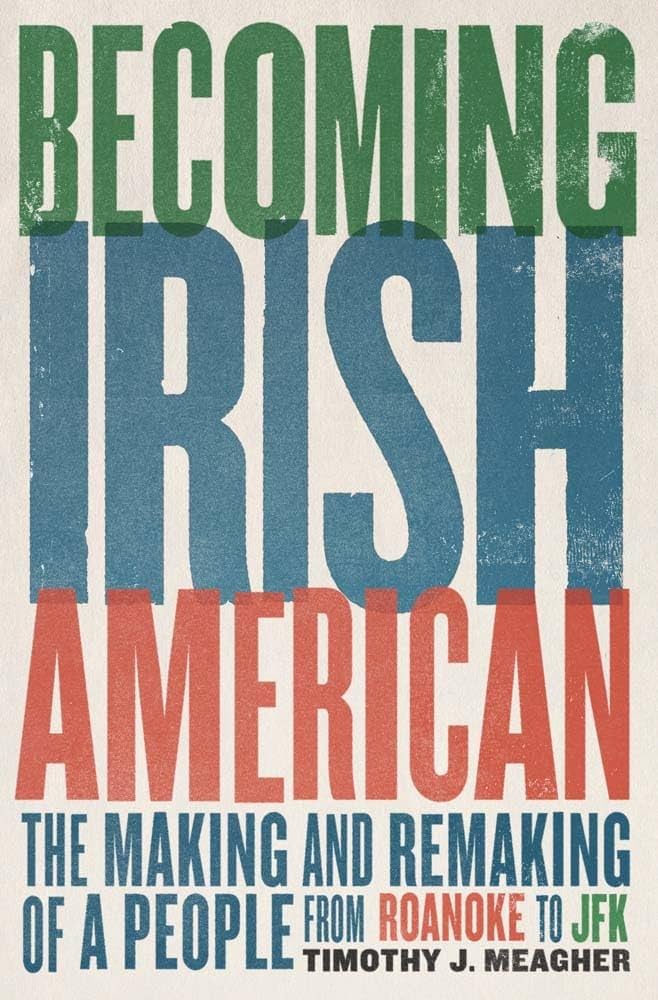
Timothy J. Meagher
Yale University Press, 2023. 344 pages.
ISBN: 9780300126273
In Timothy J. Meagher’s Becoming Irish American, the author rejects the previously theorized dichotomy between “assimilation and ethnic persistence” in favor of a more malleable definition of what it means to be an Irish American, from the birth of America to the middle of the twentieth century (5). Meagher acts as a flexible interpreter of Irish American history, challenging the monolithic representations of Irish American “Catholic Ethnocentrism” in the late nineteenth century or the “anti-elitism” seen in Joseph McCarthy’s rhetoric (168, 222).
Using the framing of Ireland as an “ancient mother” laid out in Walt Whitman’s poem “Old Ireland”, Meagher makes arguments throughout the book that Irish Americans across time take certain elements of their “ancient mother” (Ireland) and leave others, depending on various circumstances that the times presented in the young country of the United States (1). The first chapter, named after the Whitman poem, introduces another paradigm of Irish America: oppression, in one form or another, countered by a reemergence of Irish confidence. The origins of this paradigm lie in the disenfranchisement of the Irish people by the English, prior to the Glorious Revolution of 1688 which offered guaranteed rights to Irish Catholics (23). Meagher continues to track this pattern of setbacks and comebacks when evaluating the transition, demographically and otherwise, of Ireland in the late-eighteenth and early-nineteenth centuries. When discussing factors that catalyzed waves of emigration from Ireland, Meagher explains that although the situation in America was better than that in Ireland, it was imperfect and any improvement would require an ascendancy of Irish Americans achieving prominence, in later years (79).
The mid-eighteenth-century climate into which Irish immigrants arrived was one dominated by racial tensions and ideological divisions. Prior to reading this book, my sole knowledge of the relationship between Irish Americans and African Americans came from Narrative of the Life of Frederick Douglass. In the memoir, Douglass was encouraged to escape slavery by Irish dock workers, who suggested that he run off to the North (Douglass, 2014, p. 51). However, it seems like this positive relationship between Irish workers and an enslaved Douglass may have been an exception, not the rule. Meagher employs a Malthusian equation (“zero sum”) to describe the perception of finite rights or resources that African Americans and Irish Americans had to fight for (118). The realization of limited liberties resulted in “racist opposition” from Irish Americans towards both African Americans and their abolitionist allies, as a defense mechanism against potential oppression that could ensue, should enslaved people be freed (81). Meagher also draws parallels between this tension and the nativist tension that manifested itself in major, urban riots and new political coalitions like the Know-Nothing Party. Meagher makes the crucial point that even beyond their hatred of immigrants, nativists made natural enemies of Irish Americans because their party platform opposed slavery (112). However, Meagher continues in his pursuit of complicating monolithic interpretations of Irish Americans when he gives anecdotal evidence describing hardline Union allegiance that many of them displayed when the US Civil War broke out in 1861. What Meagher insinuates, but does not fully flesh out, is the idea that the Union was the true America that gave Irish Americans a chance in the first place, so when the time came, they tried to show their “American patriotism”, even though Lincoln and the Union fought for something that was against their perceived best interest (121).
The theme of connection to the “ancient mother” is brought to light through Meagher’s assessment of the Fenian Brotherhood, and the failed 1866 Fenian invasion of Canada as an act of retribution against the British. The label of the “Irish American Army” represents a clinging of Irish Americans to their Irish distaste for the British inaction during the famine and maintenance of the skills they learned while in the American army (125-128). Fenians were both Irish and American, and Irish American, all at the same time, according to Meagher. Meagher continues to track the multiple identities that resisted a binary understanding in his exploration of the Ancient Order of Hibernians (AOH) in the latter half of the book. Meagher explains the boom in popularity of the AOH as a desire to show “strength in numbers” through public displays of Irish culture such as St. Patrick’s Day parades (168-169). The book then transitions to Irish American groups with political goals, rather than strictly cultural ones, such as the United Irish League of America and the Friends of Irish Freedom, which both had deep ties to the Irish Republican struggle in the homeland (184). Regardless of the period that Meagher is discussing, when it comes to Irish American groups, his argument for seeing flexibility and change within the diverse Irish American community rings true, as there was a fluctuation between political, cultural, and even economic goals, depending on the time and place. One organization that the book fails to catalog in detail is the Irish Northern Aid Committee (NORAID). Meagher does mention NORAID briefly in his epilogue as an avenue for Irish Americans to prove their “authentic Irishness” (244). However, he fails to engage with the group in a way that follows the statement he makes in the introduction: “By the 1960s and 1970s, many Americans were not so sure assimilation was a good thing, as an ethnically diverse America seemed richer than a culturally uniform one” (3). Of course, the lack of detail on this group comes from the periodization that Meagher uses (ending the book with the election of John F. Kennedy), but that is not to excuse the limiting periodization.
The latter chapters of the book focus on the ascendancy that Meagher argues for in the early chapters of the book. This came in the form of more widespread American patriotism, and by extension accession to political office. Meagher makes the argument that the hegemonic patriotism that arose from the First and Second World Wars also manifested itself in the widespread phenomenon of Irish Americans running for, and winning public offices at all levels of government, particularly for the Democratic party (199, 221). This trend from politicians in the interwar period like New York Governor Al Smith to the Kennedy family in the 1960s and beyond, Meagher argues “ended the old and opened opportunities for the new” (241). This was a “new” that meant “Irish American Catholics were no longer locked into an ethnic or religious identity by outside forces” (242).
While this framing is useful, Meagher ending this book in the 1960s leaves much to be said about Irish Americans and their role in the increasingly interconnected, globalized world. Questions of the Troubles, the changing demographics of the Irish people, and shrinking of concentrated diasporic sites are left unanswered. However, that is not to say that Becoming Irish American leaves all questions unanswered. The establishment of a malleable framework for Irish America, that avoids the pitfalls of previous scholarship, makes Meagher’s book a strong candidate for a secondary survey of Irish America and a cultural angle to modern Irish Studies.
Works Cited
Douglass, Frederick. Narrative of the Life of Frederick Douglass, an American Slave. Penguin Classics, 1845.


