
 by
Hailey Haffey.
This text may be archived and redistributed both in electronic
form and in hard copy, provided that the author and journal are
properly cited and no fee is charged for access.
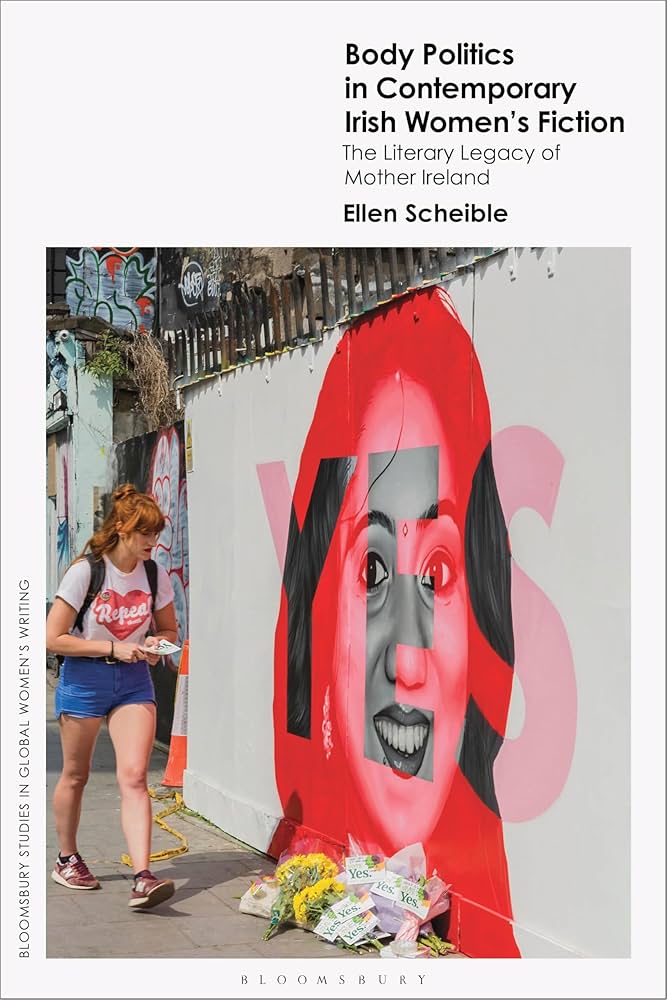
Ellen Scheible
Bloomsbury: Bloomsbury, 2025. 192 pages.
ISBN: 9781350429109
The last thirty-five years have brought dramatic changes for gender-related rights in Ireland, including the legalisation of divorce, gay marriage, and abortion. Such advancements in marital laws and reproductive health are closely aligned with women’s position in society, both informing and being informed by cultural metaphors for women’s agency. Accordingly, tracing the trope of Mother Ireland in Irish culture and literature is key to understanding the meaning and potential of gender-oriented advancements in Ireland – in short, so we better can assess how gender politics, relationships, and beliefs are routed through our imaginations and back into our world. Ellen Scheible seeks to answer the call to critically appraise cultural myths of gender in contemporary Irish literature in her book Body Politics in Contemporary Irish Women’s Fiction: The Literary Legacy of Mother Ireland.
In Body Politics, Scheible makes crucial strides in showcasing the Mother Ireland trope’s legacy through a holistic analysis of its evolution since the late nineteenth century, with emphasis on fiction by James Joyce, Elizabeth Bowen, Emma Donoghue, Tana French, and Sally Rooney. In unravelling Mother Ireland’s development, Scheible explores the political functions of fairy lore and Catholic iconography, gender and family dynamics of Irish cottage and Big House literary symbolism along with related gothic conventions, the constraints of “double binds” of Irish masculinity in the context of postcolonial nation building, and the shifting landscape of narratives about women’s reproductive agency in the aftermath of the Celtic Tiger, Waking the Feminists, and the repeal of the Eighth Amendment. Scheible’s discussions of the endurance of Joyce’s work in the trope’s development, the evolving political symbolism of domestic and interior spaces, and her examination of the adaptations of gothic conventions support her thesis that both before and after the Celtic Tiger period “woman-as-symbol remains consistent”, although “the metaphorical relationship between feminine and national identity has not always produced the same stories and has not always made the same arguments about the role of women in Ireland” (11-12). Importantly, Scheible also correlates diversity in symbolism with diversity of texts – from high literature to popular fiction.
Framing Mother Ireland’s literary arc, Body Politics begins with a reading of James Joyce’s “The Dead”, through which Scheible outlines a metaphoric “mirroring” relationship between Irish women and Ireland that correlates with “miscalculations and misunderstandings” in the shared vision of the Irish nation and patriarchy, represented by Gabriel Conroy (32). Accordingly, Scheible situates Joyce’s “politics” of gender as central in the project of outlining and deconstructing an “Irish nationalism that is inseparable from its dependency on female otherness and oppression to validate Irish (Catholic, male) identity in the modern nation” (8, 13). Throughout the text, Scheible revisits the Joycean metaphor of misinterpreted reflections through her strategies (e.g., applying Lacanian mirror stages to character development) and subjects (e.g., discussing Sally Rooney’s essay “Misreading Ulysses” as well as allusions to “The Dead” in Rooney’s fiction). This consistent return to Joyce shows the significance of both his narratives and literary methods in perpetuating images of a Mother Ireland who signifies evolving identities and relationalities, whether they be in the writings of Edna O’Brien or Sally Rooney.
Further considering the dangerous functions of otherness for the trope, Scheible outlines a template for reading the often-abused symbolic body of Mother Ireland from Angela Bourke’s retelling of Tipperary seamstress Bridget Cleary’s 1895 murder. Scheible uses this story, “one of Irish literature’s overarching metaphors that depicts or confronts the Irish domestic interior and the Mother Ireland image”, to explain Mother Ireland’s transmutations at precarious intersections of gender, belief, nation, and power (14). Scheible contends that “domestic metaphors” since the Cleary case “either expose the national push to suppress the fluid gendered power of interior space or openly resist the gender binary that produced feminine disempowerment and masculine violence” (45). Accordingly, with Cleary’s story as a lens, Scheible evaluates metaphors of space in Elizabeth Bowen’s The Last September (1929) and Pamela Hinkson’s The Ladies’ Road (1946).
Scheible’s analysis of domestic spaces grafts effectively to her discussions of the Irish Gothic in literature emerging from the Celtic Tiger. Thus, Scheible’s characterisation of the Celtic Tiger as a mediator of Mother Ireland’s permutations is one of the text’s most illuminating modes of analysis. Her observation that “the fear that Celtic Tiger wealth might have been a misleading illusion replaces the Protestant concern with property theft” previews the trope’s gothic path of adaption to modern social dilemmas (67-68). Attention to depictions of disappointment with the Celtic Tiger’s fallout clarifies this transformation, as Scheible shows that stories evoking the Tiger’s remnant ghost estates are “built on the back of Big House histories” (77). Accordingly, Scheible argues that “women writers employ the contemporary Irish Gothic to represent the global threat of domestic erasure to both nation and family as a revelation of the ironic expectations placed on the female body to reproduce the nation while simultaneously repressing an innately dangerous sexuality” (71).
Body Politics impressively organises an exacting collection of research, much of which is used to develop robust interpretative frameworks. However, literary, political, and cultural contextualisation often outcompetes close readings, limiting opportunities for analysis of women’s fiction that could explore additional dynamics and manifestations of the Mother Ireland trope. Only short sections of Body Politics are dedicated to close readings of women-identified writers and characters representing the trope’s history before the early 2000s (though many are referenced). For example, while the text addresses Edna O’Brien’s fiction to a degree, descriptions are connected with discussions of Joyce. However, additional close readings of women-identified characters would also further elucidate Body Politics’ analysis of texts by Donoghue, French, and Rooney.
While more time for close readings of key, earlier Irish women’s fiction would help with tracing the literary and cultural lineage of Mother Ireland, extended engagement with gender and queer theory would support further disambiguation of these lineages. Body Politics discusses queer theorists Lee Edelman and Jack Halberstam briefly but invokes their language more broadly. Accordingly, detailed examinations of their theories (with other gender and queer theories), could contextualise Body Politics’ sometimes overlapping uses of gender- and sex-related categories, such as “female” and “feminine”, which at times seem to be characterised as ontologies, such as when Scheible explains that “Ireland’s process of modernity is a history of interwoven ideological misconceptions about both female sexuality and childhood development”, which the “Irish literary landscape” has combatted (4). Such phrasing seems to imply not only that a better understanding of female sexuality is on the horizon – but that female sexuality coheres as a truth as opposed to a construction. Accordingly, while Scheible is clear that the Mother Ireland trope results in varied arguments and stories about “the role of women in Ireland”, the text seems to advocate for the trope’s (and nation’s) movement toward an ideal, liberated form of femininity, despite its many assertions about resistance to binaries and heteronormativity (11-12). Support of this trajectory toward an ideal is buoyed by descriptions of Joyce’s and O’Brien’s views, characterised by “vision” and “prophesy”, as Scheible explains, “Joyce envisions a future Ireland where a recognition of the feminine as a signifier of cultural difference, not reproductive futurism, is essential to national development”, and that Rooney evokes “O’Brien’s prophecy that a liberated female sexuality is key to rewriting the legacy of Mother Ireland as both freeing and potentially reproductive” (155, 148). The alternative the text does not arrive at is that recognising latent queerness of gender and sexuality in Mother Ireland might be one path to navigating the oppression of gendered otherness.
Body Politics often situates narrative decisions, including the choice to have an abortion or not to bear children, as examples of Irish women characters resisting a heteronormative “reproductive futurism”, a concept derived from Edelman’s No Future: Queer Theory and the Death Drive. However, in No Future, feminist visions are not immune to the politics of “reproductive futurism”, for as Edelman argues, “even proponents of abortion rights, while promoting the freedom of women to control their own bodies through reproductive choice, recurrently frame their political struggle, mirroring their anti-abortion foes […] as a fight for the future”, which still “returns to the Child as the image of the future it intends” (3). Edelman’s radically deconstructive paradigm does not neatly support hope for an Irish feminist future (even one repudiating colonial, Catholic, and nationalist aims). However, further engagement with his argument in this text could clarify Scheible’s views and support a critique of No Future’s limitations, which scholars including José Esteban Muñoz have made. Such work could also prompt new discussions of race and immigration related to the trope.
Overall, in Body Politics, Scheible does significant, meaningful, and successful work tracing and illuminating what is at stake in Ireland’s persistent metaphor of gender, nation, and religion. In the process, she shows how the trope has a distinctive capacity to help readers reflect on the roles of power and gendered otherness in Ireland’s past and present, thus bringing understanding to what has been an “unresolved homeland” in gender relations (146).
Works Cited
Edelman, Lee (2007). No Future: Queer Theory and the Death Drive. Duke University Press.


