
 by
Ciara Whelan.
This text may be archived and redistributed both in electronic
form and in hard copy, provided that the author and journal are
properly cited and no fee is charged for access.
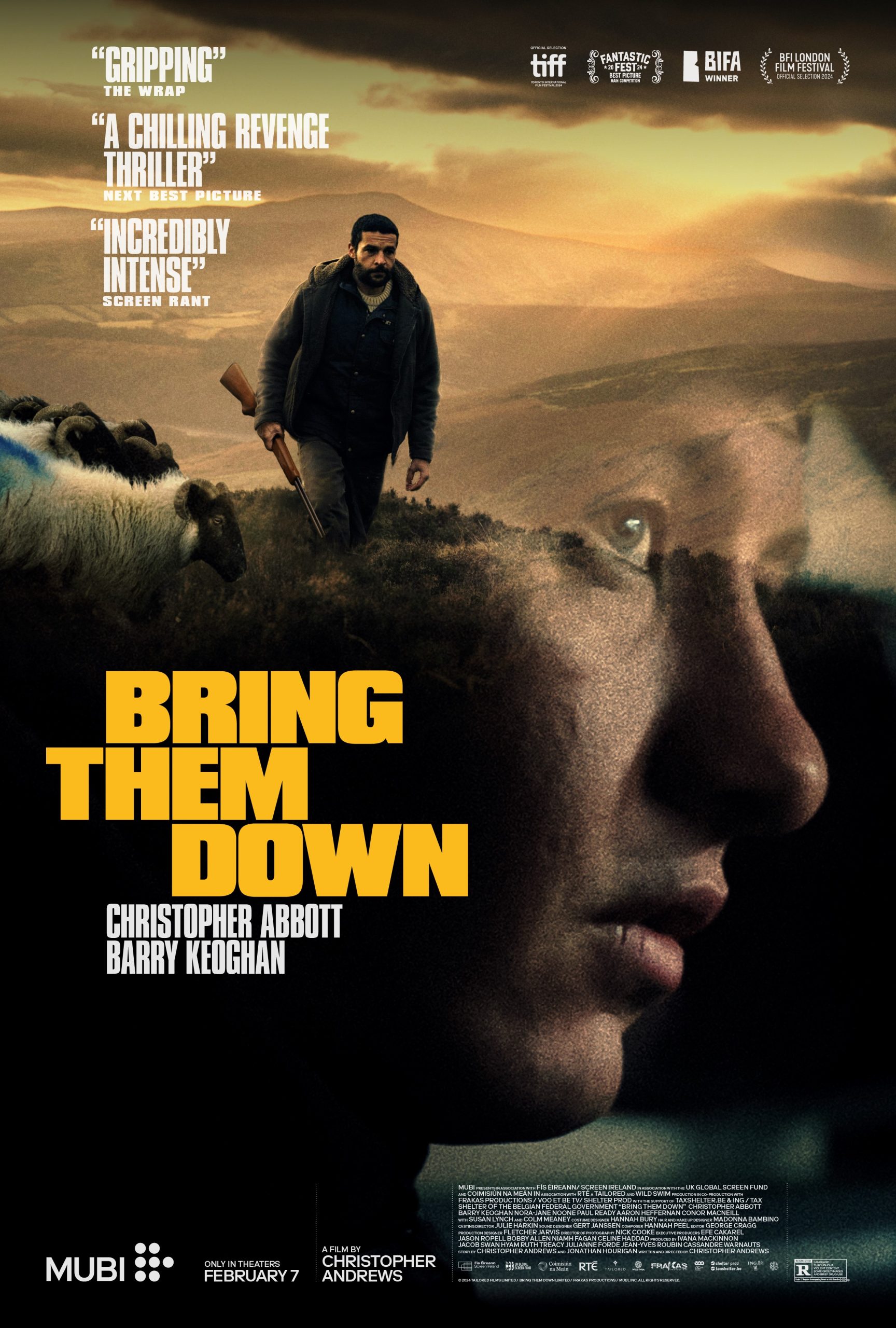
Christopher Andrews (2025)
An affective shift toward the tragic spectacularity of male decline is represented in the recent migration of the Irish cinematic crime narrative from urban to rural settings. This is apparent in a new spatialisation of male civil disobedience that dichotomously invests in pastoral Ireland as a repository of restorative authenticity and a site of conservative repression (Holohan 2019: 408). These newly wrought rural settings stage a reversal of traditional Irish masculine subjects, subject matter and ideological positions that were frequently represented during the Celtic Tiger:
Not only did the focus shift from a concern with rural male characters in distinctively Irish contexts to a growing preoccupation with urban, working-class masculinities in more universal settings; there was also a distant ideological trajectory at work here, whereby an unequivocally critical approach to patriarchal masculinity gave way to more ambiguous portrayals of machismo. (Ging 2021: 161)
In these early years of the twenty-first century, the deluge of urban-set crime and gangster screen media constituted a generic break with traditions of exploring Irish masculinity in relation to the natural landscape contrived by Irish films of the first wave (Bob Quinn’s Poitín [1978], Joe Comerford’s Reefer and the Model [1988]) and second wave (Jim Sheridan’s The Field [1990], Neil Jordan’s The Butcher Boy [1997]). Although the concern with Dublin-based working-class masculinities and gangster social worlds has endured somewhat in the post-Covid period, with low-budget gangster flicks like The Irish Mob (Patrick McKnight, 2023) and independent co-productions by Irish filmmakers with credentials in the genre such as Amongst the Wolves (Mark O’Connor, 2025), this urban cycle is lately surpassed by a series of rural-based crime thrillers. The satirical placement of gangster aesthetics in rural Ireland by Martin McDonagh’s dark comedy The Guard (2011) is superseded by crime thrillers like Bad Day for the Cut (Chris Baugh, 2017), Dark Lies the Island (Ian Fitzgibbon, 2019), Calm With Horses (Nick Rowland, 2019), In the Land of Saints and Sinners (dir. Robert Lorenz, 2023) and, more recently, Bring Them Down (Christopher Andrews, 2025).
While Irish crime and gangster screen media produced during the Celtic Tiger did frequently retreat to rural spaces, they still ardently maintained their affinity with the urban landscape. Director Paddy Breathnach’s I Went Down (1997) and Man About Dog (2004), as well as screenwriter Mark O’Rowe’s Intermission (2003) and Perrier’s Bounty (2009), depicted underclass criminals and urban “scumbags” temporarily removed to the Irish countryside, for example, and Holohan notably contends that the climactic chase sequence in Intermission enacts a key binary in Irish screen culture’s spatial logic in which the rural is foregrounded as absolutely alternative to the urban (2019: 407). Young Offenders (2016) adopts a similar narrative geography, moving the juvenile delinquents from their native Cork City across the unfamiliar rural and coastal landscape of West Cork. So, violence is not an unfamiliar spectacle in Ireland’s rural landscape, but what is significant is the slow transposition of a screen genre normally locked in the Dublin (or Belfast) cityscape to the Irish countryside in the decade after the financial crash.
The Celtic Tiger years saw the architectural and metaphysical renewal of Dublin city, located by Diane Negra in “the metallic sheen of a new Dublin landscape that showcases generic, postmodern features such as the Spire, the Luas, the refurbished Connolly Rail Station, and new financial districts/cultural quarters such as the International Financial Services Centre and the Docklands” (2010: 844). In the wake of economic collapse, Dublin’s financial district and the city at large constituted the ideological and geographical site of the nation’s plutocratic and liberal glut. In terms of the Irish spatial binary, then, rural Ireland increasingly became the setting of an authentic national culture and attractive Irish masculine mythologies. In contrast to “the celebratory cinema of the Celtic Tiger Ireland, [in which] the country’s urban landscape is reimagined as a home that is open to all – gay, straight, black, white – in a rhetoric of non-exclusion, even as the actual experience of exclusion which persists in the country is somewhat evaded” (Holohan 2015: 19), rural Ireland serves as an authenticated national homestead and new masculine domain for a delimited demographic of white Irish men in the contemporary crime genre cycle. The new cycle of rural-based crime thrillers creates a sense of place in a post-crash Ireland fraught with masculine crises, that was in part provoked by the prospect of a commercialised and globalised nation devoid of authenticity; a modern egalitarian Ireland that is signified in the nation’s urban spaces. The newly wrought rural settings connect their male representations with histories of outmoded masculine mythologies and, consequently, Irish crime thrillers like Bring Them Down render spectacular the phantasmagoria of white male injury and decline (Carroll 2011).
Bring Them Down is a non-linear dual narrative film set in an unspecified region in the rural Irish countryside, and focuses on the spiralling rivalry between two male-dominated local sheep farms. The film depicts the destruction of a peaceable male existence within the Irish agricultural industry by the corrupting forces of greed and envy, in which shepherd Michael O’Shea’s (Christopher Abbott) humble flock is stolen and then maimed by his neighbouring farmer’s young son, Jack (Barry Keoghan). Patriarchal agriculturalism is presented as the natural order of the rural locale, especially when, for example, the construction of temporary tourist accommodation near the farmland by competitors is condemned by Ray O’Shea (Colm Meaney) and framed as a stain on the natural Irish landscape, tenderly cultivated by a patrilineage of Irish-speaking O’Shea shepherds. The film’s scattered imagery of Michael sheep farming, against the backdrop of a sprawling and mountainous valley, operates a similarly sublime wide-angled visual economy. Depicted in this reverential light and framed by the immutable rugged Irish scenery, Michael’s representation connects his masculine performance with older modalities of Irish manhood screened in early-twentieth century national cinema: “which attempt[ed] to (re)construct Irish masculinity as virile and self‐determining as well as spiritual, family‐oriented, and connected to the land” (Ging 2019: 387). Inflected by Christian myth, the film’s narrative and aesthetics combine to produce a mode of male-dominated national culture indelibly linked with the restorative powers of the rural farmland.
The film’s harsh natural landscape stages the brutal conflicts that emerge in this male-dominated industry. Bring Them Down shares with Calm with Horses (also starring actor Barry Keoghan) a tense car chase down winding forested roads, and a concern with their protagonists’ bloodied hands after strenuous bouts of violence: Arm’s (Cosmo Jarvis) from his instructed assault of a sexual predator and Michael’s after euthanising his maimed herd. The repeated close-up shots of the men’s bloodied knuckles imbue their masculinities with a “reflexive sadomasochistic” spectacularity, something that David Savran argues has come to characterise reactionary white masculinity and is discursively materialised in print and screen media through fictional male heroes (or anti-heroes), who “remonstrate against a culture made uneasy by traditional machismo by proclaiming themselves victims, by turning violence upon themselves and so demonstrating their implacable toughness, their ability to savour their self-inflicted wounds” (1998: 207). Both films map the gendered rural spatial realms in which the phantasmagoric pleasures of white male injury and decline are sadomasochistically indulged (Carroll 2011), and thus connect vicariously with disaffected and discursively emasculated Irish men.
Such a gender performance is firmly situated in the rural landscape in Bring Them Down during the climactic fight between Michael and Jack. Having discovered that Jack is responsible for the loss of his flock, Michael chases the young man into the rugged mounds of the hilly landscape. Armed with the same dagger Jack used in the massacre, Michael fumbles aimlessly in search of his prey until he is pounced upon by the boy himself. The pair’s pitiful showdown leaves Jack with the dagger lodged in his stomach and an injured Michael steeped in regret, as he carries Jack back home to his mother Caroline (Nore-Jane Noone). The martyred male body is the imagistic apotheosis of contemporary white masculinity’s reflexive sadomasochism, informed by a Christian iconographic and filmic tradition that values the spectacle of painful male sacrifice (Walsh 2010: 51-52). The film’s denouement privileges the restorative power of the Irishman’s reflexive sadomasochism and martyrdom to produce a masculine mythology of power and virtue that is undergirded by the virile significance of the Irish rural space. The bleak ending underscores the tragedy of men’s ostensible redundancy in contemporary Irish society; a tragedy that is accentuated by the crime thriller’s rural setting as the mythic site of Irish men’s trials and injury.
The new rural spaces represented in contemporary Irish crime and gangster screen media texts such as Bring Them Down dually articulate the restorative powers of the authentic national pastoral homestead and the mythic qualities of this space that naturalise the phantasmagoric spectacle of male pain and sacrifice. The film’s narrativisation of male martyrdom operates as justification of Irish patriarchal authority and order as a form of righteous self-sacrifice rather than imposed social condition. The genre cycle, whose growing popularity is indexed by the renowned Irish and international actors cast in lead and supporting roles (Jarvis is an English actor with Armenian-American heritage and Abbott is American with Caribbean and European ancestry, for example), and the international channels in which they find distribution, marks the resurgence of historically-contingent modes of nationalism in screen representations of fraught post-crash Irish masculinities. The contemporary crime and gangster screen genre cycle, transposed to the rural domain, avoids the ostensibly emasculating forces of modern urbanity and, furthermore, circumvents critical discussion around social and economic marginalisation in post-crash national culture.
Works Cited
Bring Them Down (2025). Directed by Christopher Andrews. Mubi, Tailored Films and Screen Ireland.
Calm With Horses (2019). Directed by Nick Rowland. Film4 Productions, Element Pictures and Screen Ireland.
Carroll, Hamilton (2011). Affirmative Reaction: New Formations of White Masculinity. Durham: Duke University Press.
Ging, Debbie (2013). Men and Masculinities in Irish Cinema. London: Palgrave Macmillan.
Holohan, Conn (2015). “‘Nothin’ But a Wee Humble Cottage’: At Home in Irish Cinema.” Ireland and Cinema: Culture and Contexts, edited by Barry Monahan. London: Springer. 13-23.
______ (2019). “Space and Place in Irish Cinema.” A Companion to British and Irish Cinema, edited by John Hill. New Jersey: Wiley Blackwell. 407-22.
Negra, Diane (2010). “Urban Space, Luxury Retailing, and the New Irishness.” Cultural Studies 24 (6): 836-53.
Savran, David (1998). Taking It Like a Man: White Masculinity, Masochism, and Contemporary American Culture. New Jersey: Princeton University Press.
Walsh, Fintan (2010). Male Trouble: Masculinity and the Performance of Crisis. London: Palgrave Macmillan.


