
 by
James Green.
This text may be archived and redistributed both in electronic
form and in hard copy, provided that the author and journal are
properly cited and no fee is charged for access.
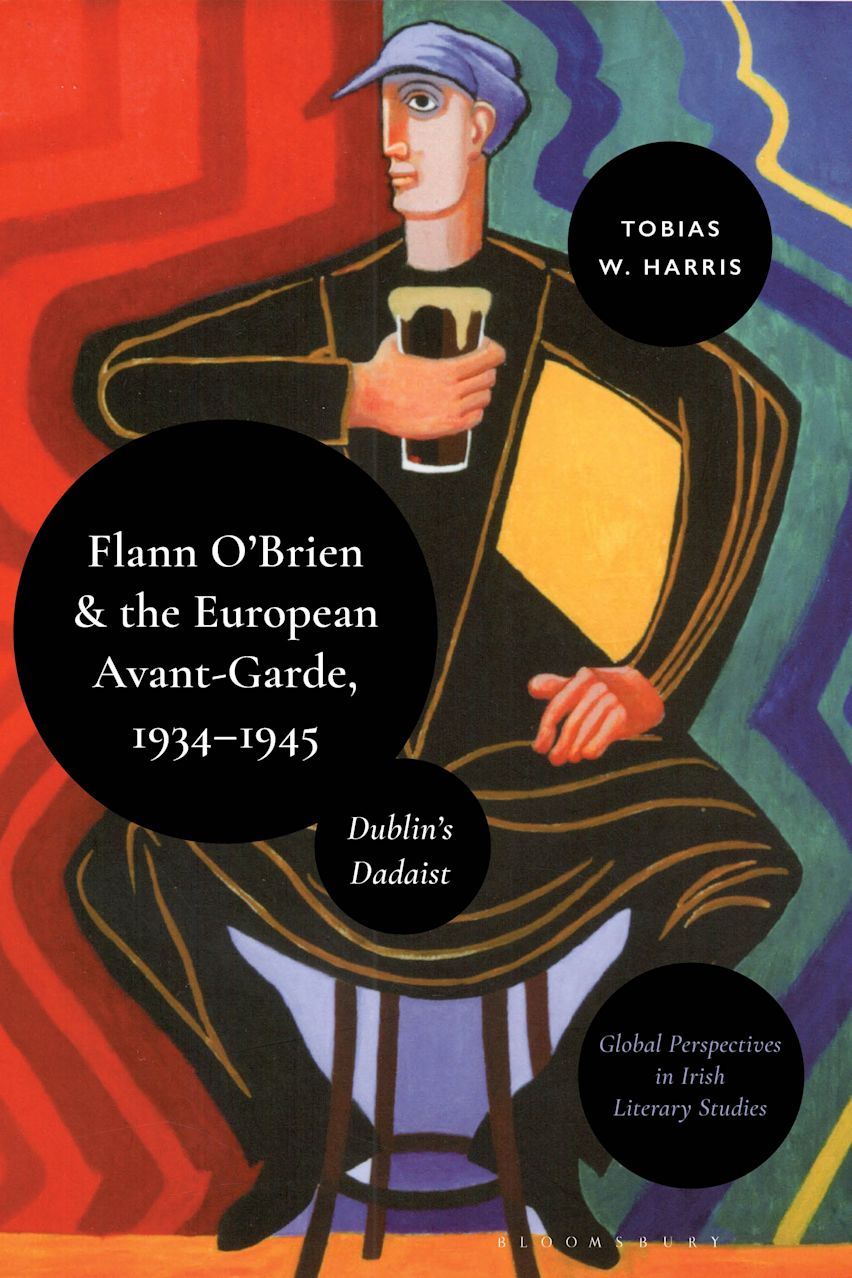
Tobias William Harris
London: Bloomsbury, 2025. 248 pages.
ISBN: 9781350415898
Often, when teaching Irish modernism, it can be all too easy to unwittingly fall into narratives that see the island of Ireland benefiting from European ideas in a one-way fashion. Situated firmly at the margins, this spare and paltry Irish modernism gets positioned as a niche off-cut of the monumentality achieved by the nearby cosmopolites from London, Paris and Berlin. The possibility of such narratives must surely be part of the reason that the editors of the recent Irish Modernisms: Gaps, Conjectures, Possibilities maintain that the term “Irish modernism” can be “critically colonising” (Fagan, Greaney and Radak 2022: 4). It is an image of Ireland as aesthetically indebted; the achievement of Flann O’Brien and the European Avant-Garde is to push back decisively against this, showing a true dialogue at work.
Tobias Harris’s aim is to survey Brian O’Nolan’s (Flann O’Brien’s) projects from 1933-45, in the light of “forms and procedures from which his writing is ‘trying with difficulty to free itself’” (9), contextualised by a corresponding global, specifically European, net of influences. In so doing, Harris provides a vibrant and persuasive picture of the coterie among which O’Nolan was set, and the material circulating in Ireland and abroad. Figures important to this narrative include Niall Sheridan and Niall Montgomery, supported by a peripheral range of notables in Irish literary life, such as Blanaid Salkeld or Micheál MacLiammóir (22). The centrality to his research is clear: “no other circle in Dublin was more attuned to the developments in European avant-gardism” (122). His broad thesis is that this set imbues O’Nolan with an “anti-authoritarian” contribution to Irish literature, in both form and politics (198). For Harris, to study this network is thus to open up a conjunction between his aesthetics and his politics.
For example, in his first chapter on “O’Nolan’s European Milieu”, Harris demonstrates that there is a need for complex accounts of literary influence. Harris shows that Niall Sheridan, who was close to O’Nolan, considered an interchange of ideas between Ireland and Europe happening both ways, with Kafka’s innovations thanks to a general “crisis” in the novel brought about by Joyce (36-7). In fact, the ethos of collaboration is itself drawn into conversation with the collagist aesthetics of Dadaism. A plain history of the network is therefore not enough: rather Harris provides a contextual sense, the cultural and aesthetic ideas proliferating in this circle, in this chapter.
In the second chapter, his analysis of “Blather, Razzle and Dada” brings out the clear connections between O’Nolan’s periodical Blather, the English satirical magazine Razzle, and, less obviously, Dada publications such as Der Dada. Here Harris argues for “linking” O’Nolan “to the practices” of Dadaism, blending the humour of Razzle with the unpredictability and anti-commercial ethos of Dada (62). Harris begins with an “extended identity trope” – the linking of the key word “Blather” to “a series of organizations and commercial products” – and makes connections, both intuitive to O’Brien scholars (such as Cruiskeen Lawn’s free play with the pseudonymous identity of Myles na gCopaleen) and unintuitive but productive: Dadaist photomontage and Blather as satires of “falsified heterogeneity” in art (63-7). In his final chapter, Harris shows how his later career develops from this point: “Cruiskeen Lawn invites readings that place it alongside both Irish newspapers or periodicals and the broader context of European modernism” (178). O’Nolan’s experience of the periodical form invests his work with a complex sense of his work’s relation to other art and society at large.
Harris therefore interprets the job of showing such connections in multiple ways. For example, in his third, more wide-ranging chapter he shows how mutually informing conditions – such as the reactionary turn in 1930s European politics – led both Jorge Luis Borges and Flann O’Brien to “happen […] upon the invented text as a central literary strategy” (86). Usually, it is prudent to avoid the verb “to happen upon” in accounts of literary influence. But it shows us that Harris is looking for not just historical but formal and stylistic connections, letting the literary side of a literary history take the reader into more speculative and exegetical places. In that sense, simultaneous discoveries are being narrated here, the sensitivities and shifting shapes of an entire network, on top of a simpler narrative that outlines plainly who borrowed what from whom. Harris seems unconcerned that Borges is not quite in a “European” avant-garde. Explaining such a turn towards metafictional techniques in the light of European history is a tall order, but also a challenge that any scholar of Flann O’Brien must feel incumbent upon them, and to explain via a correspondence with the Argentine author makes sense.
A still more convincing act of contextual linkage occurs in the fourth chapter, on Kafkaesque elements of The Third Policeman and An Béal Bocht. Here, the book’s association of O’Nolan’s projects to the world-historical depravity of fascism is clearest. With war in Europe breaking out decisively in 1939, the Dáil empowered the government to suspend democratic norms, generating considerable unease among intellectuals like O’Nolan. It is no coincidence both novels exhibit, according to Harris’s interpretation, the infernal inversion of “growth and renewal”, the “rule of arbitrary justice” and “the constant threat of violence” (114-16). The strength of this argument is in a revelatory emphasis on this wartime context to these two novels. There is also strength in seeing the popular English translations of Kafka from the 30s, with their Christianised emphasis on redemptive possibility, reinvented in O’Nolan’s emphasis on a hopeless and exhausted nonhuman world, where human flourishing is actively thwarted by new, violent technologies.
The final two chapters provide what might be to readers the clearest linkages to the European avant-garde thus far outlined. His penultimate chapter, on O’Nolan’s wartime plays Faustus Kelly and Rhapsody in Stephen’s Green: The Insect Play, provides a lucid window into a flourishing theatrical scene in wartime neutral Dublin. Harris brings out Brechtian dimensions, positing these works as examples of his “epic” theatre: through refashioning old stories, the audience is alienated into an observer role, but thereby empowered into decisions, with “comic results” (159). Faustus Kelly joins the chorus of ironisations of Goethe’s Faust spurred by the war, with Thomas Mann, Karl Kraus and Paul Valéry. The Insect Play, meanwhile, transfers a play by the Čapek brothers, From the Insects’ Life, and Kraus’s The Last Days of Mankind, to an Irish context. The humorously strained allegories of these works become parodic “warning[s] against hegemonic politics of any political stripe or ideological justification” (161). Far from an exercise in genre play, the overall understanding is that the Irish political context and the violence raging through the European continent achieve a disquieting convergence in O’Nolan’s plays, “one of the darker statements of O’Nolan’s career as a satirist” (167).
The final chapter, on Cruiskeen Lawn, fully demonstrates O’Nolan’s developed achievements. Engaging with the impact of exhibitions of international modernist art in Dublin by the IELA (“Irish Exhibition of Living Art”) in 1943 and 1944, the column presents a “counterpoint” to The Irish Times war coverage and reveals another anti-authoritarian slant (181). O’Nolan is argued to have evolved his irreverent approach to the periodical from his Blather days, by nurturing a complex aesthetics that seems to point to significant works like Theodor Adorno’s posthumous Aesthetic Theory. The column levels a critique at something “invariably off-stage”, using a “montage procedure [that] reaches outside itself as an object”, thereby bringing an audience to awareness of an incongruence between reality and the art-object, rather than providing a false catharsis like the Irish Times’ reception of the IELA (182). This means the column “encompass[es] in its comic frame the entirety of the daily paper”, which Harris stresses is often reporting from a putatively “neutral” standpoint on the war (186). What emerges is a politicised relationship between art and society: faced with the prospect of art being wholly subsumed into authoritarian structures, Cruiskeen Lawn is also a column explicitly “includ[ing] a critical account of itself”, and thus unable to be co-opted by those who insist on art’s transhistoricality (182-3).
Harris has written a book that both counts as a celebration of O’Nolan’s work and argues for his position in a canon of anti-authoritarian aesthetics and politics. Pointing to a conceptual sophistication behind the humour, the book draws on wide reading and precise archival research to depict O’Nolan convincingly as a successful writer, not a fable of thwarted ambitions. When reading Cruiskeen Lawn, a picture might emerge from Myles na gCopaleen’s unique voice of a satirist paring his fingernails, so to speak, but Harris argues for an engaged, committed artist. This argument requires literary interpretation to work, rather than depending on biographical fact, but this is equally true of many successful Joyce studies, for example. At times, I admit, this mode can feel like arguing by analogy, rather than a genuine dialogue between O’Nolan’s circle and Europe. But by showing a command over the aesthetic debates, and persuasively historicising political developments, Harris has decisively argued his corner. Perhaps directions for future research are suggested by this: how might O’Nolan the reader make connections in time, as well as in space? But also, how else might we define or even qualify O’Nolan’s “anti-authoritarianism”? With these connections amply demonstrated here, the study of Irish modernist writing in general can only benefit from carefully reading, maybe questioning, but surely learning from Harris’s example.
Works Cited
Fagan, Paul, John Greaney and Tamara Radak, eds. (2022). Irish Modernisms: Gaps, Conjectures, Possibilities. London: Bloomsbury.


