
 by
Sandra Costello.
This text may be archived and redistributed both in electronic
form and in hard copy, provided that the author and journal are
properly cited and no fee is charged for access.
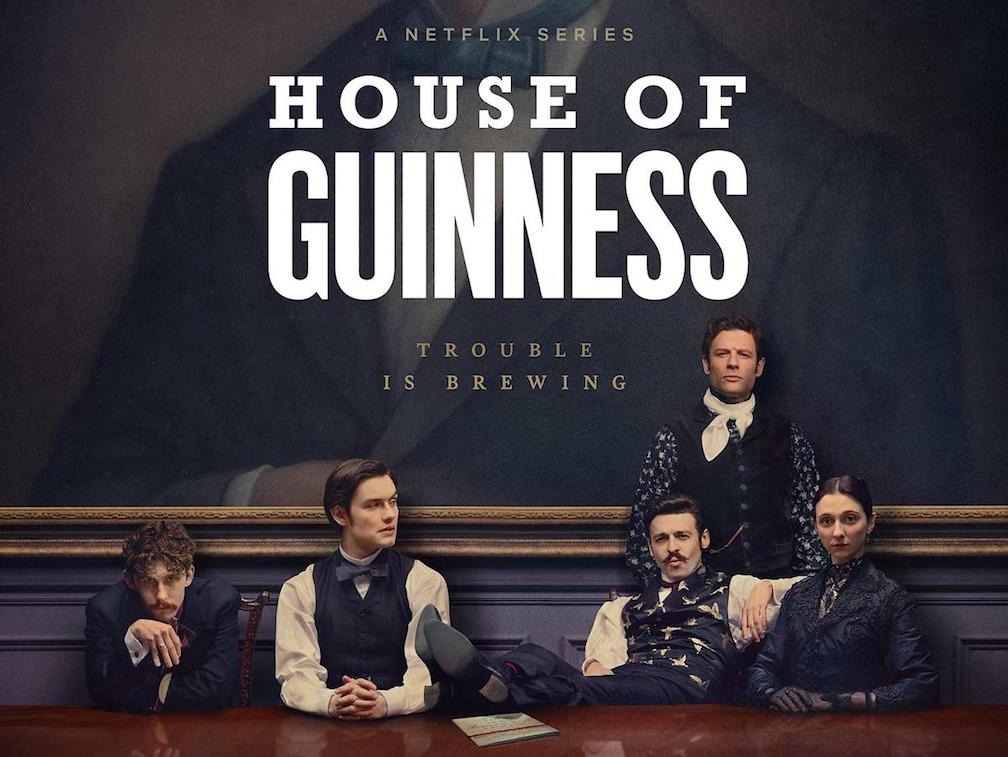
Steven Knight (2025)
The narrative of Stephen Knight’s much-anticipated Netflix series House of Guinness begins in 1868 with the funeral of Sir Benjamin Guinness, who has brought tremendous success to the Guinness brewery. The patriarch is survived by his sons Arthur (Anthony Boyle), Benjamin (Fionn O’Shea) and Edward (Louis Partridge), as well as by his daughter Anne (Emily Fairn). As the eldest son, Arthur, along with his brother Edward, reluctantly inherits the brewery. Arthur is forced to move home to Ireland after a period having enjoyed a certain amount of freedom and independence in London. Arthur is a closeted homosexual man, so his freedom is marked as personally important. It is made clear, however, that if he does not run the brewery with his brother he will be cut off financially from his due inheritance. Benjamin and Anne are both left out of the will because of the former’s issues with alcoholism and the latter’s status as a married woman. Other major characters include: Guinness henchman Sean Rafferty (James Norton), Fenian Ellen Cochrane (Niamh McCormack), Arthur’s wife Olivia (Danielle Galligan), Edward’s wife Adelaide (Ann Skelly), and their distant cousin Byron Hedges (Jack Gleeson).
In the last few years there has been a trend of similarly plotted shows and films across diverse genres depicting powerful, wealthy and influential families in productions like House of Gucci, The Fall of the House of Usher and House of the Dragon. It was Ivana Lowell, a Guinness family descendent, who conceived the idea of creating a programme about her ancestors after watching an episode of Downton Abbey (McHugh 2025). The worldwide success of that series alone demonstrates, at the very least, a contemporary universal desire to look at the fictional lives of wealthy families navigating the changing world and social circumstances of their times.
Kevin Egan, historian of nineteenth-century Dublin, has stressed the central importance of the Guinness family to the history and shaping of Ireland’s capital by comparing them to the Medici of Florence (White 2025). In today’s society, the Guinness brand and name are entities that carry potent cultural and economic significance. For many, it is likely that the association is indelibly present as they connect the product with the country. Considering this prominence, it was evidently timely and viable for distributors that a programme be made about the family behind the name.
Since, according to Egan (White 2025), the Guinness family has shaped Dublin more than any other family or person ever has done, for reasons of residual benefits to the local industry, it is a pity that this show was not made in the city. Rather it was shot in Liverpool, Manchester and Wales (Sunde-Brown). Although this is partly due to the changing architecture of Dublin city over the years, one could be tempted to ask if there might have been a way to film some scenes in Dublin, or at least the scenes where existing architecture and infrastructure are still ostensibly available, such as those in Ashford Castle and in the surrounding countryside. Filming completely outside of Ireland arguably creates an implicit separation from the country and its history, and invites reflection on the construction of the series’ narrative.
The critical response to the Netflix series has largely been one divided between Irish reviewers and their international counterparts. The overall domestic reaction has been focused on the inaccuracies of the dramatisation while the international one has been mostly positive and enthusiastic in response to characterisations and narrative. Irish reviewers are adept at criticising foreign-made representations and often have good reason to do so. Notwithstanding this protectionist tendency, in this instance a few commentators may have been somewhat poetically pedantic. For example, Ed Power of The Irish Times states that English actor James Norton sounds like a “Steampunk Mr Tayto” in his portrayal of Sean Rafferty (2025). In terms of accents, Power fails to mention that Fionn O’Shea uses his own South Dublin accent in his performance as Benjamin Guinness, despite the fact that this accent only developed in the later part of the twentieth century. O’Shea’s accent is not called out because of the actor’s Dublin origins, but this surely demonstrates the unreliability of examining individual Dublin accents in terms of “accuracy”.
Power describes the Fenians as dressing and speaking like “feral leprechauns” (2025). The Fenians’ depiction in some cases is certainly, collectively one-dimensional and they do wear a lot of green (!), but the exaggeration may compromise the evaluation. These characters are mostly played by Irish actors with authentic accents. Power also likens the show to “Succession with shillelaghs” which is a nicely alliterative soundbite but does not quite capture the essence of the series. The show is comparable to Succession because it involves a rich family and issues arising from inheritance, and indeed the success of the earlier show may make the comparison inevitable. The other obvious comparison is Peaky Blinders, Steven Knight’s earlier television series success. In terms of contemporary music choices, violence and shots of slow-motion action, a more favourable formal and aesthetic similarity might have been found between House of Guinness and Peaky Blinders.
Certain types of critical commentaries run the risk of devaluing important areas of contention around Irish representation. An article by Rory Carroll in The Guardian summarises a barrage of negative Irish reviews, juxtaposing them with positive foreign counterparts (2025). Perhaps not as successfully avoiding essentialist positions as he may have been intending, Carroll’s meta-review might nevertheless imply that the Irish tend to find representational faults by falling into long-established ways of critical reaction. The issue is not that commentators are ill-disposed towards the show. However, many of the responses by reviewers fail to consider how it deviates from historically problematic representations of which they have been perennially critical. There is much less of a focus on the writing and plot than there is on costumes and accents. We could usefully ask about the ideological implications of overt (and unrelenting) concentration on historical accuracy in certain modes of critical address and not others.
On The Hard Shoulder podcast with Kieran Cuddihy, Kevin Egan (who has carried out extensive research on the Guinness family during the time represented in the Netflix series), remarks that the show is a “great jumping off point” to get people interested in learning more about the famous family (Cuddihy 2025). Egan takes a different approach when he recognises that there are many inaccuracies in the dramatic work, but goes on to identify that key aspects of the show – such as the Guinness family’s philanthropy, the depictions of the introduction of a contemporary comprehensive social care package, and the contextualisation of political interventions, events and ambition – constitute a very real part of Dublin’s history (White 2025).
The music has been largely applauded, although the score is manifestly unconcerned with historical accuracy and may, in fact, be consciously working against expectations. The soundtrack contains compositions by Kneecap, Fontaines D.C., Gilla Band and Thin Lizzy all of which work in a strategic way to bridge the chronological gap between the diegetic events and the twenty-first-century spectator. In this way, House of Guinness takes its cue from shows like Bridgerton and Peaky Blinders and its use of contemporary songs and music provides a connective access point to period narratives, and simultaneously creates a mismatch with the scenes that suspends verisimilitude in favour of dramatic imperatives. Graphics are used to translate nineteenth-century monetary figures into modern equivalents so there are continual apparent reminders that we are invited to look back at, and reconsider, the representation with a contemporary and distanced eye. This works in a Brechtian (alienating) way that discourages our unreserved and unquestioning immersion in its narrative world.
In the scenes set in Mayo when the action moves to the Guinness-owned Ashford Castle, the show acknowledges the devastating consequences of the famine, undermining the superficiality of the family’s struggles in comparison to the widespread starvation and illness rampant in the countryside. This inspires Anne and later Edward to contribute more to support working class Irish people. The people living in the tough conditions of the Mayo countryside speak only in Irish. This was an important example of a decision deliberately made counter to what might have been economically-motivated decisions; translating the dialogue would have ensured the show’s greater accessibility and audience reach on the global streaming platform. The New York scenes also significantly reference the mass and forced emigration of Irish people to the United States after the famine. The production therefore attempts to present a broad portrait of Ireland and Irish people in the second half of the nineteenth century.
Ultimately bringing long-forgotten people back to life in a part of Irish history that has received less attention than more frequently depicted moments of the twentieth century is a quality worthy of note. Stephen Knight brings his own brand of aestheticised violence and slow-motion action to an Irish context and, in doing so, perhaps necessarily changes a number of real-life events. Knight has been candid about this, however, and even a nod in the credits forewarns viewers of liberties taken: “This fiction is inspired by true stories”. Although it is necessary to be wary of stereotypical representations of Ireland that serve foreign interests, we must be able to decipher the exact areas in which accuracy matters and when we should let the minor details go.
Works Cited
Carroll, Rory (2025). “‘A Steampunk Mr Tayto’: Why Irish Critics Hate Netflix’s House of Guinness.” The Guardian (October 1). https://www.theguardian.com/world/2025/oct/01/irish-critics-netflix-series-house-of-guinness-ireland
Cuddihy, Kieran (2025). “Does it Matter if House of Guinness isn’t Accurate?” The Hard Shoulder (podcast) Newstalk (September 2025). https://www.newstalk.com/podcasts/highlights-from-the-hard-shoulder/does-it-matter-if-house-of-guinness-isnt-accurate
McHugh, Clare (2025). “‘A Lot Juicier than Downton Abbey’: The Real-life Family Drama Behind New Netflix Show House of Guinness.” BBC (September 23). https://www.bbc.com/culture/article/20250922-the-real-family-drama-behind-house-of-guinness
Power, Ed (2025). “House of Guinness on Netflix Review: Wildly Unfaithful Retelling is like Succession with Shillelaghs.” The Irish Times (September 25). https://www.irishtimes.com/culture/tv-radio/2025/09/25/house-of-guinness-on-netflix-review-wildly-unfaithful-retelling-is-like-succession-with-shillelaghs/
Sunde-Brown, Daniela (2025). “‘House of Guinness’ Filming Locations (and How you can Visit them IRL).” Trafalgar.com (October 8). https://www.trafalgar.com/real-word/house-of-guinness-filming-locations/#:~:text=Why%20wasn’t%20House%20of,can%20visit%20in%20real%20life
White, Jack (2025). “House of Guinness: Fact v Fiction – Is the Netflix Series Historically Accurate?” The Irish Times (October 1). https://www.irishtimes.com/culture/tv-radio/2025/09/30/house-of-guinness-fact-v-fiction-is-the-netflix-series-historically-accurate/


