
 by
Daniel Gallen.
This text may be archived and redistributed both in electronic
form and in hard copy, provided that the author and journal are
properly cited and no fee is charged for access.
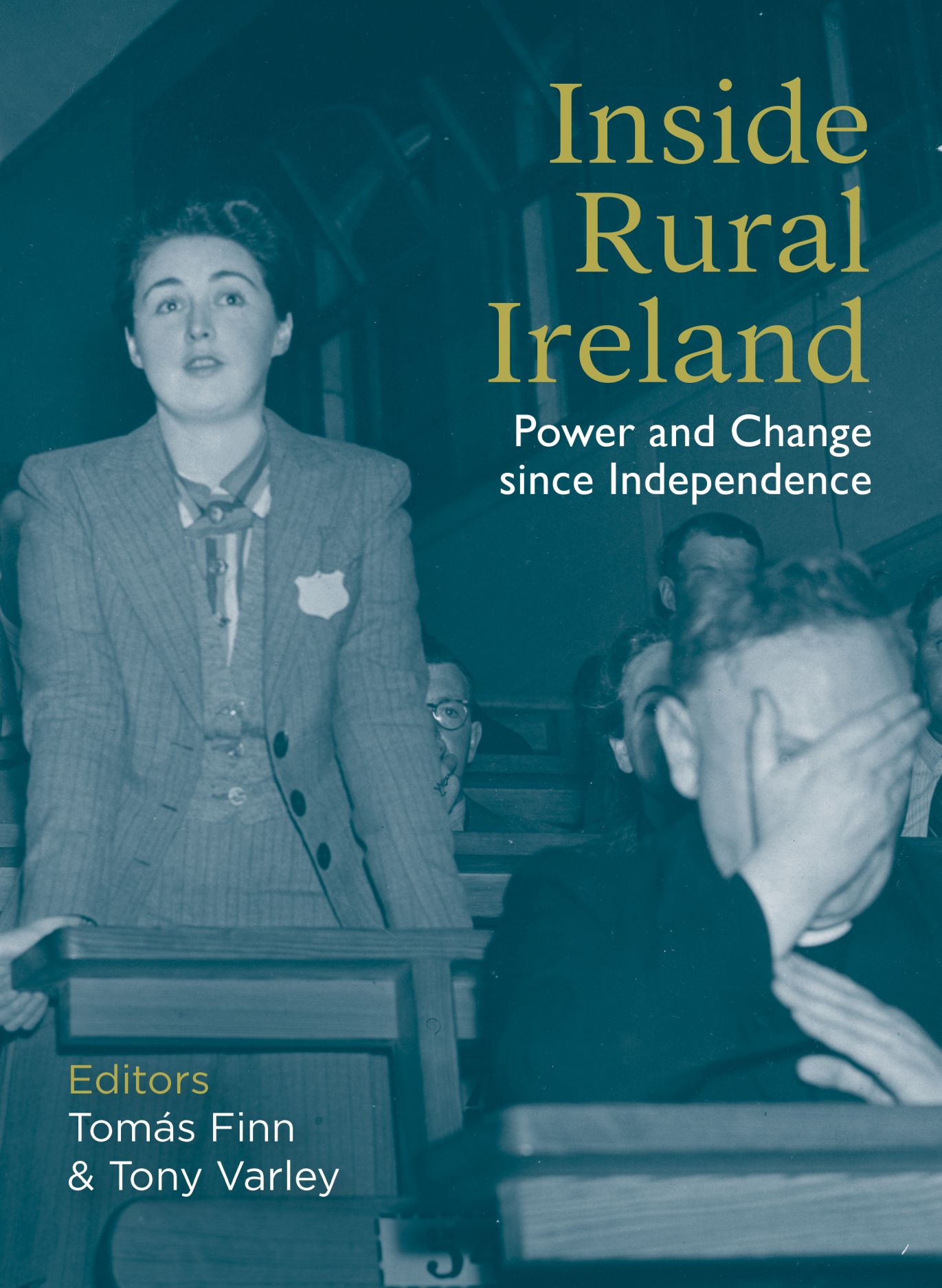
Tomás Finn and Tony Varley, eds.
Dublin: University College Dublin Press, 2024. 304 pages.
ISBN: 9781739086367
Inside Rural Ireland is an insightful examination of an oft-overlooked dimension of Irish history and society. The work shines a light on the diverse, multifaceted, and often contradictory inner workings of rural Irish society and politics from the beginning of the Irish state right up until the present day, illuminating the myriad ways in which the Irish countryside navigated developments and power dynamics over the past century.
Following an introduction written by editors Varley and Finn, the book is divided into five sections, each inspecting unique elements of Irish rurality. The first of these examines the role of the state in its direct interventions and planning efforts in rural areas; in Chapter Two, Gearóid Ó Tuathaigh focuses on the changes in official intervention in the pre- and post-Independence period; and in Chapter Three, Peter Murray and Maria Feeney examine the developments of the 1960s during a period of nationwide economic recalibration. These opening chapters, taken together, show that – despite being separated by a generation and status-quo-upending global war – there existed a noted disconnect between official plans for rural Ireland and their real-terms impact. This is exemplified in Ó Tuathaigh’s essay through the case of the newly established Free State’s dismantling of the Congested Districts Boards in favour of a system that treated all impoverished rural areas as a homogeneous mass; and in Murray and Feeney’s chapter by the seemingly inverse correlation between the number and scale of enthusiastic proposals brought forward by groups like Muintir na Tíre, and the relative dearth of funding or support provided by the Irish government of the mid-century.
The second section addresses the means by which groups and individuals – in particular, Father John Hayes – attempted to organise rural civil society. Much of this section deals with the ideologies and activities of Muintir na Tíre, but analysis is also devoted to political organisation such as the mid-century farmers’ parties like the National Farmers’ and Ratepayers’ League (NFRL) and Clann na Talmhan, and to civic groups like Tuairim. Chapter Four sees Eoin Devereux critically reassess the work and legacy of Father John Hayes, founder of Muintir, and present his role in defining the early ideological direction of the organisation along with its use of the parish as a vehicle for rural community organising. Further, Devereux invites us to ask if Hayes, in this regard, was representative of a real desire to shape and direct rural development, or merely to reinforce a conservative social hierarchy by providing a forum within which class differences could be ameliorated but never, ultimately, challenged. Tony Varley, in Chapter Five, then outlines the ways in which a number of groups – such as Muintir, the NFRL/National Centre Party, and Clann na Talmhan – sought to organise rural communities, how they did or did not manage class and gender differences, and their relationships with the political establishment. Varley also highlights the very interesting divergence in methodology between them, in that the latter pair sought to directly challenge the power of the ruling Fianna Fáil party by contesting elections whereas Muintir sought to collaborate with them from outside of the party-political system. In Chapter Six, Tomás Finn assesses the work of two groups: Muintir and Tuairim, the former a Christian, parish-centric, rural community development organisation; the latter a secular, urban, intellectual society seeking to effect change in Irish society by driving it in a more liberal direction. This chapter explores these groups’ divergent approaches to tackling social change in mid-century Ireland, and their varying relationships to both the Catholic Church and the State.
The third section examines contemporary perceptions of rural Ireland in the mid-twentieth century. Caitriona Clear analyses the portrayal of rural Ireland in popular Irish fiction of the 1940s, and provides an interesting overview of the depiction of rural life and communities in novels of the time. Of note are the representations of entertainment, such as going to ‘the pictures’ or dancing, as well as the surprisingly (for the era) complex treatment of the experiences and attitudes of female characters. Bryan Fanning then provides an interesting insight into the broader theological and sociological theory through which Catholic intellectuals – and, by extension, their institutions – viewed and engaged with rural Ireland, its problems and its “decline”, as well as their proposed “solutions”. An interesting observation the reader may make is how many of these problems, and the anxieties that followed from them, were – to some extent – realised in modern Ireland, or how the issues identified in the pages of Christus Rex in the mid-century reflect those still present today.
The penultimate section focuses on the position of women and their relationship to – and challenges of – patriarchal structures of power in rural society. Anne Byrne and Tanya Watson track the evolution of the place of women in farming households in the twentieth century through careful analysis of anthropological and sociological studies carried out between the 1930s and 1990s. It particularly identifies changing externalities (economics of agriculture, sustainability concerns, etc.) as being of equal import to developments in their positions as changing conceptions of a “woman’s place” in farming due to a growing feminist consciousness. Chapter ten, by Micheál Ó Fathartaigh and Anne Cassidy, charts the development of female-led advisory bodies in the Irish agricultural sector and questions the extent to which these can be seen as challenging traditional structures of patriarchal power. One of the examples herein – that of the poultry-farming instructresses – was so successful that it created sufficient demand to warrant increased industrialisation of poultry-farming. However, because of the analysis by Ó Fathartaigh and Cassidy, the instructresses almost appear to have become victims of their own success: as poultry-farming became such a lynchpin of the agricultural sector – thanks in large part to the work of the instructresses – it stopped being seen as within the domain of women and, ultimately, became a more male-dominated field.
The final section turns its attention to the contemporary Irish countryside: synthesising, in a way, the work of all the preceding chapters to elucidate the current state of rurality. Mary Cawley provides an insightful statistical analysis of surveyed emigrants and returnees from rural areas, tracking their reasons for leaving and coming back. While it notes the overall importance of economics as a driving factor for migration, it also highlights the impact of “social causes” on both out- and in-migration and shows that emigration (and return) cannot be viewed through a purely economic lens. The decision to return she attributes to a desire to “settle down” and a perception of the Irish countryside as a preferable environment in which to start or raise a family, coming as it does with proximity to social support networks, while still recognising that improving economics “facilitated return” (152). Mary E. Daly rounds out the book with an overall hopeful chapter that dispels many of the myths and anxieties associated with the “decline” of rural Ireland. She tracks the many positive developments – both economic and social – that have affected the region, while still paying heed to the challenges it and its inhabitants continue to face. She also highlights that the traditional rural/urban divide has, in many ways, been diminished over the past century through advancements in infrastructure, connectivity and improved employment and education prospects. However, her suggestion that the COVID-19 pandemic’s contribution to the prevalence of remote working could see “large city-centre office complexes […] become redundant” (163) would appear to overlook the myriad other reasons individuals choose to live in urban centres, beyond employment opportunities.
As a whole, the book excels in dispelling the perception of rural Ireland throughout the twentieth century as a cultural and economic monolith, to be viewed simply as a periphery of the urban centres of the island. Rather, it shows that the rural “hinterland” was anything but – and that many of the driving forces of change (or, at least, attempted change) were developed from within by an active and civic-minded rural public. Far from being a society averse to adaptation to economic and societal challenges, or one merely having said adaptations imposed upon them from without, Inside Rural Ireland demonstrates that rural populations, through their community groups and leaders, were more than willing to organise and campaign for these adaptations on their own terms.
However, the exact nature of these “terms” was hardly set in stone, and contributions to the book reveal the heterogeneity of thought and opinion even within groups that were, prima facie, broadly aligned ideologically. Varley’s comparisons between John Hayes’ Muintir na Tíre on the one hand and Frank MacDermot and Michael Donnellan’s Farmers’ Parties on the other is an excellent example: while both groups sought to organise rural communities generally and agricultural workers specifically, MacDermot and Donnellan sought to challenge the ruling party by engaging in electoral politics, whereas Hayes adhered to a strict doctrine of subsidiarity – one that would cooperate with the ruling party but stand apart from it. Furthermore, Finn’s examination of Muintir’s relationship with the institution of the Catholic Church (and with archbishop John Charles McQuaid in particular) in chapter six highlights that Muintir, whom one would be hard-pressed to argue was not heavily influenced by a contemporaneous current of conservative Catholic social thought, were seen by McQuaid as “not Catholic enough” because they self-described as a “Christian” organisation and allowed participation from Protestants (77). The work is also careful to avoid viewing rural Ireland purely in terms of political alignment or agricultural output. While these elements are certainly tackled in many of the chapters, space is also devoted to such diverse themes as external perceptions of rurality; the position and agency of rural women; the contact and conflict between rural Ireland and a globalising economy; and the myriad, often idiosyncratic, manifestations of class dynamics in such a setting.
The term “rural” is, of course, not synonymous with “agricultural”’ and while several chapters within the book do make an effort to engage with rurality beyond the boundaries of the farm (Clear and Fanning’s chapters standing as notable examples of this), the lion’s share of the text centres the experiences of agricultural labour within the farming sector. One cannot help but feel that this was a missed trick for a work whose primary raison d’être seems to be to challenge the perception of homogeneity within rural Irish life. For instance, it seems very likely that the experiences of rural communities, even rural farmers, located around the border would not – could not – have been the same as those on the Atlantic coast in Munster, especially during the IRA’s border campaign of the 1950s-60s, or during the Troubles, or in the post-Good Friday Agreement era. Yet this is something left unexamined. Similarly, little mention is made of those involved in the fishing industry, despite this being a) a form of agricultural labour, and b) an economic activity predominantly centred in rural areas. The annual report on sea and inland fisheries from the Department of Agriculture and Fisheries (7 & 20) in 1974 recorded slightly over 13,000 people engaged in employment in the fishing industry. This was also an industry that would have been significantly impacted by Ireland’s accession to the EEC in 1973, as well as by broader technological advancements in shipping and fish farming. However, this industry – and by extension the communities built up around it – are absent from any analysis in the book, despite such analyses being applied rather thoroughly to its landed counterparts. A further work covering such omissions could make for a compelling companion to this book.
Overall, Inside Rural Ireland is a well-researched, thought-provoking, and generally accessible foray into the history and sociology of a somewhat understudied – and certainly underappreciated – element of modern Ireland. It challenges us to view Irish rurality not as some kind of backwater: frozen in time and solely reliant on urban centres to drag it kicking and screaming into modernity; but rather as a vibrant, dynamic socio-cultural milieu brimming with life, ideas, personality and – most importantly – agency in its own development. This is of particular relevance to Mary E. Daly’s final chapter, where a more careless reading thereof could give the impression that all the work laid out thus far – of Muintir; of Macra na Feirme; of feminist agitation – was ultimately “wasted effort” because everything “turned out fine”. But rural Ireland, as has been demonstrated by the book, has been shaped in the modern day by all that which came before. The attempts, regardless of their levels of success, by those rural inhabitants to exercise their agency is brought to light within the text and demonstrates the importance of finding and analysing those historically overlooked and maligned voices so that we might listen to, and learn from, that which they have to say.
Works Cited
Ireland, Department of Agriculture and Fisheries. “Fisheries Division. Sea and Inland Fisheries Report for 1974.” The Stationery Office, 1975, https://oar.marine.ie/bitstream/handle/10793/1584/Report%20of%20the%20Sea%20and%20Inland%20Fisheries%2C%201974.pdf?sequence=4&isAllowed=y.


