
 by
Tadhg Dennehy.
This text may be archived and redistributed both in electronic
form and in hard copy, provided that the author and journal are
properly cited and no fee is charged for access.
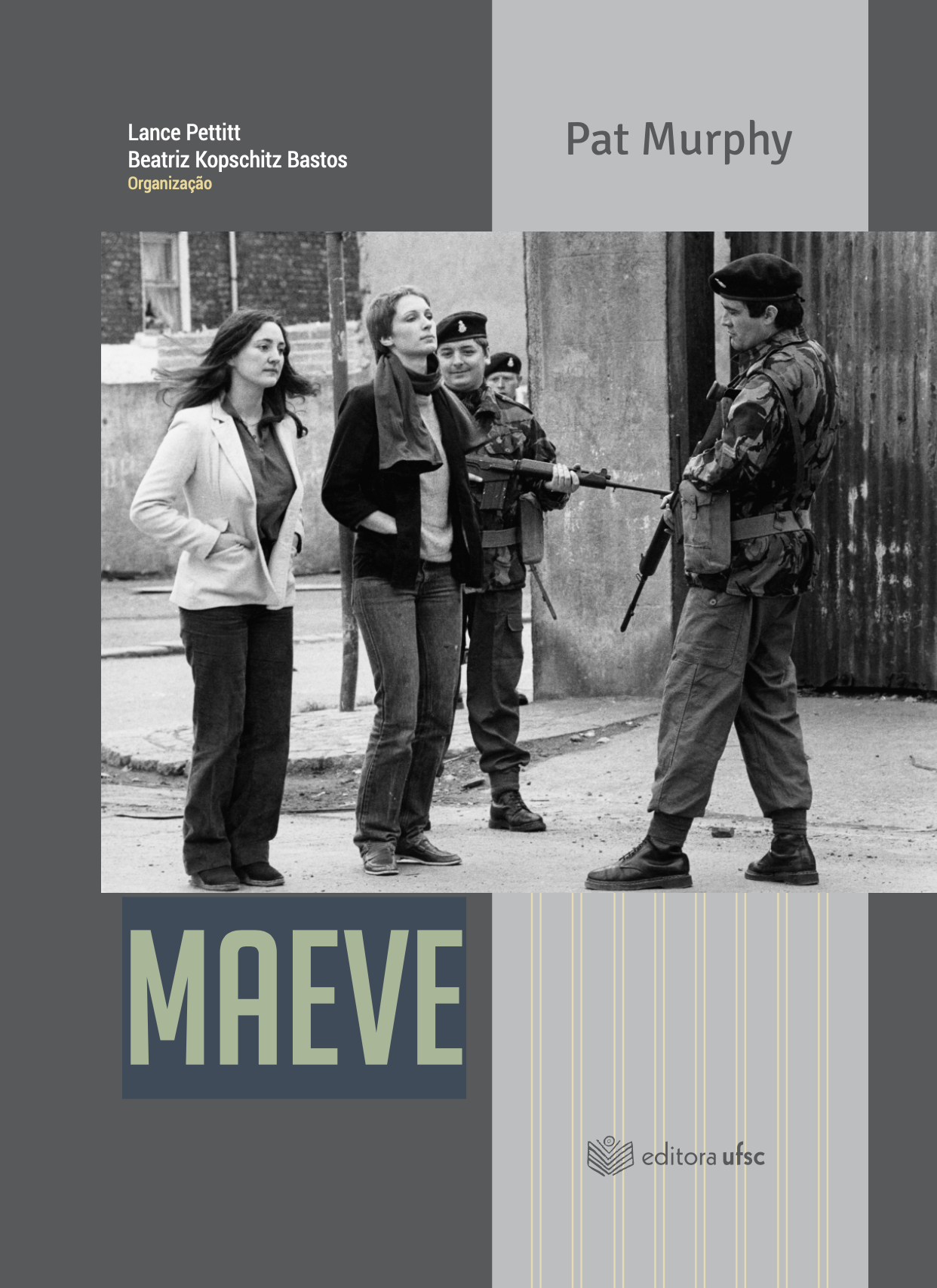
Lance Pettitt and Beatriz Kopschitz Bastos, eds.
Editoria UFSC, 2022
E-Book
In “Making Maeve”, Pat Murphy writes “I think there’s a definite moment when the national cinema of different countries comes into focus and interesting films are made. In the 40s it was Italy and Neo Realism. Then it was the French New Wave followed by the New German Cinema of the 1970s. I thought that the 80s was going to be Ireland’s turn” (Murphy 2022: 74). This reflective piece included as part of Lance Pettitt and Beatriz Kopschitz Bastos’ fourth entry in the series Ireland on Film: Screenplays and Critical Contexts captures the sense of optimism surrounding cinematic practice in Ireland in the 1980s. This, of course, was the decade that saw the establishment, in 1983, of what became the first iteration of the Irish Film Board, providing long overdue statutory support for a then fledgling Irish film industry. By decade’s end the Board was disbanded by then Taoiseach Charles Haughey due to poor financial returns, not before it put its name to a number of noteworthy pieces of indigenous Irish filmmaking. While Pat Murphy’s 1981 film Maeve, the subject of this publication, was produced prior to the Irish Film Board’s establishment, it stands as an exemplar of this period of abundant creative practice and artistic inventiveness in indigenous Irish filmmaking.
Through this publication, editors Lance Pettitt and Beatriz Kopschitz Bastos cement Maeve’s position among other “outstanding films from Irish cinema” and present the reader with a series of critical essays, by Alice Butler and Emmie McFadden, and a personal reflection on the film’s production by Pat Murphy, to help us better appreciate the film’s worth as a work of art and its cinematic and cultural afterlife (8). Also included is the film’s complete screenplay which brings into sharp focus the subtleties and nuances of the film’s dialogue, particularly when read in tandem with the critical reflections here.
Alice Butler’s “‘Permissions and Contexts’: Framing the Work of Pat Murphy” offers a detailed and comprehensive overview of Murphy’s career, and the contexts surrounding the production of her four feature length films: Maeve (1981), Anne Devlin (1984), Nora (2000), and Tana Bana (2015). Following this is “Making Maeve”, Pat Murphy’s personal reflection on the production process. We are then presented with the film’s screenplay which, when presented alongside these critical and personal reflections provides an added depth and dimension to both the viewing and reading experience, bringing welcome focus to the “skilful rendering of words in the process of composition for the final screen effect” (8). The final critical essay is Emmie McFadden’s “From Belfast to Maeve: Remembering as Re-vision”, which considers “two forms of dominant kinds of memory manifest in Maeve, namely personal memory and cultural memory” (262).
Maeve tells the story of Maeve Sweeney, played by Mary Jackson, a young woman from a Catholic background who returns home to Belfast after years of studying in London. Her homecoming is fraught with tension as she reckons with her past and a city that feels hostile and unwelcoming. This estrangement is fuelled not only by the oppressive presence of soldiers and police but also by the deeply embedded sexism and at times blatant misogyny within the Republican movement. Her boyfriend, Liam, played by John Keegan, is the embodiment of this hostility with his disdain for Maeve’s feminism, dismissing her concerns as a divisive and indulgent distraction. “I represent the women here more than you do,” he states, a line that resonates with all the weight of the Republican movement’s inherent androcentrism. The layered, multi-generational narrative of Maeve captures the emotional toll of societal and political forces on personal lives, particularly through the lens of women striving to redefine themselves and their place within Northern Irish society.
A formally inventive and politically charged film, Maeve was produced, cast, shot, and set against the backdrop of Belfast during the height of the Troubles. Dublin-born filmmaker Pat Murphy, who lived in Belfast between 1967 and 1972, returned with editor John Davies and cinematographer Robert Smith, both fellow graduates of the Royal College of Art, London. They, together with local actors and theatre groups, crafted what was to become the first film to be made entirely in Belfast since the beginning of the Troubles. Murphy writes in her personal reflection “Making Maeve” of her sense of shame around her insistence on making the film in Belfast, and at her “ignorance in exposing people to danger by trying to make [Maeve] in the middle of an escalating war” (72). Indeed, at the time of the film’s production the political situation in Northern Ireland was particularly tense, with the first hunger strikes beginning shortly after production wrapped on the film.
The narrative unfolds through a series of fragmented flashbacks and present-day scenes, painting a vivid picture of Maeve’s life as a child, a schoolgirl, and a young woman in both Northern Ireland and London. Maeve’s move from Belfast to London, an experience which is shown to trigger her progressive awakenings, is mirrored perhaps in Murphy’s own childhood experiences. Alice Butler describes her family’s move from Dublin to Belfast, as “a deeply formative experience during [her] upbringing” (26). Murphy would later move to London to attend the Royal College of Art. Regarding Maeve, Butler highlights the fact that through her schooling in both Dublin and Belfast, Murphy was exposed to a distinct “variance between […] two accounts of Ireland’s recent past”, where on the one side she was taught to “believe in the reunification of Ireland as you believed in God”, and on the other the “completely opposite position of English textbooks” (26). This “afforded Murphy the important opportunity to appreciate the mutability of narrative as well as the power and significance of authorship in relation to any recounting of history” (26).
This mutability manifests itself throughout the film in the clash of two “dominant kinds of memory”, personal and cultural, as outlined by Emmie McFadden in “From Belfast to Maeve: Remembering as Re-vision”. The film’s several memory sequences serve as a devise for Murphy to utilise “personal memory to destabilise the history and myths that help form cultural memory” (262). Indeed, Maeve is seen to totally reject the received cultural myths and memories that define the Republican struggle, a position that is received by her boyfriend Liam “as an attempt to erode the dominant narrative of the past and undermine the memories upon which his struggle is based” (268). Similarly her father Martin, “the dominant storyteller in the household” (269), played by Mark Mulholland, brings a different dynamic to this clash of memory. In flashback he is portrayed as a roguish, fast-talking salesman, however his once-romantic charm now seems tinged with creeping fear as he clings to the stories that once defined him. Both McFadden and Butler’s chapters tease apart the dominant themes that have occupied Murphy throughout her filmmaking career from Maeve to Tana Bana, to great effect.
Indeed, these progressive themes at the heart of the film led to some divisiveness following some early screenings in London and Belfast. Murphy describes the film as “a discursive open-ended film that raised questions about Republicanism and feminism at a volatile point when the space for those debates seemed to be closing down” (73). Murphy details the reaction among the film’s Northern Ireland based production team; they “disliked the film intensely” and felt that given the ongoing hunger strikes, where members of their community were “now watching [their] young men die”, the film represented a danger to them by dint of their taking part in its production. The crux of this sentiment stems from the feeling among those early viewers that “when someone got an opportunity to make a film that she shouldn’t make something that criticised her community at a time like this” (73). Ultimately however, no one wanted their name removed from the film. Murphy goes on to detail the positive reception the film received internationally, including screenings at the Edinburgh, Venice, and London film festivals, and domestically with the award of Best Irish Film at the Cork Film Festival.
The inclusion of Maeve, a meticulously crafted and intellectually stimulating film, as the fourth entry in the Ireland on Film: Screenplays and Critical Contexts series represents a significant and commendable contribution by editors Lance Pettitt and Beatriz Kopschitz Bastos. This volume offers a welcome critical lens through which to examine a film’s that remains somewhat under-appreciated and foregrounds that film’s exploration of feminism, identity, memory, and the political complexities of Northern Ireland. The in-depth analysis provided by Alice Butler and Emmie McFadden not only enhances an understanding of the film’s nuanced themes but also situates Maeve within broader cinematic and socio-political discourses. Furthermore, Pat Murphy’s personal reflection on the film’s production adds a valuable insider’s perspective, enriching the reader’s appreciation of its artistic and ideological significance. This volume serves as an essential companion for both first-time viewers and those revisiting the film, offering new insights into its enduring relevance and critical impact.


