
 by
Christine Cusick.
This text may be archived and redistributed both in electronic
form and in hard copy, provided that the author and journal are
properly cited and no fee is charged for access.
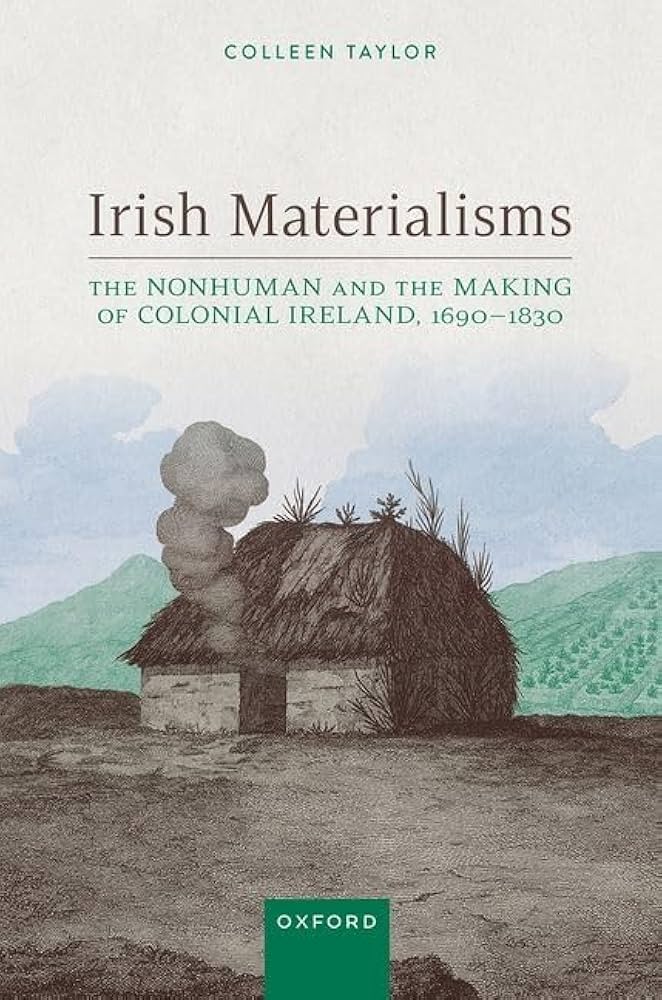
Colleen Taylor
Oxford University Press, 2024. 256 pages.
ISBN: 9780198894834
Colleen Taylor’s study Irish Materialisms: The Nonhuman and the Making of Colonial Ireland 1690-1830 (2024) invokes a diligent new materialist methodology to offer a meticulous analysis of nonhuman narratives. This study enters the conversation of an established and evolving field of Irish ecocriticism and environmental humanities, with scholars such as Gerry Smyth and John Wilson Foster, more than two decades ago, among the first to invite scholars to consider the place of nonhuman nature in Irish Studies. Through diligent research and close analysis, Taylor’s framework of new materialism joins this conversation of environmental humanities, offering us a valuable lens for how we might honor the complex networks of colonial loss and their impact on ways of being upon the earth.
While Irish Materialisms expertly draws upon an impressive body of literary voices, ranging from Maria Edgeworth, to Sydney Owenson (Lady Morgan), to Jonathan Swift, to John and Michael Banim, to William Carleton, Taylor reminds us from the start that “The main characters of this book are the five nonhuman objects: coins, flax, spinning wheels, mud, and pigs, carefully chosen as case studies in colonial culture and thought” (1). The book’s austere organization is its strength, inviting readers to closely examine these chosen objects: coins, flax, spinning wheels, mud, and pigs, so that the lens of materialism is highlighted through hermeneutics and form. Through these case studies, Taylor shifts the reader’s expectations, inviting close readings of the material histories and what she describes as “narrativity” of objects specifically used and/or experienced by all classes. The study of cultural texts in this book, specifically their use of these objects to designate class and/or national identity, becomes a means to the greater end of unlocking the stories of the objects themselves. Moreover, the study also astutely uncovers the ways these stories are intricately connected to ways of knowing the earth and the labors that shape it. By way of example is Taylor’s incisive chapter on mud, in which her final analysis of the mud cabin ecosystem reminds the reader a
new materialist history of mud cabins has traced an environmental narrative and a colonial one. The effect of colonialism in Ireland was to cut the human off from nature conceptually and physically. Colonial writers sought to intercept the symbiotic relationship between Irish tenant, local soil, and animals like pigs, using powerful metaphors to denaturalize Irish survival and their ability to live creatively in nature. (182)
Taylor’s attentiveness to the far-reaching consequences of this material history and her invocation of a postcolonial framework unfolds into an important gesture toward ecological epistemologies: “The colonial tragedy in Ireland, therefore, is not just what happened to the native Irish people and their culture, but also the erasure of an entire human-nonhuman ecological system and all its possibilities” (182-3). Through this conclusion to the case study of mud, Taylor calls forth the value of her own analysis, leaving the reader wanting more about the loss of an “alternative ecological philosophy” (183).
The book closes with a fascinating study of the pig, the only sentient object chosen for Taylor’s consideration. Drawing parallels to the analysis of the mud house, Taylor argues that “pigs were a crucial and neglected part of the eighteenth-century Irish tenantry ecosystem, contributing to rural Ireland’s collaborative, creative survival” (185). Mapping the pig’s long history from medieval wild forager to the domesticated peasant companion and commodities that are central to the land worker’s daily routine, the chapter proceeds to situate the pig as a central character in the Irish colonial culture.
Taylor begins the book with “Preface: Retrieving the Colonial Past”, a reflection that offers a compelling framework for her study, situating it within her own family history of emigration from west Clare to the flourishing marketplace of the textile industry, naming her curiosities about the silences as a force for the research, which seeks to “look closely at materiality in order to texturize and add layers to the history of colonialism and its forgotten, silenced citizens” (xvi). And although she offers a bit of an apology for this turn, her instinct, and the deep understanding that it “matters” – as she writes in the next sentence – to both the “family” and to the “methodology,” is a strength of this study (xvi). These are the stories that meaningfully wed us to our subjects, and they are also the force by which the field of environmental humanities might have planetary impact beyond the academy. This turn subtly locates Taylor’s study within a tradition of narrative, ecocritical scholarship that acknowledges that the scholar’s situated place can function to disrupt the human constructed hierarchies that deny our embodied existence on this planet. The fact that Taylor’s study unfolds from this point of recognition enriches the methodological lens and the comprehensive result. When studied with Taylor’s care, these objects hold the stories of complex connections: from the coin’s allusion to the intersection of colonial enterprise and gender violence, to the complicity of the flax plant in industrial expansion, to the spinning wheel’s connection to feminist subjectivity. By situating these objects within their cultural, colonial, and planetary contexts this study gives voice to the silenced nonhuman and human lives with which they are enmeshed.


