
 by
Seán Patrick Donlan.
This text may be archived and redistributed both in electronic
form and in hard copy, provided that the author and journal are
properly cited and no fee is charged for access.
Jim Sheridan (2025)
It would be difficult to overstate the importance of Jim Sheridan to Irish cinema. Born in Dublin, he worked in the theatre there and in the United States before becoming Ireland’s best-known film director. His friend Neil Jordan was his only significant cultural equal over the next decade or so. The international success of Sheridan’s My Left Foot (1989), his début as writer-director, was aided by an extraordinary cast, including a young Daniel Day-Lewis. Inevitably, some biographical details of his subject, Christy Brown, were altered or occluded. But the director artfully balanced the talent and tantrums of Brown, who succeeded as a writer despite cerebral palsy. The film received five Oscar nominations and won two. Fittingly, the story of one Irishman’s need to express himself against the odds helped to initiate a new era for the domestic film industry enabled by the subsequent successes of The Commitments (1991), Jordan’s The Crying Game (1992), and the relaunch of the Irish Film Board in 1993, which oversaw the allocation of government funds directly to the sector.
My Left Foot, co-written with Shane Connaughton, was the first of several films in which Sheridan interrogated Irish events and identity. He adapted John B Keane’s The Field (1990), with Richard Harris, although he shifted its historical setting rather substantially from the 1960s to the 1930s. Sheridan went on to write Into the West (1992) with David Keating. Directed by Mike Newell, the film was informed by a folkloric Celtic magic realism very different from the gritty urban realism of the Dubliner’s other work. With Terry George, Sheridan wrote In the Name of the Father (1993), centred on the Guildford Four – a group of Irish men and women who, while resident in England, were wrongly accused of IRA-associated bombings in that country. Directed by Sheridan and again starring Day-Lewis, it was another global success, achieving seven Oscar nominations. But just as a wilful distortion of legal facts and the concerted construction of a false narrative had effectively imprisoned the accused, the writer-director’s considerable liberties with the truth were troubling. Still, there appeared an underlying veracity about the corruption of the British state and legal order that demonstrated an ability to accommodate convenient deceptions.
Sheridan’s contributions to Irish film expanded into production. He wrote Some Mother’s Son (1996) and The Boxer (1997), again with Terry George, and he directed the latter. He co-produced Anjelica Huston’s Agnes Browne (1999) and returned to an earlier passion when he acted (in a brief cameo scene) in John Boorman’s The General (1998). His last significant success was In America (2002), a semi-autobiographical film about modern Irish emigrants to the United States. It was co-written with his daughters. In the same year, he acted as Executive Producer for Paul Greengrass’ Bloody Sunday (2002). But Sheridan’s subsequent films, mostly set outside of Ireland, have been of a decidedly uneven quality, although they demonstrated some ingenuity with generic formulae such as those featuring in works like Get Rich or Die Tryin’ (2005), Brothers (2009), and Dream House (2011). The Secret Scripture (2016) saw him return to Ireland, adapting Sebastian Barry’s novel. But local audiences were somewhat disorientated by the narrative, an experience not relieved by the director’s choice to rearrange the film chronology by fragmenting the novel’s original timeline, fundamentally altering its context and rendering many of its conflicts confusing. It is fair to assume that these creative decisions were taken as a way to accommodate foreign viewers who might have been ignorant of Irish affairs.
A few years after In the Name of the Father, a violent murder occurred in rural County Cork, a few days before Christmas 1996. French national Sophie Toscan du Plantier (née Bouniol), a television producer, was killed. She was thirty-nine. The narrative of the event has gripped Ireland ever since. Englishman Ian Bailey, a resident of the small West Cork village of Schull where the crime was committed, quickly became the primary focus of press coverage and police investigations. Peculiar and violent, he had held a variety of jobs, including work as a freelance journalist. As the number of his enthusiastically self-directed media interviews and appearances grew, unfavourable and incriminating details emerged, which intensified the mystery around the event: Bailey had suspicious scratches and was shown to have lied about his whereabouts on the night of the murder. While Bailey’s partner initially supported him, her story changed over time, and he was later convicted of domestic violence against her. Some even claimed that he privately admitted the murder, although this was dismissed as the result of drink and colourful conversation. When the Department of Public Prosecutions failed to charge Bailey, the French government unsuccessfully attempted to extradite him. Finally, he was convicted in 2019 in absentia by the French courts. He was sentenced to twenty-five years but was never imprisoned. Ian Bailey eventually died of natural causes in January 2024, just shy of his sixty-seventh birthday.
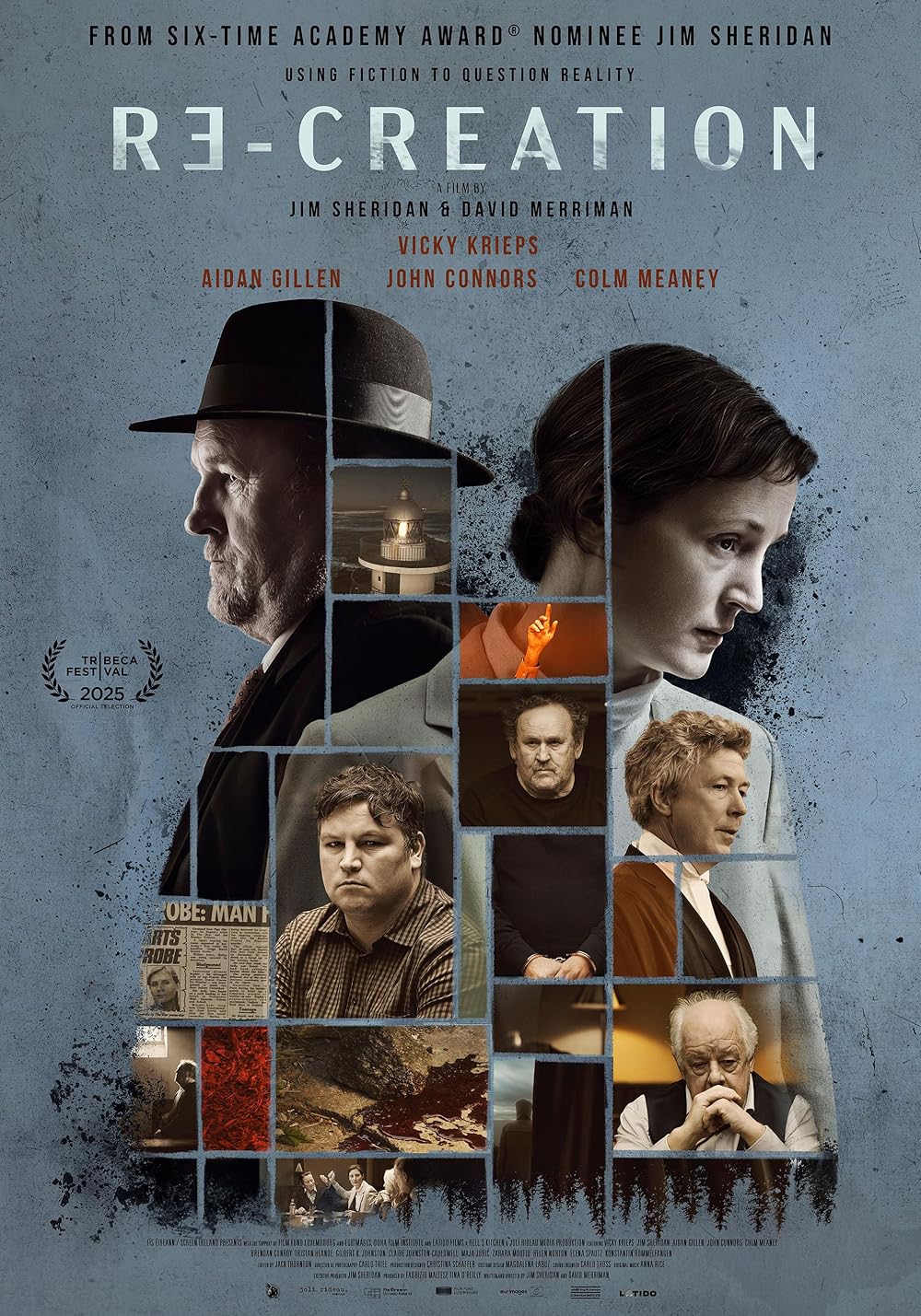
At some point, Sheridan became interested in Toscan du Plantier’s murder. Twenty-five years after it occurred, he directed a five-part documentary about the events. In Murder at the Cottage (2021), he suggested, against the weight of public opinion, that Bailey was innocent. The press and police were to blame for the failure to find the real killer. Re-Creation (2025) takes the same view. It began as an attempt to provide another dramatic retelling, supplemented by documentary footage, of the murder and its subsequent investigation. Sheridan and David Merriman directed the reiteration of the recreated historical story. The actress Vicky Krieps, best known for Phantom Thread (2017), played the central role. In interviews, Sheridan said that she would act as the victim’s ghost, a sign of stranger things to come. But that initial project ran into financial problems, forcing a rapid rethink by its creators. With cast and crew sequestered, a script was written in a week. Under financial pressure, filming was limited for the most part to a single set. The resulting narrative film, prompted by necessity, would draw very deeply from Sidney Lumet’s 12 Angry Men (1957).
Re-Creation opens stylishly enough, with informative title cards, prosecutor Aiden Gillen, and a Camille O’Sullivan cover of Bob Dylan’s “Long Black Coat”. The cards note that the film imagines what an Irish trial would have looked like and proposes that real evidence will be presented in the reconstruction. When the film opens, Gillen asks the jury to convict so that Bailey will “die in a French Prison”, presumably by extradition after the fictional trial, although it is not entirely clear why this would be necessarily the case. The jury settles. We meet a few jurors who are named; however, several remain almost anonymous throughout the film. Sheridan casts himself as foreperson; his real-life partner – producer, writer, director, and actress Zahara Moufid – plays the role of another juror. Sheridan, as foreman, is strangely given a “flashlight”, a torch that is both metaphorical and comes to have a practical narrative function later in the film. Almost immediately, as an initial vote is taken, it is clear that Re-Creation’s cinematic intertextual borrowing will not be subtle. Krieps, for example, essentially plays the equivalent character of Henry Fonda from 12 Angry Men, nobly holding out until, one-by-one, the other jurors reach a “not guilty” verdict. With an exaggerated wink, Sheridan and Merriman assign Krieps as Juror #8, the same role Fonda played in the earlier film.
12 Angry Men is a classic. Originally a Reginald Rose teleplay in 1954, it was adapted for the stage the following year and reached the big screen in 1957. It has been remade and adapted across the globe: in Germany (1963), Spain (1973), India (1986, 2012, 2025), Japan (1991), Russia (2007), China (2015), and Korea (2019). Some of these countries include jurisdictions that do not actually use a jury in a form that would be familiar to western cinematic audiences. There was a television remake of the film, too, in 1997, as well as numerous parodies. Literary theorist Stanley Fish has correctly noted that
[a]s viewers we are encouraged to understand the narrative as a vindication of liberal political values and as a demonstration of those values in action. Clouds of prejudice, bias, and ignorance are dispelled by rational deliberation supported by evidence that emerges from careful measurement and disinterested observation. In short, enlightenment occurs. (Fish 2024: 9)
But the film can be criticised for its idealisation of the jury, who are all white and male, and for its accuracy with respect to legal practice. In its more significant moments, viewers are, in fact, victims of “rhetorical manipulation at every moment” (Fish 2024: 12), and for dramatic purposes the film pushes us “toward a predetermined conclusion while presenting itself as the passive recorder of the discovery of fact” (Fish 2024: 20). Re-Creation, parasitic of this classic, attempts the same sleight-of-hand, with considerably less success. To some viewers taking a moral stance because it involves the circumstances and narration of an actual murder, it is arguably offensive in its liberal handling of accuracies of process and evidence.
Juries have been important to the Anglo-American legal traditions for centuries. This was true, too, for Ireland, given its long historical, political entanglement with Britain. Over time, the use of the jury declined in favour of more professional procedures. Its role remained significant, however, in serious criminal matters where the involvement of lay people appeared a safeguard against the state. Indeed, other legal systems beyond the common law borrowed the institution, usually in modified forms. The French courts, for example, combine several judges and a larger number of lay jurors; they sit together during trial and decide collectively. But Re-Creation’s “European Jury”, situated in Ireland, appears a sui generis creation. Perhaps it reflects a repurposing of the cast assembled for the planned docudrama. But it is an odd sampling for an Irish jury, even for contemporary Ireland. And here the jurors are under constant supervision, appear to introduce new evidence that was not considered in the imagined trial, and seem to assume unanimity is required for a verdict. It was the case in 12 Angry Men, but it is not so in Ireland, provided deliberations are not rushed. The whole film feels jury-rigged.
Indeed, it is fair to reason that Sheridan and Merriman sometimes forget that their film is, in fact, fiction. Some press and reviews have suggested rather breathlessly that Re-Creation is engaged with real evidence, in profound questions of justice and judgement. It speaks to the Irish psyche, personal prejudice, fake news, state corruption, and a modern rush-to-judgement by a manipulated public. But the evidence in the film was liberally, creatively and conveniently manipulated by its writers. As journalist Senan Molony, author of Sophie: The Final Verdict (2024), has suggested: significant but inconvenient evidence was excluded or ignored (Molony 2025). The film’s jury deliberations are not remotely like the adversarial process of a trial, nor do its participants constitute a random sample of the public. They are ostensibly actors playing roles and their verdict is patently dramatically scripted: qualities of production necessity that the filmmakers have be unable – or unwilling – to transcend. For example, for lawyers, it is a well-known rule of cross-examination not to ask questions to which one does not already know the answers. For Re-Creation, Sheridan and Merriman have written both questions and answers in a way that logically creates dramatic tension where required, but which disregards some of the basic realities of the professional courtroom experience. Echoing Fish, we can identify that the film “at every moment pushes us toward a predetermined conclusion while presenting itself as the passive recorder of the discovery of fact” (Fish 2024: 20).
Re-Creation’s cast does what it can. John Connors engages in scripted histrionics as Juror #3, the equivalent role performed by Lee J Cobb in 12 Angry Men. By cinematic cliché, his resistance to reason is revealed to be the result of his personal, if fictional, trauma. Colm Meaney’s mute Bailey broods as an occasional spectral presence. But the deliberations are progressively contrived. As Re-Creation slouches towards its conclusion, one juror somewhat mystically claims feeling “the spirit of Sophie”. Maybe this is mere colour or a mistranslation of the French spoken by the real-life counterpart. However, the statement is immediately followed by a reenactment of the murder that descends into a séance-of-sorts. Nor is the film averse to playing with the emotional machinations of melodrama. Sheridan’s otherwise inexplicably present torch and soapbox eventually come out in the darkened room. Like Benoit Blanc, he rapidly explains what the public, the press, and the police have been too negligent to understand or too prejudiced to perceive. On Sheridan’s character’s intervention, Jurors #3 and #8 hug, with tears flowing. Talking about his late mother, the former says to the latter: “You remind me of her. She had integrity”. Then, as the fictional jury reaches its fictional verdict, Bailey draws his final breaths. A stately and solemn montage follows for the “poet and journalist”: he glares at his own coffin, a sober service takes place, and the “Long Black Coat” is reprised.
In fact, Sheridan attended the scattering of Bailey’s ashes in summer 2025, just as Re-Creation made the festival rounds. At the film’s end, Bailey receives what amounted to a two-and-a-half-minute homage. Sheridan’s original project sought to conjure Toscan du Plantier’s ghost, an image that would always have been his projection. Actual footage of her at Re-Creation’s end amounted to twenty-five seconds. Whatever the facts are, it is difficult not to feel that the directors have been incredibly negligent in their creative pursuits. Their film does little justice to the victim of a grisly murder. And it does little credit to Sheridan’s legacy.
Works Cited
Fish, Stanley (2024). Law at the Movies: Turning Legal Doctrine into Art. Oxford: Oxford University Press.
Molony, Senan (2024). Sophie: The Final Verdict. Dublin: Hachette Books Ireland.
______ (2025). “Jim Sheridan’s Sophie Toscan du Plantier film showcases a jury lost in seance and shouting.” The Irish Independent (September 30). https://www.independent.ie/entertainment/movies/movie-reviews/jim-sheridans-sophie-toscan-du-plantier-film-showcases-a-jury-lost-in-seance-and-shouting/a514685810.html


