
 by
Lorraine Lawrance.
This text may be archived and redistributed both in electronic
form and in hard copy, provided that the author and journal are
properly cited and no fee is charged for access.
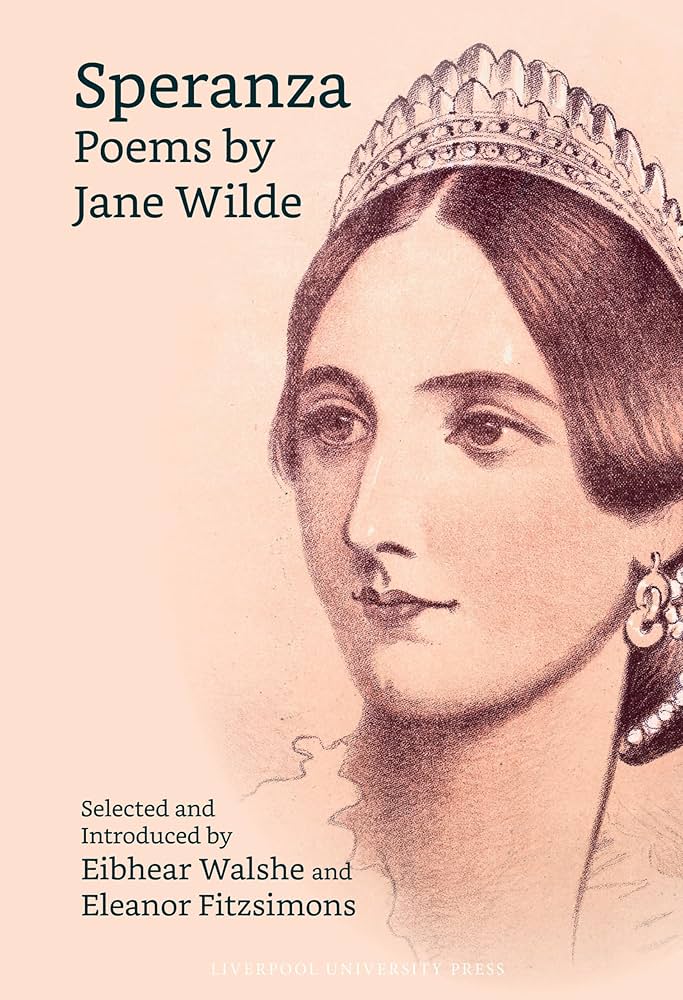
Eleanor Fitzsimons and Eibhear Walshe, eds.
Liverpool: Liverpool University Press, 2025. 332 pages.
ISBN: 9781836240372
Speranza: Poems by Jane Wilde is a welcome contribution to Irish literary scholarship. Jane Wilde (née Elgee, 1821-1896) has long been known as the mother of Oscar Wilde, but this collection restores her as an accomplished poet, translator, and nationalist intellectual in her own right. Eleanor Fitzsimons and the late Eibhear Walshe have produced a work of both literary recovery and cultural restoration. Their careful curation, scholarly commentary, and inclusion of several previously unpublished poems make this the first contemporary edition of Wilde’s poetry. It reveals a writer whose imaginative range encompasses political fervour, spiritual questioning, and an enduring empathy with the suffering of the Irish poor.
The edition is framed by two interpretive essays. Fitzsimons, a noted biographer and author of Wilde’s Women (2015), situates Wilde’s poetry within the intellectual circles of nineteenth-century Ireland and Europe, while highlighting her role in the Young Ireland movement and her advocacy for women’s education. Walshe, who passed away suddenly in 2024, brings a sensitive and reflective reading to Wilde’s work, interpreting her poetry as a dialogue between personal conviction and public duty. His contribution, in retrospect, reads as a final testament to his enduring commitment to voices overlooked in Irish literary history.
Wilde first came to prominence as “Speranza” – the Italian for “hope” – writing for The Nation in the 1840s, a period defined by famine, revolution, and cultural awakening. Among the most fascinating inclusions in this edition is “Our Fatherland”, first published in The Nation in November 1846. The poem expresses a passionate longing for Irish freedom and bears striking resemblance to a later poem of the same title published under the pseudonym Spartacus by William James Lincon, the only Englishman to write regularly for The Nation. Both versions echo Herwegh’s “Schlusslied” (1841), suggesting Wilde’s engagement with continental revolutionary literature. This intertextuality reflects the editors’ insight that Wilde’s nationalism was at once fervently Irish and cosmopolitan in outlook – a blend of local patriotism and European idealism.
Equally compelling is “Sign of the Times” (1847), written during the height of the Great Famine and on the brink of the failed rising of 1848. In this poem, Wilde implores the younger generation to take up the struggle against oppression. Her voice here is both exhortative and mournful, blending hope with warning. Yet her work also introduces a tone of moral introspection rarely found in her male contemporaries.
No discussion of this volume would be complete without reference to “The Famine Year” – perhaps her most famous poem – first published in The Nation in January 1847 under the title “The Stricken Land” (74). Here, Wilde confronts the catastrophe of the Great Famine with unflinching moral clarity, denouncing a system that allowed people to perish “in the midst of plenty”. On page 74, the authors depict how Canon John O’Rourke, writing in his History of the Great Irish Famine (1875: 10), described Wilde as “the gifted poetess” (74) who, “through verse and prose in The Nation, exposed the system which left people to die of starvation” (74). The poem’s raw indictment of political negligence and its evocation of maternal grief place it among the most searing documents of nineteenth-century Irish experience. Its inclusion in this edition allows readers to appreciate how Wilde’s poetry stood at the intersection of art, politics, and humanitarian witness.
Another standout piece, “France in ’93”, connects the French bread riots of the 1790s with the cries of starving Irish people during the Famine (81). The duo detail how in The Spectator, 3 April 1847, pp. 323-4, “the Irish need to be humoured, as they humour their own brutes”. Wilde’s use of historical analogy highlights her belief in the universality of suffering and resistance. The parallel between the sans-culottes and the Irish peasantry is not simply rhetorical; it reveals Wilde’s understanding of history as cyclical, her conviction that oppression and revolution are recurring human dramas. As Walshe and Fitzsimons outline in their introduction from The Spectator, “a battle-cry may be the way to pacify the Irish” (81). In Wilde’s hands, history becomes moral argument. Her cosmopolitanism – rooted in the revolutionary ideals of liberty and fraternity – broadens the emotional and political reach of Irish nationalism.
Later works such as “The Shorn Sheep” (1882) and “The Soul’s Christening” (1876) reveal a more intimate and contemplative side of Wilde’s art. “The Shorn Sheep”, first published in The Pilot, was written as a translation and later admired by Victor Hugo, who thanked Lady Wilde for sending it to him while modestly noting his limited English. Lines from the poem later appeared in The Vision of the Vatican, drawing further intertextual links with Hugo’s “Le Pape” (284). The poem’s pastoral imagery and its quiet meditation on vulnerability suggest Wilde’s growing interest in spiritual endurance. By contrast, “The Soul’s Questionings”, composed during her husband’s final illness and published just days after his death, is a dialogue between suffering souls and an unresponsive Fate (273). Its sombre tone and theological questioning mark a departure from the earlier nationalist verse, demonstrating her capacity to move from the collective to the personal, from rhetoric to metaphysical reflection. As the authors depict, “The poem takes the form of a dialogue in which ‘the souls of the death stricken’ question Fate, asking why they must suffer ‘this cruel, remorseless Death’” (273). As Fitzsimons observes, Wilde’s later poetry deepens our understanding of her as a woman who endured profound personal loss while remaining intellectually and morally engaged with the world.
The editorial achievement of Fitzsimons and Walshe lies not only in assembling these texts but in presenting them with sensitivity and precision. Their annotations guide readers through the historical, literary, and biographical contexts without overwhelming the poetry itself. The decision to include previously unpublished works enriches the portrait of Wilde as a versatile writer whose themes range from national liberation to personal salvation. Her bilingualism, her engagement with European Romanticism, and her advocacy of women’s education all emerge clearly through the editors’ framing.
The style of Wilde’s verse inevitably reflects its Victorian origins: ornate, rhythmic, and steeped in moral earnestness. Yet, read today, it is precisely this sincerity that gives the poems their power. Wilde wrote not for aesthetic experiment but for ethical persuasion. In that sense, her poetry resembles a form of civic education, an effort to awaken empathy and responsibility in her readers. This quality aligns her with the moral and pedagogical ambitions of later Irish writers who sought to use literature as a vehicle for social awareness.
For educators and researchers, Speranza: Poems by Jane Wilde offers both a resource and an invitation. The edition encourages the integration of Wilde’s work into discussions of Irish history, gender, and identity in the classroom, expanding students’ awareness of nineteenth-century literary voices beyond the canonical male figures. By reintroducing Wilde’s poetry to contemporary readers, Fitzsimons and Walshe open a space for renewed dialogue about literature’s role in shaping civic and moral imagination. This review, written from an educational research perspective, highlights how Wilde’s poetry – rich in empathy, justice, and idealism – continues to resonate within both literary and pedagogical contexts.
In sum, this finely edited volume not only restores Jane Wilde’s literary reputation but also reaffirms the enduring importance of poetry as a form of social conscience. It stands as a fitting tribute to Wilde’s vision and to the editorial dedication of Eleanor Fitzsimons and Eibhear Walshe.
Works Cited
O’Rourke, John (Canon) (1875). The History of the Great Irish Famine of 1847: With Notices of Earlier Irish Famines. McGlashan and Gill, Dublin.


