
 by
Marjan Shokouhi.
This text may be archived and redistributed both in electronic
form and in hard copy, provided that the author and journal are
properly cited and no fee is charged for access.
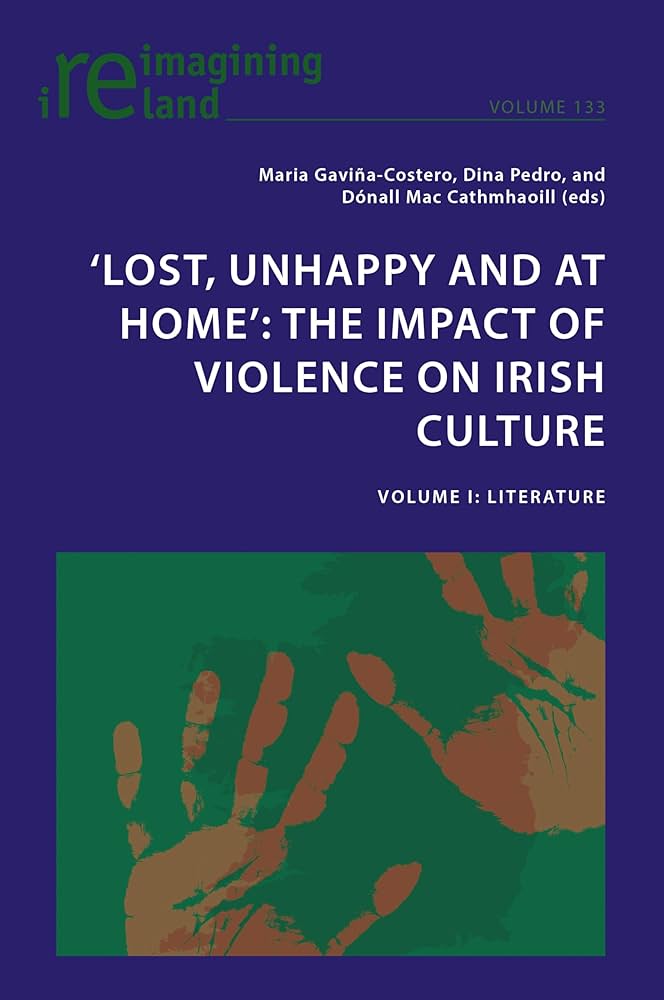
Edited by María Gaviña-Costero, Dina Pedro, and Dónall Mac Cathmhaoill
Oxford: Peter Lang, 2024, X, 302 pages.
ISBN: 9781803743196
‘Lost, Unhappy and at Home’: The Impact of Violence on Irish Culture. Volume II: Socio- Cultural Aspects, edited by María Gaviña-Costero, Dina Pedro, and Dónall Mac Cathmhaoill, contains fifteen chapters which delve into the representation of violence in Irish cultural products: its sources, its socio-historical conditions, its perpetrators, its manifestations, its repercussions, as well as the ways in which its victims confront and resist it. Violence as a pervasive phenomenon in Ireland’s history – the anti-colonial struggle, a civil war, the “Troubles”, the patriarchal oppression, etc. – is examined by experts in Irish studies who offer in-depth analyses of how artists experience and portray it in their works. The chapters, with the exception of the initial one, are organized into four thematic sections: History, Film, Theatre and Poetry, covering symbolic violence, gender violence, race violence, class-based violence, structural violence, armed conflict, and ecocide among many other forms of violence.
In the introductory chapter, editor Dónall Mac Cathmhaoill offers an insightful reflection on the sources of violence that have plagued Ireland for centuries and the country’s efforts to combat them. The first thematic section, “Part I: History”, includes five essays that explore various aspects of Irish history, illustrating how violence has traditionally shaped Irish identity from a socio-cultural perspective. Luca Bertolani Azeredo opens this section with “Manly Physique, Attractive Uniforms and Drill Manoeuvres”, a work in which he compares two young paramilitary bodies: the nationalist Na Fianna Eireann, founded in Dublin in 1909 with the purpose of shaping a revolutionary generation of people who could rise up and establish a free Ireland, and The Young Citizen Volunteers, formed in Belfast in 1912 to foster discipline and municipal nationalism. He considers the role that religion, social status, culture, and background had in the shaping of these groups. The next essay by Yann Bévant, “From the Good Friday Agreement to Brexit, an Assessment of Republican and Northern Irish Politics”, sheds light upon the northern Irish question by exploring the diverging interests of the communities co-existing in Northern Ireland, and their antagonistic perceptions of national identities, the product of competing and conflicting interpretations of History. Bévant pays particular attention to contemporary Irish republicanism, examining the development of both its ideological corpus and its political strategies from the beginning of the 20th century up to now.
The third chapter, “Historical Institutional Abuse against Women in Ireland and Spain during the Twentieth Century”, by Pilar Iglesias-Aparicio, shows the parallelism between the Magdalene Laundries in Ireland and the Spanish Patronage for the Protection of Women (Patronato de Protección a la Mujer), founded in 1941 under Franco’s dictatorship. She analyses how institutional violence against women is perpetrated in these patriarchal institutions run by Catholic nuns, where women were imprisoned, deprived of their identity, isolated, punished, humiliated and forced to perform slave labour. In the following essay, “‘Dreamers Turned Fighters’: Celticism as an Ideological Foundation for Bloodshed and Self-sacrifice in the Easter Rising”, Marie Jonietz contends that Celticism was an important source of inspiration for the protagonists of the Easter Rising in 1916. The insurgents linked the struggle for Ireland’s freedom with the mystical Celtic past and placed themselves in the tradition of heroic figures such as Cuchulain, whose willingness to self-sacrifice became the model for the martyrdom Pearse and his followers were prepared to undergo for the sake of Ireland’s independence. The last work in this part is offered by Sara Romero Otero, who, in “‘Those who had no voice’: Ethnicity, Racism, and Discrimination during and after the Northern Irish Troubles in Anna Lo’s The Place I Call Home”, examines the way in which the Troubles are narrated by the Chinese writer Anna Lo in her memoir The Place I Call Home (2016). In it, she reflects upon the situation in which people like her, who cannot clearly fit on either side of the conflict – as they cannot be easily classified as Catholic or Protestant, Republican or Loyalist – find themselves in Northern Ireland. To analyse Lo’s rendering of oppression due to political issues, but also to matters of ethnicity, religion, or sexual orientation, both theoretical approaches to the autobiographical genre and postcolonial theory are employed.
The second thematic section, “Part II: Film”, comprises four pieces of research. E. Guillermo Iglesias-Díaz, in “Beyond Sectarian Violence: Vulnerable Male Bodies in the Communitas through a Situated Gaze”, studies how sectarian violence marks the communitas of Northern Ireland in Chris Baugh’s debut feature film, Bad Day for the Cut (2017). His contention is that both violence and vulnerability are represented as gendered concepts in this film that tackles these issues away from binarist classifications. In “Representing the Aftermath of Ireland’s Great Famine in Neo-Victorianism on Screen: Colonization and Forced Diaspora in Carnival Row (2019– 2023)”, Dina Pedro offers an analysis of how the Great Irish Famine (1845–1852) and the mass migration it brought about have been represented in the neo-Victorian fantasy television series created by Amazon Studios Carnival Row (2019–2023). Since the depiction of the discrimination and cruelty that fairies, Irish mythical creatures, face in The Burgue – a city based on nineteenth-century London – is a reminder of the Irish experience in the aftermath of the Great Famine, Pedro concludes that the series aims to denounce the extreme violence to which the colonized, the Irish, were subjected by the British Empire. But ironically, he adds that the series does so while reproducing common exoticizing stereotypes that reinforce imperialist discourses. The third essay, “The Experience of Political Violence in Belfast and Mickybo and Me”, presents Stephanie Schwerter’s research on two films, Terry Loane’s Mickybo and Me (2003) and Kenneth Branagh’s Belfast (2021). Both portray children and young adults as collateral victims of the Northern Irish conflict. After analysing the cinematographic perspectives adopted by the directors, Schwerter states that these films subvert the political and moral values deep-rooted in Northern Ireland by challenging the rigid principles on which power structures such as the British army, the RUC, and the paramilitaries from both sides are grounded. Timothy J. White also deals with Branagh’s Belfast (2021) in “From the Troubles to a Troubled Peace: Representation of Violence in Recent Northern Irish Film”. Two more films depicting the origin of the Troubles, the impact of sectarian violence on the individuals suffering it, the road to the peace process, and the challenge of overcoming the bloody past in Northern Ireland are examined in this essay: Nick Hamm’s The Journey (2016) and Oliver Hirschbiegel’s Five Minutes of Heaven (2009). Through an analysis of these cinematic portrayals of violence and its lasting impact in Northern Irish society, White suggests that the peacebuilding project may be multi-generational.
The third thematic section, Part III: Theatre, includes three essays. Lisa Fitzpatrick’s “Gender, Activism, and Performance in Northern Ireland” explores the representation of various kinds of violence against women and girls in three productions that depict Northern Irish society since the Peace Process. She analyses two theatrical performances: The Crack in Everything (2018) and Don’t Shoot my Wane (2019) by Greater Shantallow Area Arts. Both depict how a culture of violence provokes terrible damages to families which experience the loss of their beloved members. Helen Cammock’s video installation The Long Note (2019) also reveals the impact of living in a hostile state where women’s civil rights must be fought for. In “The Trouble with Trouble: Restaging Historic Acts of Violence”, Dónall Mac Cathmhaoill examines the transforming power of the theatre that stages conflict-era violence in Northern Ireland. He pays particular attention to Shannon Yee’s play Trouble (2015) dealing with the murder of Darren Bradshaw, a gay police officer, at the hands of the Irish National Liberation Army (INLA) while he was at a gay bar in central Belfast in 1997. The analysis of this production, which makes violence against LGBTQ+ people visible in the context of the Troubles, lets Cathmhaoill conclude, among other things, that productions that address the legacy of the Irish conflict by restaging historic acts of violence can be an effective tool to recover the truth, thus contributing to the healing of the society, as well as being a powerful means by which violent histories can be reified and traumatic memories retained. J. Javier Torres-Fernández’s chapter critically addresses Neil Watkin’s A Cure for Homosexuality (2005) as an example of homophobic violence in the contemporary Irish theatrical scene confronting such violence with trauma, internalized shame and stigma, and the mental health of Paddy Doyle, an HIV-positive gay man struggling with social rejection and conversion therapy. Torres-Fernández contends that the play emphasizes how sex, drugs, and addiction can be used as thematic devices to expose the systemic violence that renders queer bodies as precarious, while also stressing that Watkins’ work holds a transformative potential in reclaiming agency and countering hegemonic narratives that perpetuate this oppression. He concludes that while critiquing the enduring legacy of HIV/AIDS stigma, the play affirms the necessity of cultural interventions in fostering political consciousness and queer solidarity, as it gives the audience an opportunity to bear witness to the persistent homophobia in contemporary Ireland.
The last thematic section, Part IV: Poetry, also contains three chapters. The first one, “‘This brute site’: Violence in the Mothering/ Ageing Phenomenological Continuum in the Poetry of Eavan Boland and Sinéad Morrissey”, by Sara de Sousa, renders a study on how the feminine body can be represented as a repository for creative energy, while also undergoing violent biological processes that continually displace straightforward semiotic connections in Eavan Boland’s and Sinéad Morrissey’s poetry. Sousa finds Donna Coffey’s typology of bodies in pain, namely the fourth category of generative force, and Julia Kristeva’s notion of ‘reliance’, or maternal eroticism, particularly useful to carry out her analysis on Boland’s In a Time of Violence (1994) and Morrissey’s Between Here and There (2002) and The State of the Prisons (2005). She draws attention to the way these works unveil an intrinsic figurative ambivalence in motherhood and ageing as phenomena connected to physical violence and psychological trauma. The so-called “bog poems” which appear in Seamus Heaney’s two collections of poetry Wintering Out (1972) and North (1975) are the subject of study in Przemysław Michalski’s essay: “The Problem of Purposive Violence in Seamus Heaney’s ‘Bog Poems’”. The examination of these poems which link together the Bronze Age rituals of human sacrifice and the crimes perpetrated during the Troubles leads the researcher to contend that Heaney wished to convey the idea that violence is inherent to Irish culture, but that it can be redeemed when it is not gratuitous, but meaningful.
The last chapter of the volume, “Ways of Violence in Medbh McGuckian’s and Sinéad Morrissey’s Nature Poems”, is written by Rosanne Gallenne and Paula Villalba Pérez. In it, they examine the representation of violence against women and nature in contemporary Irish women’s poetry through an ecocritical lens. They analyse a selection of Medbh McGuckian’s “impressionist” gardens and Sinéad Morrissey’s seascapes to find out the poets’ aesthetic strategies, thematic motifs, and ideological implications. They reveal that both poets resort to ecopoetic strategies to explore the nature of violence and its social, political, and environmental consequences, to link the notion of violence with those of trauma, resilience, and healing, and to put forward a new conception of the relationship between humans and the natural environment.
This collection of scholarly essays provides the reader with a comprehensive picture of the ways in which violence has mapped Ireland, together with the ways in which it has been confronted by the Irish people. It is, no doubt, a useful book for both scholars undertaking research on this area of expertise and lecturers teaching Irish Studies in the classroom.


